
When Should We Defy Authority?
Our blind allegiance shouldn’t compromise human values.
“Were they just following orders?”
Yale Professor Stanley Milgram posed this question about those tried for the war crimes of World War II.
He set out a series of experiments to see if ordinary people would obey authority, even if they had no emotional involvement with the authority’s purpose. The study asked participants to act as “teachers,” where the “learners,” who were actually accomplices in the study, were tested on how well they could remember sets of word pairs.
The learner (L) was seated in a chair that would administer electric shocks if an error was made. The teachers — the actual research participants — would administer the level of shocks. To test the shock generator, the experimenter (E) gave teachers (T) a 45-volt shock, then the experimenter presented a range of switches from 15–450 volts.
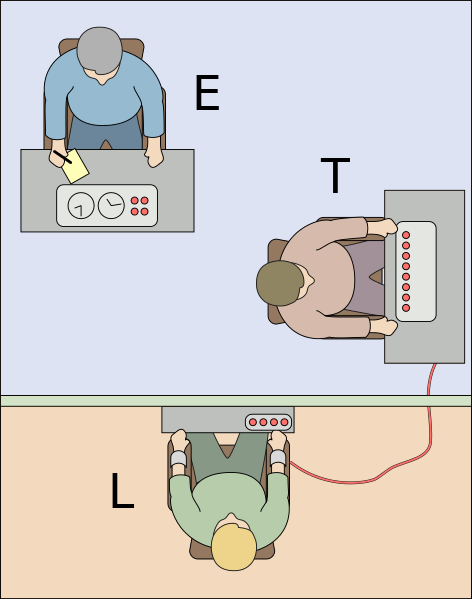
Although the accomplices weren’t actually shocked, they acted accordingly as if the shock was indeed real. The accomplices would grunt at levels of 75 volts, insist on leaving the experiment at 150 volts, and screamed at 285. Voltages above 285 elicited silence, which led some participants to believe the learner might have passed out or died.
The teacher could not see the learner/accomplice, but only could hear the verbal complaints and the electric buzzing. The teacher would experience an inner conflict — should I continue to harm this person in obedience to authority?
In fact, some participant/teachers asked the experimenter if they should continue, especially when they considered that the learner had a heart condition. The experimenter urged them on, insisting they have “no choice.”

One participant/teacher indicated that she had participated on her own free will, and she chose to abandon the experiment. “I don’t want to be responsible for anything that happens to him,” she said.
Milgram thought this would be the case for everyone else, but it wasn’t.
Out of 40 participants, 25 of them obeyed the experimenter’s orders until the end, giving the learner/accomplice the most powerful shock. Experiments similar to this one were replicated to the greater New Haven community and in several countries around the world.
Even when their moral standards are tested, people find it difficult to resist authority.
Milgram cites some of tension the participants were feeling, most notably regarding who would accept responsibility for the harm inflicted. Once the experimenter accepted the responsibility for any injury or death to the learner, the participant would continue in spite of the escalating screams of agony. Many participants indicated concern for the learners and asked the experimenters to check on them.
The participants of the study were told the nature of the study after the experiment was over, and many expressed their surprise at their behavior. One participant noted how this challenged her conscience.
What appalled me was that I could possess this capacity for obedience and compliance to a central idea…even after it became clear that continued adherence to this value was at the expense of violation of another value, i.e. don’t hurt someone who is helpless and not hurting you.
Milgram learned that ordinary people didn’t have violent or aggressive tendencies, but they were very susceptible to obeying orders. Even when their moral standards are tested, people find it difficult to resist authority.
Milgram writes, “[O]rdinary people, simply doing their jobs, and without any particular hostility on their part, can become agents in a terrible destructive process.”
What is interesting about this series of experiments is the attribution of responsibility. The participants compromised their moral values partially because they knew they wouldn’t be responsible for any damage or harm of the learner.
In fact, many participants felt more responsibility towards the experimental authority than they did towards the moral compromise.
Rebellious action of others
A subsequent study employed three teachers (two actors and one actual participant) to administer the level shocks. When the two actors refused to continue with the experiment, 90 percent of participants abandoned the tests as well.
When we consider authority figures in our own lives, how do we rationalize our behavior if it compromises our moral values? If we fear our opinions are the minority, we have a tendency to silence them out of fear of isolation, particularly if certain opinions or opinion leaders are particularly loud.
Therefore, it is possible that our desire to obey authority, combined with fearing isolation, might compromise our fundamental human values.
Additionally, if we believe that our compromised actions are not “us,” but only our desire to please authority, what happens when the authority does not accept responsibility for those actions? How do we rationalize our own actions when we are the ones who must face the consequences?
Milgram’s studies suggest that we are less likely to comply with bad behavior if we know that we would suffer the consequences.

We could also consider the “learner,” or the recipient of our actions. If we get to know others, we might be less likely to engage in harming them. We might find a way to “cheat” because we have developed a relationship with that person. Milgram found that if a participant had to place the learners hand on the shock plate, the participants were less likely to obey.
On the other hand, if we never see the person and don’t see the consequences of our actions, would we be more likely to comply with authority? Do we assume that if we don’t know the person on the other side of the Twitter handle or even the people on the coast in 50 years, it’s ok commit harm?
Ultimately, we must consider to whom we offer blind allegiance. Do they uphold fundamental, universal or moral values?
Our ideologies might be different, and perhaps our adherence to authority might not be as pronounced. However, one fundamental human value is “do no harm.” If an authority asks us to compromise this human value, it’s a call for disobedience.