
When Pythagoras Said ‘C,’ He Didn’t Mean Cha-Cha-Cha!
The Right Angle to Life
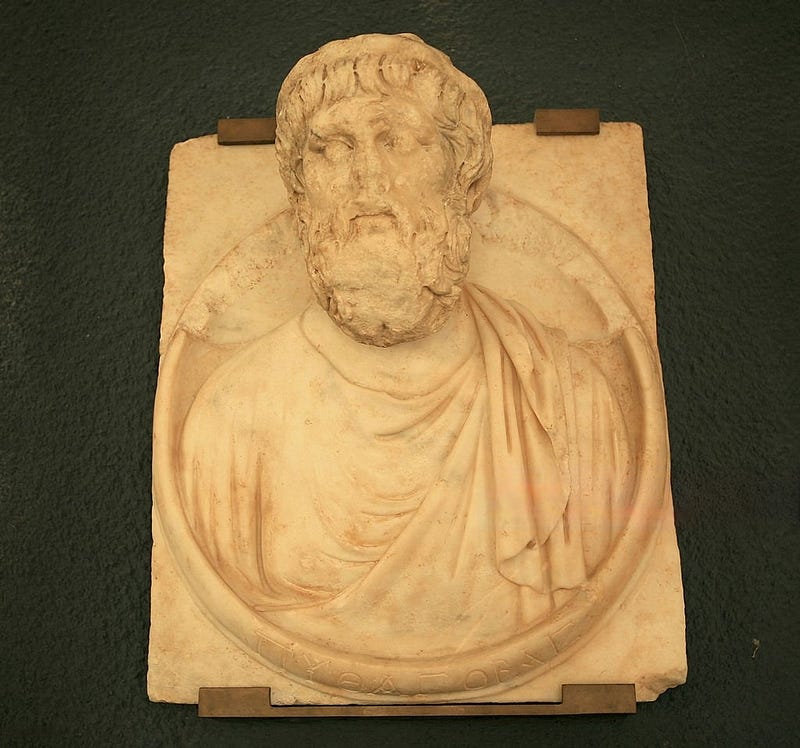
Pythagoras. What a guy! While most remember him as that Greek dude with a fetish for triangles, there’s much more to unpack. Like, did he ever bust a move at a geometry rave? Probably not. Never say never.
Let’s get one thing straight: when Pythagoras uttered ‘C,’ he was probably pointing at the hypotenuse and not leading an impromptu cha-cha-cha session in the streets of Samos. Disappointing, I know.
Our story begins around 570 BC, in a world sans TikTok dances but abundant in revolutionary mathematical ideas. The Pythagorean theorem (a² + b² = c²) is a testament to Pythagoras’ genius. However, unless we’re reading some lost scrolls, there’s no evidence he twirled on ‘C.’ Imagining him to do a jive whenever he solves a triangle paints a fun picture!
Okay, quick pop quiz! What’s the first thing you think of when you hear the letter ‘C’? If your answer was ‘cookie’ (à la Cookie Monster), we should probably be best friends. If it was ‘cosine,’ we might end up studying buddies.
Pythagoras wasn’t just about triangles. He laid the foundations for trigonometry, and ‘C’ became a crucial component in sines, cosines, and dancing tangents. I was kidding about the dancing part. Or am I?
Imagine being at a party. The DJ drops a beat and yells, “Give me a triangle!”. As the crowd forms an impromptu triangle on the dance floor, you can’t help but think: “Pythagoras would’ve killed this!” The idea isn’t as far-fetched as it sounds. Geometry and music share deep roots, from scales’ harmonies to strings’ vibrations. Pythagoras was deeply interested in music and saw ratios and patterns everywhere. Who’s to say he didn’t boogie a little on the side?
Like any trailblazing mind, Pythagoras faced challenges. Not all of ancient Greece was on board with his radical ideas. “Hey Pyth, why don’t you stick to playing the lyre and leave the triangles to us?” some might’ve sneered.
But our hero danced (mathematically speaking) to the beat of his drum, challenging naysayers and converting skeptics. Whether he faced issues proving his theorem or combating the early ‘You’re Doing Math Wrong’ YouTube comments, he pushed through, leaving us an invaluable legacy.
Pythagoras might’ve been a severe mathematician, but he probably knew how to let loose like all great minds. Maybe, just maybe, after a long day of geometry, he’d take a moment to enjoy life’s rhythm. While there’s no historical evidence to back it up, can’t we imagine him shimmying every time he cracked a tricky equation?
Put on your time-traveling shoes (they’re a thing, right?), and let’s shimmy back to ancient Greece. Beyond triangles and tunes, Pythagoras had some intriguing beliefs that intertwined math, mysticism, and a move or two.
Pythagoras founded a group called the Pythagoreans. Now, this wasn’t a boy band, though wouldn’t that be the plot twist of the millennium? This group believed in the sanctity of numbers. They saw numbers not just as mathematical symbols but as spiritual entities.
While today we’re more accustomed to considering our ‘soul numbers’ as the age we feel rather than our actual age, for Pythagoreans, numbers had personalities, stories, and rhythms.
To Pythagoreans, numbers weren’t static; they danced. Even the number 1 had its special jig as the ‘Monad,’ the source of all numbers. The number 2, or ‘Dyad,’ represented diversity and was like the tango — fiery and full of tension. And the number 3? That’s a jolly waltz, symbolizing harmony. The intricate dance of numbers goes on, revealing how Pythagoras wasn’t just about dry theorems. He believed in the poetic movement of math.
The most riveting idea Pythagoras had? The Music of the Spheres. This is a lost track from a celestial album. Pythagoras believed the planets and stars created harmonious sounds as they moved. It is the universe’s eternal dance track, playing the most cosmic ballroom waltz.
While we don’t necessarily hear these melodies, the idea emphasizes the interconnected dance of existence. It’s a symphony where every celestial body knows its moves, adding to the grand choreography.
Today, we’re participating in an ancient rhythm as we bust moves on electronic beats or sway to melodic tunes. Math isn’t a static, drab subject confined to textbooks. It’s alive, vibrant, and groovy.
So, thank Pythagoras for helping us calculate the shortest ladder to sneak out of our bedrooms and reminding us of the dance in everything. Because if numbers can waltz and stars can sing, we can find the rhythm in our daily grind.
As we’ve pirouetted through Pythagoras’ world, one can’t help but marvel at how math and music have shaped humanity’s evolution. But what if Pythagoras was on to more than just the evidence? Let’s tango through the transcendental!
Pythagoras might’ve been the poster boy for triangles, but math’s dance floor is vast. Fast forward a few centuries, and you’ll meet Fibonacci, another mathematician who arguably could have been Pythagoras’ spiritual dance partner.
Fibonacci introduced the sequence: 0, 1, 1, 2, 3, 5, 8… and so on. Notice something? Nature does. This sequence waltzes its way through the branching of trees, the arrangement of leaves, and even the spirals of galaxies. It’s like Mother Nature’s favorite playlist; Every organism bops along!
Did you know that while we live in a three-dimensional world, mathematically, there are spaces that exist in multiple dimensions? Pythagoras might have stuck mainly to 2D, but modern mathematics swings, jives, and does the moonwalk through 4D, 5D, and even 11D spaces.
In these realms, shapes like the Tesseract (a 4D hypercube) might sound like the newest dance craze but are multi-dimensional figures. If Pythagoras peeked into today’s mathematical landscape, he’d need a moment… before busting out a brand-new groove.
In modern times, we’ve begun to grasp the resonance between diverse systems, all dancing to a universal beat. Chaos theory’s butterfly effect? It’s a delicate flutter that triggers a typhoon of events. Quantum entanglement? It’s particles doing a synchronized waltz, regardless of the distance between them.
As different as these theories may sound, they all hinge on interconnectedness. Pythagoras might have intuited this when he spoke of the harmony of spheres. He tapped into the idea that everything is intrinsically linked, rhythmically resonating in a grand cosmic choreography.
We might chuckle at the notion of imagining Pythagoras cha-cha-cha’ing his heart out. Yet, every time we see a movie where the protagonist finds the solution to a problem while dancing or when we think more apparent after a quick jig, we’re nodding to the ancient philosopher’s philosophy.
Mathematics, often seen as rigid and unyielding, in reality, is dynamic, flowing, and incredibly alive. It pulses through our world, our very being. The harmony between theorems and thrills, equations and delight, is a testament to the universe’s multifaceted magnificence.
When you’re stumped by a problem, whether a math puzzle, a work challenge, or just deciding what to eat for dinner, stand up, play your favorite tune, and dance.
Because as Pythagoras might’ve said (or, okay, as we wish he would’ve): “When in doubt, dance it out!”
Thanks for taking the time to read. I’d like to hear your perspective.
You can also refer to the related articles:
Please subscribe here to receive the latest insightful stories by email.
Did you find this enjoyable? If so, remember to hit the clap button, which you can press up to 50 times and comment. Take advantage of more from me — ensure you’re following if you still need to. Thank you for being an integral part of my journey.