
When Peter, Paul and Mary Collide With Metallica
The Beginner’s Guide to Heavy Metal (Part 3)
In Part 1 of this series, Anthony Overs provided a great survey of classical heavy metal, covering some of its history, a number of classic bands, and hints of its diversity:
In Part 2, I challenged some of the stereotypes people hold regarding metal and highlighted some artists who break the mold, particularly by emphasizing melody and euphony.
Here in Part 3, I’m looking at what happens when seemingly incompatible genres of music mix and merge. Anthony Overs was on deck for Part 3 but was busy dealing with a personal situation. He has a great feature in the works, which will show up as Part 4.
Musical genres can be a trap. Suppose you try to define a particular genre based on things like what instruments they use; what scales they play in; how their vocalists are trained; or any other of a thousand possible technical criteria. You will always miss something. Yet, for communicating, it is useful to draw distinctions between types of music. So, how do you avoid the trap?
For me, the key is not the technical details, but the intent behind the music. For example:
All cultures have folk music, though it may sound very different from one country to another. Indian, Nigerian, and American folk music don’t sound at all similar if you judge by the instruments they play or the scales they use. But they do share the same intent: Folk songs are, by definition, rooted in local tradition. They convey stories that are passed from generation to generation, and are often about a specific place.
In other words, folk songs serve as a form of cultural memory. In societies that predated writing, folk music served as oral literature. Everyone participated in passing it down. Folk songs usually do not require formal training to perform, though there are, of course, some trained musicians who play folk music. This differs from classical music or jazz, which are steeped in technicality and innovation and tend to evolve intricate intellectual frameworks.
Metal is the opposite of folk music in almost every way. The obvious difference is that folk music usually conveys comfort and familiarity and is played at modest decibels. Metal is meant to challenge one’s comfort zone and is usually played loud.
Even more important, like classical music, metal is highly technical. Also, like classical music, it is composed de novo, not just passed along. In metal, there is a focus on both precision and innovation. It is borderless and, in some ways, academic — metal bands are influenced by sources everywhere in space and time. Metal is constantly changing and evolving in response to those influences.
Rock music (of which metal is one branch) infiltrated almost every corner of the globe and was initially considered completely separate from local, traditional music. Older generations greeted it in many places with hostility and feared cultural contamination. If you are old enough, you may have personal memories of your parents’ generation angrily denouncing Elvis, the Beatles, or the Stones.
Some countries tried to ban rock, but it persisted and became a universal language. The generations who grew up with it are merging it with their ancestral folk music, and the results can be wonderful and fascinating.
Folk music mashed up with metal would seem particularly unlikely. Because of the fundamental tension between tradition and innovation, combining the two ideas successfully is a special challenge. Here are some groups around the world that are doing just that.
Shepherds Reign (Samoa/New Zealand): “Le Manu”
Five “brothers” from various parts of Polynesia, they sing mainly in Samoan. This song is based on an old war chant. Samoans perform it as part of a ritual dance prior to major sporting events. It’s not unlike the Maori “Hakka,” which is well known to anyone who has watched international rugby matches.
Eluveitie (Switzerland): “The Call Of The Mountains”
They’ve been around almost 20 years and cover many styles, but always with this melding of folk and metal sounds. They sing in a mix of English and ancient Gaulish (reconstructed from modern languages and old inscriptions. Many of their songs touch on mythical themes, mysticism, and nature worship.
Is some of it sentimental and cheesy? No doubt. By the standards of today’s obligatory pose of cynical detachment, almost any folk music is sappy. All that hopefulness? Yikes! But if you are looking for melodic and uplifting metal, Eluveitie is a good place to start.
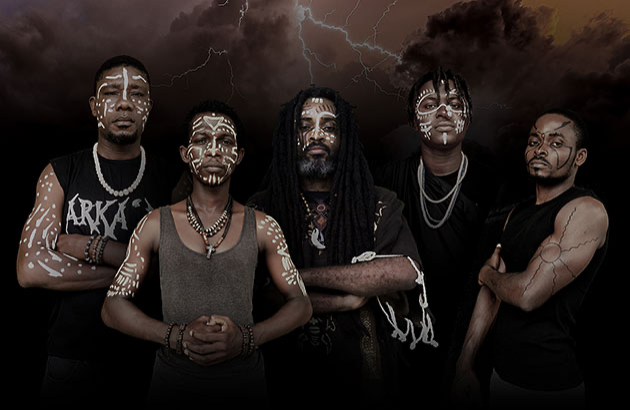
Arka’n Asrafokor (Togo): “Walk With Us”
I find these guys mind-blowing, and I can’t understand why they are not much bigger. They layer traditional drums and chanting with rapping over a bedrock of straight-up metal thrashing. The effect leaves you unable to choose between dancing or head-banging.
Like the rest of the world, they were under lockdown at the time of this recording, so this clip is from a virtual music festival. It’s long and completely worth the time:
The Hu (Mongolia): “Wolf Totem”
Mongolia is the most sparsely populated country in the world. The Mongols are essentially a collection of small tribes that, prior to 1200, spent a lot of time skirmishing with each other over meager resources. Then Genghis Khan united them and conquered everything in sight, creating the largest land empire in human history. By the 1600s, the empire had splintered once more into many smaller kingdoms and sultanates, and Mongolia found itself, in turn, subject to a series of foreign invasions.
After being warred over by the Russians and Chinese, Mongolia regained its independence 100 years ago. Today, it is a country of 3 million, still sandwiched between Russia and China. Theirs is a precarious existence, one that requires a lot of moxie.
The Hu have that in spades. They mix traditional instruments and throat-singing with a metal vibe. A good throat singer can sing a low note and a high harmonic simultaneously, a startling effect if you haven’t heard it.
Wagakki Band (Japan): “Tengaku”
“Wagakki” is Japanese for “traditional instruments.” The band was founded by Yuko Suzuhana, a shigin (classical poetry) singer who is also a classically trained pianist. She assembled the group to pursue the concept of fusing traditional Japanese musical tropes and instrumentation with heavy metal. There may be no group in the world that does this better.
The “lute” thing is a shamisen. The “harp” thing is a koto. The “flute thing” is a shakuhachi. The Japanese drums are collectively called “wadaiko.”
Oh, and for the record, I’m in love with Beni, the shamisen player (just sayin).
Watch for Part 4 of “The Beginner’s Guide to Heavy Metal”!