
When People Thought They Were Made of Glass
The Glass Delusion
Today’s article goes over a very strange phenomenon in European history. In 1422, King Charles the Sixth died after ruling France for over four decades. He had a couple of different nicknames. One of them was ‘Charles the Mad’.
He may have been the first person to exhibit what is known as the glass delusion.
So this delusion, for Charles was brought on by melancholia, which is a fabulous film by Lars Von Trier. And I thought it was a made-up word, but it’s actually what they used to refer to depression as. And this continued to pop up weirdly throughout history.
Even Hippocrates used the term melancholia in his book of aphorisms. He called it a long-lasting fright or despondency and profound depression. The term over time became depression.
The condition of melancholia affected people who were isolated and generally around a lot of people. And it sounds like something that could easily happen to a queen or a king, especially just being surrounded by sycophants.
So, some of these folks who had melancholia at this time exhibited this glass delusion, which was also accompanied by something called photophobia, which is sensitivity to light.
For background of the time here, Charles was born in 1368 in December and died in October 1422. The Mad wasn’t his only nickname. He was also called the Beloved Man and that’s two extremes there.
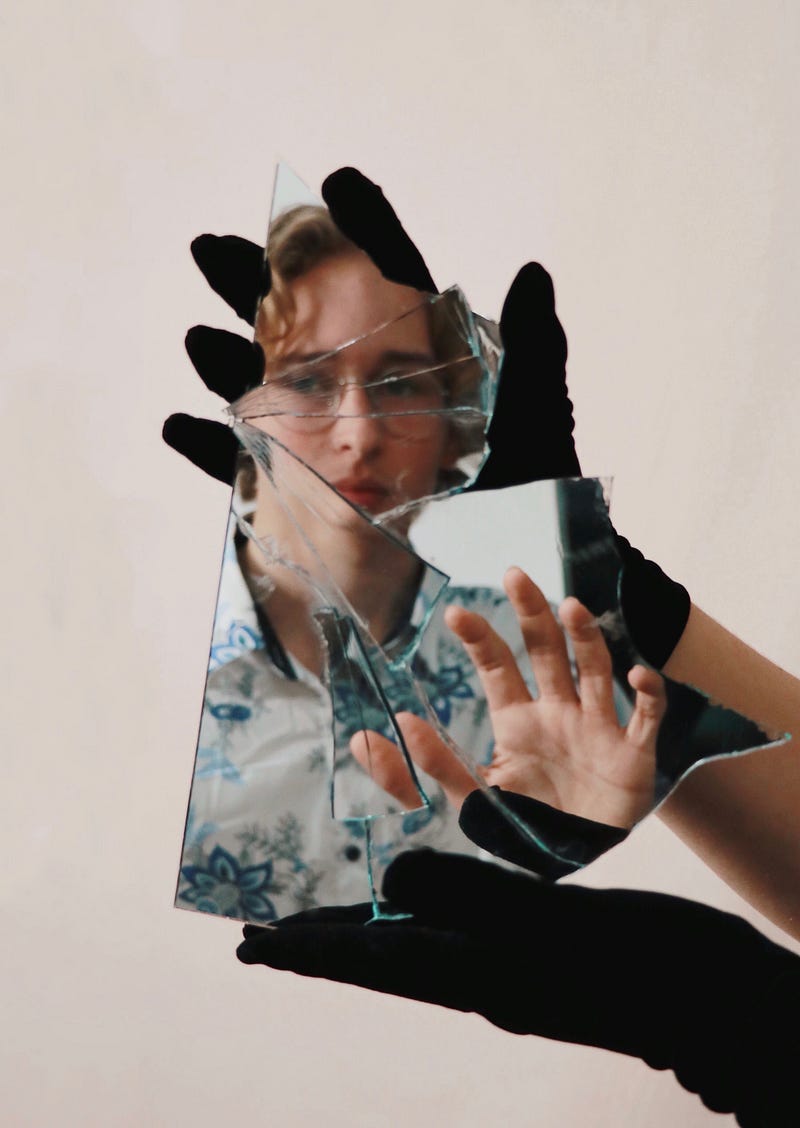
Charles was convinced that he was physically made of glass. He had some very specific requested demands from everyone in court. He demanded they have special clothes made for his person to protect him from the possibility of shattering and this was reinforced with iron on the inside.
He would also not allow people to touch him because he was afraid that they would break him into tiny smithereens. And this is not something that was just a passing fancy for him.
In 1392, struck with a fit of rage and paranoia, he slaughtered four of his knights. The rest of his life was haunted by the specter of this ghastly act.
And he was not the only member of royalty with this same delusion. There was also Princess Alexandra, Amelie of Bavaria. And she believed that because she had swallowed a mini glass grand piano as a child, it somehow turned her into fragile glass.
Sometimes obsessive thoughts can haunt us, you know, imagine if you’ve ever had, and I’m not equivocating these things entirely, but just by way of comparison, imagine if you ever had a song stuck in your head to the point that it becomes torturous.
Compulsive thoughts that you don’t want to have, but cannot escape can occur for a very long period of time. So this isn’t just restricted to the glass delusion, which by the way, was one of the most prevalent delusions of its time.
A lot of this is tied to the actual technology of glass.
There’s a history of psychiatry paper from 1990 that dives into this type of melancholy and shows that other people had delusions where they thought they were specifically flasks or what you and I would refer to as urinals in the modern day, or oil lamps or like any number of other glass receptacles.
But it was also the new invention of clear glass that is largely blamed for this delusion because people just had not seen this before. And it appeared as magic. It appeared as something utterly mystical. And you could probably see how something like that might play into the delusions of people that are possibly predisposed to those cyclical thoughts that we’re talking about.
In his analysis of the literary response to the Glass Men phenomenon, “’El Licenciado Vidriera’ and the Glass Men of Early Modern Europe,” the historian Gill Speak described the melancholy acts whose delusions manifested this way. He said it was manifesting because it was a need to protect the body, and they were often also preoccupied with protecting their souls.
So in a layered way, this delusion might have been a side effect or a symptom or consequence of the internal struggle dealing with the metaphysical reality of death. And of course, the overwhelming desire to avoid death at all costs, which is still very understandable in modern day.

And these issues have not disappeared. If you’re isolated from people today, and you’re suffering from mental illness, you can see how it would make sense to imagine yourself as a material that’s easily breakable, largely invisible, and incredibly fragile.
In Speaks’ paper, they address this concept of mortality. And there’s a fantastic quote here that builds which is the concept that this delusion is in the context of theologians reacting to the world of free thinkers versus the strict boundaries of Orthodoxy.
Is it heretical to think that you are made of glass in a world that is governed by strict religious monotheistic dogma, where there is an absolute God with an absolute plan? So people try to address this both as a social conundrum and an internal struggle.
And I’ll just state the quote here;
‘ for those whose faith was strong enough to shoulder the church’s advocation, to prepare oneself for dying, the melancholic delusions manifest itself in a fervent wish to be released from this earthly form.’
So this idea of dying a good death, choosing the way in which you die, seems central to this glass delusion. Because now, if you know you’re going to die, and you have a spiritual belief that something happens after you die. And you live in a society that tells you more or less an if-then scenario. If you are a good person, if you follow the rules of the church, then you will go to paradise.
It’s interesting, and actually, as it turns out, this delusion carried on into the present even. There are quite a few cases of glass delusion up into the 1800 and 1880s. Another case from the 1880s turned up in the footnotes to an edition of Cervantes’ The Glass Graduate, referring to a contemporaneous case having occurred in an asylum in Paris, but with no further details.
Peter Ilyich Tchaikovsky had some of his actions or neurotic behavior that led people to think that he was suffering something similar to the glass delusion, at least in terms of his perception of his fragility. He had this deep set dead certain belief that if he did not hold his chin, while he was conducting, his head would fall off.
People debate over whether this legend is exaggerated, but it seems to have a basis. In fact, he had said himself that he felt his head would fall sideways unless he constantly fought to keep it upright. So he’s scared to conduct. And he said that he also had a tremendous insecurity about conducting because he was aware that his condition might make him look weird. This was in the 1860s.
So, Tchaikovsky is suffering from something similar to this, but it’s not specifically glass. The weird thing is, we have to ask ourselves what happened to this delusion that was once relatively well known such that authors like Cervantes were writing about it.
The general assumption for a long time was that around the 1830s, cases of glass delusion disappear from the literature from the medical records. And at first glance, it would be easy to assume that society and culture had changed so extremely over time, such that people who are suffering from mental illness will no longer manifest this particular delusion.
However, a psychiatrist named Andy Lameijn, a psychiatrist from Leiden in the Netherlands, uncovered more cases, and he felt that he was finding an authentic case of a genuine glass delusion. And his research in this field at the psychiatric hospital in Leiden, where he was serving as director led him to discover the last cases recorded after that 1830s disappearance day.
He found a lecturer in 1883 from an Edinburgh mental hospital that cited the symptoms of 300 female patients and one of them was convinced that her legs and her back part of her back all of her back we don’t know but her legs and her back were made of glass. She had such a fear of this condition that just like Charles the sixth, she would not allow people to touch her nurses could not get near her to change her clothes or help her. She had apparently recovered after treatment.
What’s interesting about all these cases is that the glass they imagined comprising their body is much more fragile than actual real-world glass because you could touch a glass and hold glasses and drink out of them without compromising them.
Another doctor brought him a case from a different hospital, from 1964.
But then a young man turned up at the University Clinic in Leiden, claiming to be made of glass. "I really dropped everything," Lameijn recalls, "I didn't want to miss this." He was to have the opportunity to speak to the only contemporary person to present with glass delusion for decades.
Lameijn talked for several hours to the man, who confirmed that he felt that he was made of glass. Lameijn asked what this feeling meant to him, not wanting to distort the conversation by suggesting ideas of fragility or transparency, and after initial reticence, the patient began to open up.
He pointed to the window in the consulting room and asked Lameijn what he could see. Lameijn replied that he could see a street, some cars, more buildings, and people walking past, and waited.
The patient said: "Ah! You've missed the glass in the window. You didn't see it. But it is there." He leaned forward and said: "That's me. I'm there, and I'm not there. Like the glass in the window."
Spooky.
So, Lameijn continues the conversation. And ultimately he came to the belief that based on some of the life events the patient told him about including a recent accident, he believed that the glass delusion was, in a way an attempt to regain privacy. What’s interesting about this patient is that he felt that he could switch it on and off. So he wasn’t stuck forever, like glass.
The next question is Oh, Are there other things that function in the same way? where does it end?
In the 19th century, when cement became a popular building material, there were people who began to have this belief that they were made of cement. And I wonder if it’s the same thing, as you know, people who believe that their minds are being hacked in the information age.
There are just different contexts, different historical periods, that lead people to you know, experience things differently and have different anxieties that are tied to their surroundings.
What would be a modern-day glass delusion? Perhaps imagining yourself to be digital or existing entirely in the internet or the Metaverse? Elon Musk has popularized the idea that our universe is a computer simulation.
Can you think of any equivalents? Is there even anything that could infect our minds or fascinate us in such a way that it could cause a delusion of that magnitude?
Sources
https://daily.jstor.org/french-king-who-believed-made-glass/