
When People Stand Up to Say, “We Do Not Want Your Cake — We Want Our Bread”!
Revolution — a common man’s plea for food since time immemorial
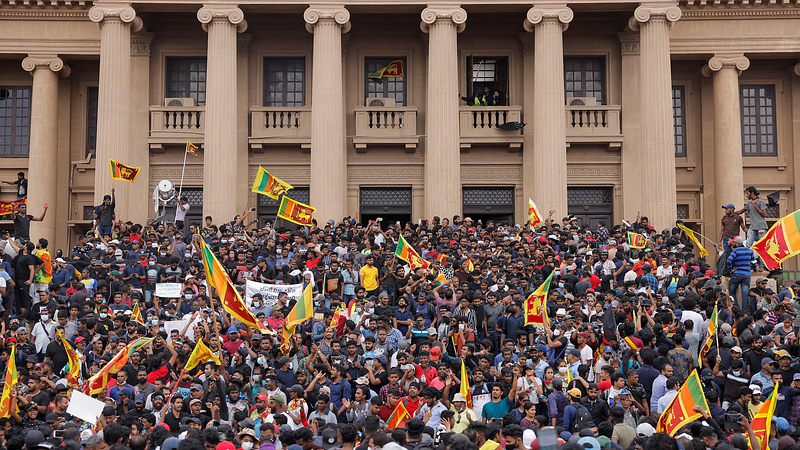
My TV screen is showing all these images of common people in Sri Lanka, rising up to take on the country.
A revolution!!
“Bliss was it in that dawn to be alive, but to be young was very heaven!” (Wordsworth, on the French Revolution).
I am reminded of this poem by William Wordsworth while watching thousands of common people milling in and out of the Sri Lankan Presidential palace corridors, swimming pools, and conference halls, wandering in and out of the most luxurious bedrooms, and stately dining rooms.
Just watching the surge of common people, (So different from the Capital Hill march of January 2021, in the US), I am thinking:
Do I dare to be elated and recite, what the Romanic poet, Wordsworth had said, while eulogizing the revolution by the common working-class men ( and women) who had stood up for their right to freedom, social justice, and their right to have their basic necessities met in his contemporary France.
And yes, men have, always stood up, time and again, whether it is the stone age, the iron age, the renaissance, the 18th, the 19th, or the 21st century, it is the right to have their basic needs, to have “bread” that has caused revolutions.
Whether the French Queen, Mary Antionette had actually said “if there is no bread, eat cake”, or something on these lines to the hungry French peasants who were demanding bread, or not (and I am leaning more towards, “no”), the point is that the rulers, the royalty, the elite, the selected, the chosen, have no idea, what hunger is, or they don’t understand, they have never themselves been without food, at least not when they are in power.
They are or they become rich, and might not know or remember, how it feels, not to have a roof on one’s head, and have no medicine for the sick, no books, no school for their children, no power, no vehicles to travel, and no petrol to drive their vehicles if they have any.
Either, they have not ever been in these circumstances, and even if any one of them had experienced hardship, once elected, or selected to run the government, they quickly forget what the common people’s needs are.
According to Pluto, when democracy gives way to tyranny then aristocracy becomes the obvious next stage. Napoleon took the lead after the French Revolution, to turn into a tyrannical head of the country, who then started his own dynasty.
When the common men and women, along with thousands of older people, children, and students had started marching a few weeks ago, in April, demanding food, electricity, petrol, medicine, and raising a voice against the selling of their public assets away, the Prime Minister and the President of Sri Lanka, did not take them seriously.
They might have even thought (assumed) that these people could be suppressed again to live without these essentials. They were not understanding the needs of people who have to get up and get out of their house to earn their daily bread and needed fuel, power, jobs, and money.*
Or just like the ignorant French aristocracy, who couldn’t understand if people could eat cake, why they want bread, they might have even assumed that people could work from home, or drive electric cars, why do they need petrol.
When I see this revolution, this mass of people, surging on the president’s residence, carrying their national flags and their pride in their democracy, I am worried.
As instead of being elated, as Wordsworth would have us feel, first what happened in the case of the French Revolution, that later on completely disillusioned the Romantic poets, troubles me.
I am also thinking that what scenarios can be envisaged developing from this revolution?
Once the revolution has run its course, (hopefully not in what the French Revolution had ended up in), what might happen next!
Would the common people-led revolution turn into tyranny?
Would there be a military rule?
Would there be a fair election?
Would the demands of the common people be ever met?
Is this the new dawn, we have been waiting for?
Although I am feeling a bit apprehensive, I still want to believe, with Wordsworth, that there will be happiness for people, in the end.
And as he had said, where this happiness might be
Sri Lanka which had been a British colony, and the British Dominion, till 1947, has had its own many issues, including religious, and cultural conflicts, resulting in bloody civil wars, and terrible terrorist attacks.
I do not want to claim complete knowledge about Sri Lanka, and not even enough to answer particular questions about its economy.
Here, I am only sharing my sentiments, a feeling of elation first, and then apprehension, that I have gone through in the last couple of days. A similar feeling when pro-democracy marches happened in Hong Kong!
Here, I have found a few articles by writers on medium, many of them might be living in Sri Lanka itself, or have a close connection with the country. They know more about what is going on there, either they have expertise in this topic, or/and have a personal stake in this development.
I acknowledge their knowledge and passion for this revolution.
Here I am mentioning three of these articles which were written this year only, a little before the revolution turned wild in July.
How Sri Lanka Has Fallen Into Darkness | by indi.ca | Medium
*It is a similar story in most developing countries.
Not being a welfare country, even in India, in 2020, it was the same problem, during the Covid-19 lockdowns, when people asked to remain at home, just could not stay at home, not many even had a home or a place to sleep at night. No social security to feed them while they could not, and did not work for the following few weeks, no way to reach their families in villages, to take care of their elderly parents and young children.
The image I have used, and some information, come from ABC news.
A Hindi song about being successful based on an English song sung in the Civil Rights movement, kept playing in my mind when I was writing this article.
Hum Honge Kamyab…
we shall overcome We shall overcome some day Oh, deep in my heart, I do believe We shall overcome some day
Here is a satire of this song, from a Hindi movie, in which those who stand up against corruption, instead of getting rewarded, get punished.
(200) Hum Honge Kamyab (HD) — Jaane Bhi Do Yaaro Songs — Naseeruddin Shah — Ravi Baswani — YouTube