avatarMichael Patanella

Free AI web copilot to create summaries, insights and extended knowledge, download it at here

2083

Abstract

r nothing</i> thinking can be nothing but a stressful, useless brain tangler. It rarely, if ever helps us.</p><p id="30df">The experts recommend trying to adjust this style, from a black and white technique, to more of a <i>“shades of grey style.” </i>Create a personal evaluation skill in your mind that encompasses rating things on a scale of numbers. It is a common practice, and it can help us get away from the insistence that something can only be <i>good or bad</i>.</p><p id="3308">Another thing to be aware of is the fact that even our own thoughts must sometimes be challenged by us. Often even more than outsiders, considering we’re the sole listeners of every thought we have, whether it’s normal thinking or distorted. If we can’t challenge ourselves, it’s still gonna be us cleaning up the mess.</p><p id="f7b4">If your thoughts seem questionable, well, then question them. Even though we may be oblivious to our thoughts as we go through our days, it still is our thoughts. I know that we can barely acknowledge a lot of our subconscious thinking from time to time, but we have to try to develop more of an awareness to our subconscious thinking. Especially if it is negative.</p><figure id="bd29"><img src="https://cdn-images-1.readmedium.com/v2/resize:fit:800/0*TQXWF-VnhsRh6ocF"><figcaption><a href="https://www.gettyimages.com/detail/photo/adding-last-piece-of-human-brain-puzzle-royalty-free-image/1279693283?adppopup=true">https://www.gettyimages.com/detail/photo/adding-last-piece-of-human-brain-puzzle-royalty-free-image/1279693283?adppopup=true</a></figcaption></figure><p id="f4c0">I read an excerpt from “<i>The Feeling Good Handbook”</i> by <b>David D. Burns MD</b>, and it said to “write down negative thoughts so you can see and read any cognitive distortions you think may either be a problem, or a potential future issue.”</p><p id="3969">I believe that a <i>Cost Benefit Analysis</i> is something that can be used just as much for our thought and emotions, with the same importance that it has for its normal usual place in business type decisions. Sp

Options

ecifically, I see emotions, being a major focus point. I believe that all of us probably go through plenty of emotions in our lives that may not quite be that necessary. It’s a result of being human, and none of us should demand perfection onto ourselves.</p><p id="ae10">We all go through wasted emotions, some from exaggerations and or overreactions. If we can go about the approach in a cost benefit style, then maybe we can strengthen our awareness in this area.</p><p id="8e9e">Take a feeling or an emotion, and decide its positive points and negative ones. See what appears to be a waste, and see what parts are very important.</p><p id="201b">If you <i>can’t </i>find a positive avenue that an emotion may be travelling, maybe it should just be let go of.</p><figure id="7fba"><img src="https://cdn-images-1.readmedium.com/v2/resize:fit:800/0*gGCEz-WXuZ42OVok"><figcaption><a href="https://www.gettyimages.com/detail/illustration/knowledge-from-books-royalty-free-illustration/484011951?adppopup=true">https://www.gettyimages.com/detail/illustration/knowledge-from-books-royalty-free-illustration/484011951?adppopup=true</a></figcaption></figure><p id="4d27">So much of this revolves around the fact that we ourselves have an absolute chance of being our own worst triggers. We fall into that trap as much as we do, because it isn’t something on the top of our minds. We are in this endless search to find all these assumed “outside sources” as the reasons and causes of every single solid problem we have.</p><p id="5473">We are molded, and evolved, to travel through life looking away from ourselves whenever there is an issue. We can’t go through life holding mirrors in front of ourselves, as we wrongly go about trying to pinpoint what entity is fooling all our real life issues. Well, we can ourselves be guilty. Even if we are not the problem, maybe we have to take a step back and remember that we are not our thoughts, and just because we think it, doesn’t mean it’s true.</p><p id="0c39">Thank you for reading,</p><h1 id="db58">MICHAEL PATANELLA</h1></article></body>

When Our Thoughts Are Tangled
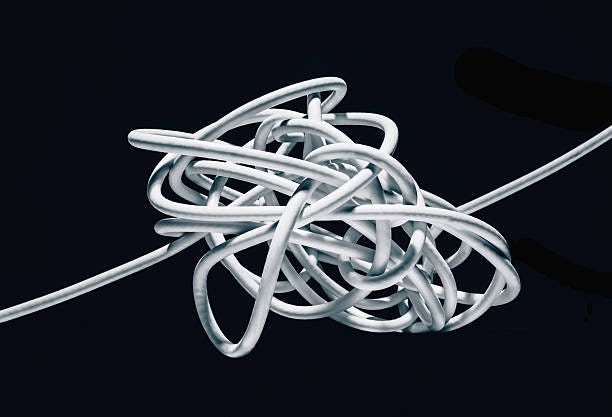
https://www.gettyimages.com/detail/photo/tagled-white-wire-royalty-free-image/482886235?adppopup=true

Some of the most complex, and multi levelled tangles can occur in our brains throughout life. Now I have never been one to be strongly proficient in untangling what we consider traditional knots; those being the kinds we may face in the form of rope or string. I was a late learner but, I eventually put that odd comparison to work in realizing that if I have problems untangling knots in small strings, then I sure as anything better learn about the tangles my mind gets stuck into.

I learned to figure that the best way to deal with these mental knots, was to never allow them to get tied in the first place. Now, that can be easier said than done. But still it’s a venture worth trying.

One of the important, and major issues that is a suspect in the brain knot tying is a topic I have actually written often about. Anyone recognize the term “black and white thinking?” Well, it is a very rigid model of thinking, that can produce multiple problems.

https://www.gettyimages.com/detail/photo/headphones-with-very-long-wires-royalty-free-image/1345111369?adppopup=true

It’s an all or nothing thinking that may easily find itself tying knots. And another problem; it is a thinking style that even when it isn’t tying knots, it sure is not going to untie any knots we may already have. So, we can see with that analysis that, all or nothing thinking can be nothing but a stressful, useless brain tangler. It rarely, if ever helps us.

The experts recommend trying to adjust this style, from a black and white technique, to more of a “shades of grey style.” Create a personal evaluation skill in your mind that encompasses rating things on a scale of numbers. It is a common practice, and it can help us get away from the insistence that something can only be good or bad.

Another thing to be aware of is the fact that even our own thoughts must sometimes be challenged by us. Often even more than outsiders, considering we’re the sole listeners of every thought we have, whether it’s normal thinking or distorted. If we can’t challenge ourselves, it’s still gonna be us cleaning up the mess.

If your thoughts seem questionable, well, then question them. Even though we may be oblivious to our thoughts as we go through our days, it still is our thoughts. I know that we can barely acknowledge a lot of our subconscious thinking from time to time, but we have to try to develop more of an awareness to our subconscious thinking. Especially if it is negative.

https://www.gettyimages.com/detail/photo/adding-last-piece-of-human-brain-puzzle-royalty-free-image/1279693283?adppopup=true

I read an excerpt from “The Feeling Good Handbook” by David D. Burns MD, and it said to “write down negative thoughts so you can see and read any cognitive distortions you think may either be a problem, or a potential future issue.”

I believe that a Cost Benefit Analysis is something that can be used just as much for our thought and emotions, with the same importance that it has for its normal usual place in business type decisions. Specifically, I see emotions, being a major focus point. I believe that all of us probably go through plenty of emotions in our lives that may not quite be that necessary. It’s a result of being human, and none of us should demand perfection onto ourselves.

We all go through wasted emotions, some from exaggerations and or overreactions. If we can go about the approach in a cost benefit style, then maybe we can strengthen our awareness in this area.

Take a feeling or an emotion, and decide its positive points and negative ones. See what appears to be a waste, and see what parts are very important.

If you can’t find a positive avenue that an emotion may be travelling, maybe it should just be let go of.

https://www.gettyimages.com/detail/illustration/knowledge-from-books-royalty-free-illustration/484011951?adppopup=true

So much of this revolves around the fact that we ourselves have an absolute chance of being our own worst triggers. We fall into that trap as much as we do, because it isn’t something on the top of our minds. We are in this endless search to find all these assumed “outside sources” as the reasons and causes of every single solid problem we have.

We are molded, and evolved, to travel through life looking away from ourselves whenever there is an issue. We can’t go through life holding mirrors in front of ourselves, as we wrongly go about trying to pinpoint what entity is fooling all our real life issues. Well, we can ourselves be guilty. Even if we are not the problem, maybe we have to take a step back and remember that we are not our thoughts, and just because we think it, doesn’t mean it’s true.

Thank you for reading,

MICHAEL PATANELLA

Thoughts
Mental Health
Self-awareness
Life
Self Improvement
Recommended from ReadMedium