
When My Mother Became My Child
Coping with the heartbreak, hopelessness, and hilarity of dementia
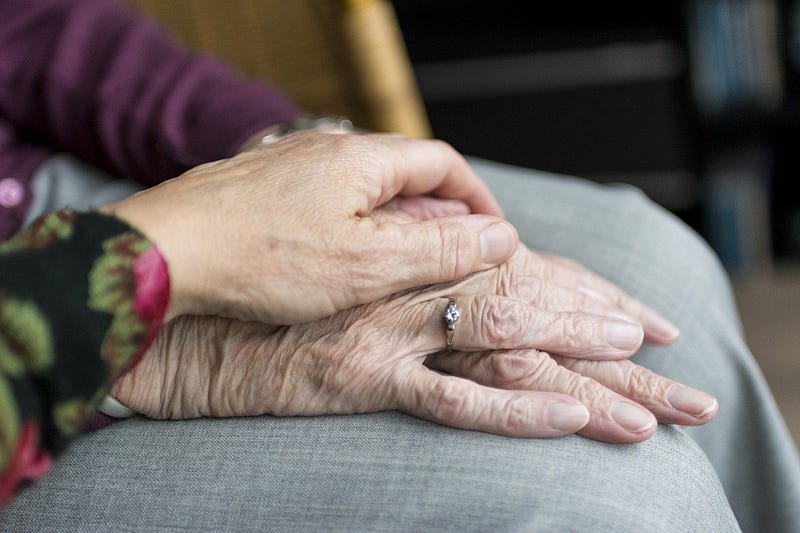
While no one can change the outcome of dementia or Alzheimer’s, with the right support you can change the journey. ~Tara Reed
My mother was 80 years old when she first displayed signs of dementia. By the time she was 82, she could no longer recognize anyone except my husband and me, probably because we had been her caretakers and constant companions for the last 20 years. At the age of 83, she became bedridden, incontinent, and no longer able to walk.
The Heartbreak
To say that my mother had been the very best of mothers was saying too little. As I reached adulthood, she also became my best friend. To watch her physical and mental health deteriorate, to see the quality and dignity of her life stripped from her, was almost more than I could bear.
Strangely, her dementia became my consolation. Why would I say such a thing? Dementia robbed her of the ugliness of reality. She never consciously related to her bedridden, incontinent state and the indignities it entailed.
There was a period when she lost recognition of me at times. That’s when she first called me Ma Ma. Her feelings at those times were like a child that had been lost and who was happy to be back home with her mother. We cried together — her from joy, me from heartbreak.
The Hopelessness
Hopelessness has surprised me with patience. — Margaret J. Wheatley
Hopelessness leads to acceptance. And with acceptance comes the patience to cope. Those are lessons I learned while accompanying my mother during this period of her life. I could do nothing, say nothing, feel nothing that would change anything. Those were my feelings in the beginning. But hopelessness soon gave way to inventiveness, imaginativeness, and a sense of rising to a greater challenge.
When my mother’s mind was in another world, no amount of reasoning could persuade her of that truth. On the contrary, it simply added to her confusion. For her sake, I learned to live in her universe. I found that I could agree to see what she saw and heard, though those things stayed invisible and silent to me.
Mother and I were fortunate in that her illusions were never violent or frightening. And while I could only get glimpses into that world and could never hope to understand all that she experienced, we shared a lot of them together.
The hilarity
Finding the hilarity in such a situation comes from learning to live in the moment, in an altered reality, in loving acceptance of what is. When I stopped trying to bring my mother back to my reality and lived moments at a time in hers, we had the time of our lives. Let me share a few of those moments with you.
There was the time she asked me if I could see the monkey in the tree. I replied, “not very well, where is he?” She pointed to the top of the wall opposite her bed. “Oh, I see him now,” I replied. Then I asked if he had friends and what the trees looked like. It was then I realized how complete and populated my mother’s altered reality really was. She described the trees, flowers, butterflies, birds, and three colors of monkeys. I could tell she enjoyed the illusion. So I just went with it. We spent many hours over the next months in that jungle paradise talking with each other and the many creatures that came and went.
Then there was the time she told me that I needed to make the two children playing on her roof get down before they hurt themselves. Dumb me, I tried to convince her that she was mistaken. That didn’t go over very well. This incident taught me that it was much better if she could resolve the situation in her own mind. So, I asked her how the children got on the roof. She said they climbed up the tree behind the house and jumped over to the roof.
I settled her in her wheelchair and we went outside to confront those two troublesome children. Of course, there were no children on the roof, and there never had been a tree behind our house. We were both staring up at the roof with perplexed expressions when she said, “Well, someone finally cut down that tree.” And that was the last I heard about those tree-jumping kids.
Sometimes I’d do odd little things on purpose just to create a diversion for her. One morning, I put syrup on her breakfast toast instead of on her pancakes. She laughed and called me a silly girl. I laughed with her and asked if she wanted me to make her a new piece of toast. Her reply, “No. I like syrup on my toast. You can put jam on my pancakes.” She ate every bite of both.
What I learned coping with my mother’s dementia
- Accept what is
- Make each day about them and find ways to enjoy the ride
- Visit their world with them often
- Help them solve problems within their current capabilities
- Find the humor in little things. And if the humor is missing, create some.
- Value the time you have with them. Forget how it’s supposed to be and live in the moment with them.
- Remember, it’s okay not to be okay. Life goes on and so must you.