
When It Comes to Blockchains, You Can’t Always Get What You Want — The Trilemma of Blockchain Unpacked
In the universe of blockchain technology, there exists an intricate problem we fondly term as ‘the blockchain trilemma’. Pioneered by Ethereum’s creator, Vitalik Buterin, the term revolves around the three fundamental features that a blockchain strives to achieve — security, scalability, and decentralization. The trilemma conveys an unspoken rule: You can nail two, but getting the triple crown is a herculean challenge.
Let’s dive into why this holds true and explore it through the lens of three distinct blockchains: Bitcoin, Ethereum, Polygon.
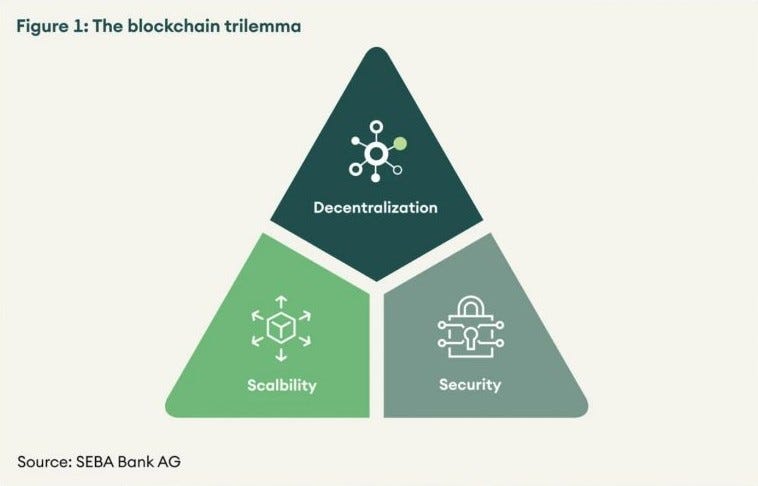
Blockchain’s Three Pillars: Security, Scalability, and Decentralization
Picture these three as the three vertices of a triangle. Any two can be connected with ease, but bringing in the third throws the system off balance.
Security ensures that transactions and data are safe from malicious attacks. Imagine this as a fortress with an impenetrable wall.
Scalability is the ability to handle increasing amounts of work and its potential to amplify when resources are added. Visualize this as a superhighway with lanes that can be effortlessly added to accommodate more traffic.
Decentralization is the distribution of authority, operations, and functions away from a central location or authority. Picture this as a city where power is evenly distributed amongst all its citizens.
The Case of Bitcoin: Security + Decentralization, but Low Scalability

In the grand theater of cryptocurrencies, Bitcoin holds the center stage. It prioritizes security and decentralization, creating an unassailable fortress that has stood firm against numerous attacks over its lifespan.
One key feature that beautifully personifies Bitcoin’s dedication to decentralization is the mystery surrounding its creator. Bitcoin’s inventor goes by the pseudonym Satoshi Nakamoto, yet their true identity remains a secret to this day.
This anonymity resonates deeply with the ethos of decentralization, making Bitcoin’s origin story a powerful symbol of the principles it stands for.
Imagine an artist who paints a masterpiece and leaves it in a public square without signing it. The art is now bigger than the artist. It belongs to the community and allows for open interpretation and free utilization, rather than being influenced or limited by the reputation, views, or potential authority of the creator.
Similarly, Bitcoin is larger than any individual or centralized entity — even its creator. The mystery of Nakamoto’s identity prevents undue influence or control from being exerted by a central figure and creates a unique system where the technology speaks louder than the individual behind it.
However, despite Bitcoin’s robust security and its symbolic commitment to decentralization, it falls short in scalability. It’s currently able to process merely 6–7 transactions per second (TPS), a far cry from the needs of a rapidly digitizing global economy. This is akin to trying to fit the Internet’s data traffic through a straw. While Bitcoin’s staunch approach to security and decentralization is commendable, its scalability issues pose significant challenges to its potential as a global transaction system.
Ethereum’s Gamble: Decentralization + Security, with Scalability Woes
Ethereum has marked its territory in the blockchain universe by championing security and promoting an environment ripe for innovation. It opened up an entirely new realm for developers, giving birth to decentralized applications (dApps) and setting the stage for the DeFi (Decentralized Finance) revolution.
However, its approach to decentralization is a mixed bag in my perspective. On the one hand, Ethereum’s architecture embodies the principle of decentralization, with no central authority governing the network. This principle was disruptive, giving developers the power to build applications with a level of transparency and immutability unheard of before.
On the other hand, Ethereum does face certain centralization risks. For instance, a significant proportion of Ethereum nodes run on centralized cloud services like Amazon Web Services (AWS). This dependence exposes the network to potential vulnerabilities — if these service providers were to pull the plug, the Ethereum network could face considerable disruption.
Moreover, the influence of Ethereum’s co-founder, Vitalik Buterin, is notable. Despite the decentralized ethos, his views can carry significant weight in the community, introducing a subtle element of centralization.
When it comes to scalability, Ethereum, like its elder cousin Bitcoin, finds itself in a tight spot. It can only process about 15–20 transactions per second (TPS), which, while an improvement over Bitcoin, falls short when confronted with its aspirations to be a ‘world computer’. This limitation is felt more acutely as the platform’s popularity grows, increasing the pressure on its ability to scale without compromising security or further eroding decentralization.
In conclusion, Ethereum has been a ground-breaking force in the blockchain world, particularly for developers. However, achieving the ideal balance between security, decentralization, and scalability is a challenge it continues to grapple with, embodying the essence of the blockchain trilemma.
The Polygon Solution: Scalability + Security, A Step Away from Full Decentralization
Polygon, formerly known as Matic Network, offers a fascinating approach to the blockchain trilemma. It serves as a Layer 2 scaling solution for Ethereum, operating ‘on top’ of the Ethereum blockchain, much like an express lane built over a highway to facilitate smoother traffic.
In terms of scalability, Polygon shines. It can support up to 7,000 transactions per second (TPS), an impressive feat compared to Bitcoin’s 6–7 TPS and Ethereum’s 15–20 TPS. It’s as if Polygon has taken a bustling, congested road and transformed it into a multi-lane superhighway capable of handling heavy traffic with ease.
Polygon leverages the security of Ethereum, utilizing the existing Ethereum network to confirm and secure transactions. This gives Polygon the benefit of Ethereum’s well-tested security, creating a protective fortress around its operations.
However, the trade-off for Polygon’s impressive scalability and robust security is a step back from full decentralization. Although Polygon has many validators, their number is significantly less than that of Ethereum or Bitcoin. The process of selecting validators is also not as decentralized, with the Polygon team playing a significant role in the selection process.
In effect, while Polygon extends Ethereum’s capabilities and tackles scalability issues effectively, it compromises on the ideal of total decentralization. This isn’t necessarily a bad thing — it’s simply the result of finding a pragmatic solution within the constraints of the blockchain trilemma. It underscores the inherent balancing act of maximizing scalability, security, and decentralization, reminding us that in the current landscape of blockchain technology, it’s a delicate game of give and take.
In Conclusion: A Tightly Woven Trilemma
The world of blockchain is richly complex and dynamic, shaped by the constant interplay of security, scalability, and decentralization. Our examination of Bitcoin, Ethereum, and Polygon illuminates how different levels of commitment to these three principles can shape a blockchain’s characteristics and capabilities.
Bitcoin, the vanguard of cryptocurrencies, illustrates the power of prioritizing security and decentralization, creating a robust and distributed network. Yet, its commitment to these principles limits its scalability, constraining its transaction capacity.
Ethereum, while also dedicated to security and decentralization, manifests this in a different way. Its ground-breaking platform for dApps shows the potential of a decentralized network, but its scalability falls short due to these commitments, handling only 15–20 TPS.
Polygon, on the other hand, offers an intriguing solution to the scalability woes of Ethereum, all while maintaining robust security. However, this feat necessitates a compromise on full decentralization, highlighting the intricate give and take inherent in the blockchain trilemma.
The trilemma is indeed woven into the very fabric of blockchain technology. It presents a profound, complex challenge, demanding innovation and thoughtful design to strike the right balance. Bitcoin, Ethereum, and Polygon each showcase unique approaches to this delicate balancing act, underscoring the fact that the art of blockchain design is a dance with the trilemma, where every step towards one principle requires a careful shuffle with the other two.
Here are some resources that can help you explore more about the blockchain trilemma and the various characteristics of Bitcoin, Ethereum, and Polygon:
Blockchain Trilemma:
- The Blockchain Trilemma by Binance Academy
Bitcoin:
- Bitcoin.org
- Bitcoin: A Peer-to-Peer Electronic Cash System by Satoshi Nakamoto
Ethereum:
- Ethereum.org
- A Next-Generation Smart Contract and Decentralized Application Platform — Ethereum Whitepaper
Polygon:
General Blockchain:
- Mastering Bitcoin by Andreas M. Antonopoulos
- Mastering Ethereum by Andreas M. Antonopoulos and Gavin Wood
Enjoyed the read? For more on Web Development, JavaScript, Next.js, Cybersecurity, and Blockchain, check out my other articles here:
If you have questions or feedback, don’t hesitate to reach out at [email protected] or in the comments section.
[Disclosure: Every article I pen is a fusion of my ideas and the supportive capabilities of artificial intelligence. While AI assists in refining and elaborating, the core thoughts and concepts stem from my perspective and knowledge. To know more about my creative process, read this article.]