avatarThe Good Men Project

Free AI web copilot to create summaries, insights and extended knowledge, download it at here

3717

Abstract

You can’t rely on empty promises to change, you need hard cold facts. The truth is that even if there’s no evidence of change right now, your partner may eventually find long-term sobriety and recovery, but how long are you willing to wait? Six months? A year? Five years? 10 years? This is your life, too. What else are you missing out on while you’re waiting for your partner to change? You’ve put your life on pause. You deserve to live a fulfilling life with a partner that meets your needs.</li><li><b>Is your life unmanageable?</b> Instead of waiting for your partner to hit bottom, consider whether you’ve hit your bottom. Do you want to live like this anymore? Are you sick and tired or being sick and tired?</li></ul><p id="0735">Answering these questions will only be helpful if you can take an honest look at yourself and your partner. The sneaky thing about denial is that you don’t even know it’s there. Sometimes you need someone outside the situation to give you unbiased feedback.</p><h1 id="b361">It’s time to seriously consider leaving if your addicted partner:</h1><ul><li>Hurts you physically, emotionally, mentally, or sexually</li><li>Puts you down; calls you derogatory names</li><li>Doesn’t take responsibility for mistakes; blames you for everything</li><li>Apologizes, but continues to hurt you in the same way</li><li>Refuses to go to therapy or treatment</li><li>Denies problems</li><li>Tells you that you’re “crazy”</li><li>Lies, cheats, steals, or other dishonest and unethical behavior</li><li>Controls where you go, who you see, what you wear, or your access to money</li></ul><h1 id="b4d9">Deciding to stay</h1><p id="d08f">I’m actually not suggesting that everyone should leave their addicted partner. There are also times when a couple can recover from addiction and codependency together. I believe that in order for this to be possible, two primary things need to happen:</p><ol><li>Both you and your partner must be committed to recovery and participate regularly in recovery activities (in-patient or outpatient substance abuse treatment, psychotherapy, group counseling, 12-step or other self-help groups).</li><li>Abusive behavior ceases completely. I can never advocate that you stay in a relationship where you’re being hurt physically, sexually, or emotionally. You deserve better.</li></ol><p id="44ac">I know from my personal and professional experience that relationships can survive addiction and become healthy.</p><p id="8183">But I also know that codependents often stick around long after change is likely. Please remember that you didn’t cause your loved one’s addiction and you can’t fix it. It’s not about whether she loves you enough to quit or about what you did wrong or what else you can try.</p><p id="b9cf">Sometimes you need to save yourself before you go down with the sinking ship.</p><p id="a375">When I was at this crossroads, going to therapy was a lifesaver that re-centered me and helped me find acceptance. I can’t possibly know what you should do in your particular situation. If anything in this article spoke to you, I strongly suggest you get some support as you wrestle with these questions and try to see your life realistically.</p><figure id="deaf"><img src="https://cdn-images-1.readmedium.com/v2/resize:fit:800/0*n5BOzUQmfjvP83qK.png"><figcaption>Infographic © 2016 Sharon Martin. All rights reserved.</figcaption></figure><p id="92f0"><i>Sharon’s workbook <b>Setting Boundaries Without Guilt</b> is now available on her <a href="http://sharonmartincounseling.com/sharon-martin-books/">website</a>.</i></p><p id="ebfd"><b><i>More by Sharon Martin on Medium:</i></b></p><div id="7267" class="link-block"> <a href="https://readme

Options

dium.com/6-big-problems-with-people-pleasing-and-how-to-fix-them-fca3daa35cbb"> <div> <div> <h2>6 Big Problems with People-Pleasing and How to Fix Them</h2> <div><h3>How to prevent losing yourself in relationship perfectionism.</h3></div> <div><p>medium.com</p></div> </div> <div> <div style="background-image: url(https://miro.readmedium.com/v2/resize:fit:320/0*c2qLcO6jwnrjNlJx.jpg)"></div> </div> </div> </a> </div><div id="c5ad" class="link-block"> <a href="https://readmedium.com/self-love-and-the-codependent-man-5e09ee921ff8"> <div> <div> <h2>Self-Love and the Codependent Man</h2> <div><h3>The way to stop being so needy and dependent is to love yourself more.</h3></div> <div><p>medium.com</p></div> </div> <div> <div style="background-image: url(https://miro.readmedium.com/v2/resize:fit:320/1*f_KXGquzWLrm9wpGof8V6A.jpeg)"></div> </div> </div> </a> </div><div id="c106" class="link-block"> <a href="https://readmedium.com/10-ways-men-can-create-the-perfect-routine-for-optimal-mental-health-3c2a8e6ba0ea"> <div> <div> <h2>10 Ways Men Can Create the Perfect Routine for Optimal Mental Health</h2> <div><h3>From the right bedtime to the right relationships, men need to establish the best routine first and foremost.</h3></div> <div><p>medium.com</p></div> </div> <div> <div style="background-image: url(https://miro.readmedium.com/v2/resize:fit:320/0*LFtMrPTT1GcpEyzz.jpg)"></div> </div> </div> </a> </div><p id="586d"><i>The story was <a href="https://goodmenproject.com/featured-content/when-is-it-time-to-leave-your-addicted-partner-martin-jrmk/">previously published on The Good Men Project</a>.</i></p><h2 id="7310">About Sharon Martin</h2><p id="123d"><i>Sharon Martin, LCSW is a licensed psychotherapist practicing in San José, CA. She earned a MSW from Boston College. Her expertise is in healing codependency and perfectionism. She is passionate about helping you increase self-acceptance and self-compassion in order to build a peaceful, balanced life. Sharon is the author of <a href="http://sharonmartincounseling.com/sharon-martin-books">Setting Boundaries Without Guilt: A Workbook to Move You From Doormat to Empowerment</a>. You can find her on <a href="https://twitter.com/smartinlcsw">Twitter</a> and her <a href="http://http://sharonmartincounseling.com/">website</a>.</i></p><p id="e38b"><b><i>The Good Men Project</i></b><i> gives people the insights, tools, and skills to survive, prosper and thrive in today’s changing world. A world that is changing faster than most people can keep up with that change. A world where jobs are changing, gender roles are changing, and stereotypes are being upended. A world that is growing more diverse and inclusive. A world where working towards equality will become a core competence. We’ve built a community of millions of people from around the globe who believe in this path forward. Thanks for joining The Good Men Project.</i></p><h2 id="a8e2">Support us on Patreon and we will support you and your writing! Tools to improve your writing and platform-building skills, a community to get you connected, and access to our editors and publisher. Your support will help us build a better, more inclusive world for all.</h2></article></body>

When Is It Time to Leave Your Addicted Partner?

Codependent couples need to consider the crossroads, treatment, recovery, and the tough choice to stay or not.

Photo credit: iStock

By Sharon Martin

Deciding whether to end a relationship is a big decision.In fact, it’s one of the things I see people struggle with the most as a therapist. For a codependent, the decision to leave an addicted partner is especially hard.

You’ve tried and tried, but things don’t ever seem to get better (or at least not for long).

You’re low on self-esteem.

You’ve devoted mountains of time to taking care of and trying to fix your partner.

However, despite the conflicts and disconnection, you love and care about your partner.

You wonder what will happen to your partner if you’re not around to help.

And what will you do without someone to take care of?

Leaving feels like a failure.

Things to consider when deciding to leave a relationship with an addict:

  • Is your relationship abusive? Abuse isn’t just about whether your partner beats the sh** out of your every time he gets wasted. It’s also the occasional shove or grabbing your arm. It’s forcing you to have sex or perform particular sexual acts when you don’t want to. It’s telling you you’re worthless or you’ll be alone forever if you leave. It’s threats to harm you or your kids. It’s blaming you and making you feel “crazy”.
  • What will happen if things continue on their current trajectory? I know you can’t predict the future, so the past is our best gauge for what’s to come. Have things gotten worse over time? Does your partner use more frequently or larger quantities? Do new problems continue to stack up?
  • How is this relationship affecting your kids? Are your kids really better off with you staying together? Perhaps their standard of living is higher in a two parent household, but don’t fool yourself into believing your kids don’t know what’s going on. Kids are very aware of arguments, abuse, or Mom being too drunk to drive; even babies can sense tension and conflict.
  • Is this an equal partnership? Marriage may not be 50–50 all the time, but it should even out to a reasonably equitable partnership over time. Are you carrying the bulk of the work and responsibility? Can you confide in your partner and feel supported? Are you appreciated and valued?
  • Is your partner invested in change? Remember the old saying, “Nothing changes if nothing changes”? Well, that’s the truth. Change takes sustained effort. Has your partner shown you that she is going to work at recovery day after or day or does she repeatedly quit programs, relapse, and make excuses?
  • What does it cost you to stay? Is staying eroding your self-esteem, your mental health, your physical health, your sense of peace, and well-being? What else are you giving up in this relationship — your friends, goals, career advancement?
  • How long are you willing to wait? Change is hard and scary. It’s always easier to do the same thing rather than change even when you know the current situation is toxic. There’s a strong desire to hang in there thinking your partner will eventually change. You can’t rely on empty promises to change, you need hard cold facts. The truth is that even if there’s no evidence of change right now, your partner may eventually find long-term sobriety and recovery, but how long are you willing to wait? Six months? A year? Five years? 10 years? This is your life, too. What else are you missing out on while you’re waiting for your partner to change? You’ve put your life on pause. You deserve to live a fulfilling life with a partner that meets your needs.
  • Is your life unmanageable? Instead of waiting for your partner to hit bottom, consider whether you’ve hit your bottom. Do you want to live like this anymore? Are you sick and tired or being sick and tired?

Answering these questions will only be helpful if you can take an honest look at yourself and your partner. The sneaky thing about denial is that you don’t even know it’s there. Sometimes you need someone outside the situation to give you unbiased feedback.

It’s time to seriously consider leaving if your addicted partner:

  • Hurts you physically, emotionally, mentally, or sexually
  • Puts you down; calls you derogatory names
  • Doesn’t take responsibility for mistakes; blames you for everything
  • Apologizes, but continues to hurt you in the same way
  • Refuses to go to therapy or treatment
  • Denies problems
  • Tells you that you’re “crazy”
  • Lies, cheats, steals, or other dishonest and unethical behavior
  • Controls where you go, who you see, what you wear, or your access to money

Deciding to stay

I’m actually not suggesting that everyone should leave their addicted partner. There are also times when a couple can recover from addiction and codependency together. I believe that in order for this to be possible, two primary things need to happen:

  1. Both you and your partner must be committed to recovery and participate regularly in recovery activities (in-patient or outpatient substance abuse treatment, psychotherapy, group counseling, 12-step or other self-help groups).
  2. Abusive behavior ceases completely. I can never advocate that you stay in a relationship where you’re being hurt physically, sexually, or emotionally. You deserve better.

I know from my personal and professional experience that relationships can survive addiction and become healthy.

But I also know that codependents often stick around long after change is likely. Please remember that you didn’t cause your loved one’s addiction and you can’t fix it. It’s not about whether she loves you enough to quit or about what you did wrong or what else you can try.

Sometimes you need to save yourself before you go down with the sinking ship.

When I was at this crossroads, going to therapy was a lifesaver that re-centered me and helped me find acceptance. I can’t possibly know what you should do in your particular situation. If anything in this article spoke to you, I strongly suggest you get some support as you wrestle with these questions and try to see your life realistically.
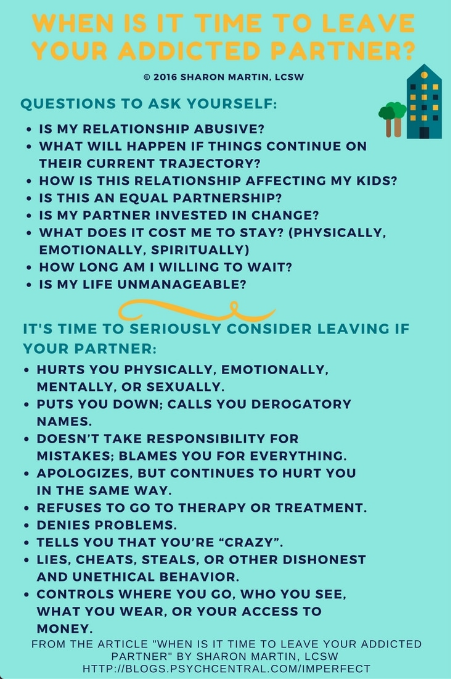
Infographic © 2016 Sharon Martin. All rights reserved.

Sharon’s workbook Setting Boundaries Without Guilt is now available on her website.

More by Sharon Martin on Medium:

The story was previously published on The Good Men Project.

About Sharon Martin

Sharon Martin, LCSW is a licensed psychotherapist practicing in San José, CA. She earned a MSW from Boston College. Her expertise is in healing codependency and perfectionism. She is passionate about helping you increase self-acceptance and self-compassion in order to build a peaceful, balanced life. Sharon is the author of Setting Boundaries Without Guilt: A Workbook to Move You From Doormat to Empowerment. You can find her on Twitter and her website.

The Good Men Project gives people the insights, tools, and skills to survive, prosper and thrive in today’s changing world. A world that is changing faster than most people can keep up with that change. A world where jobs are changing, gender roles are changing, and stereotypes are being upended. A world that is growing more diverse and inclusive. A world where working towards equality will become a core competence. We’ve built a community of millions of people from around the globe who believe in this path forward. Thanks for joining The Good Men Project.

Support us on Patreon and we will support you and your writing! Tools to improve your writing and platform-building skills, a community to get you connected, and access to our editors and publisher. Your support will help us build a better, more inclusive world for all.

Advice
Self-awareness
Psychology
Life
Toxic Relationships
Recommended from ReadMedium