
MEMOIR | TRAVEL | MEMORIES TO LAST A LIFETIME
When I Thought the Trail Was Endless
It never was, but oh, how I wanted it to be
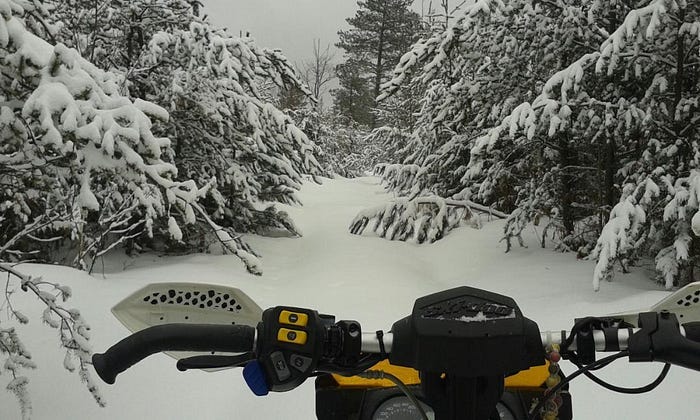
Sometimes I open the closet door and bury my face in my old snowmobile jacket hanging unused at the far end. Even after all these years, it still smells like two-stroke oil and immediately transports me back.
I love that smell.
We’d been riding since early morning. Hours just seem to disappear when we’re on the trail. The others continued on to the lodge, far down at the bottom of the steep hill, but we paused to enjoy the last light. We turned off our snow machines when we reached the highest point of our journey, and the sudden cessation of noise amplified the perfect quiet.
The coming of evening fell around us like a sacred shroud.
Earlier in the day, in the blinding sunlight, we had skimmed alongside wolf tracks trotting down the middle of the road, a reminder of just who these woods belong to.
High up on the bluff overlooking Whitefish Point and the bay at dusk, we sat and drank in the glorious silence of a winter forest. The wind sighed softly in the white cedars and balsam pines above our heads, the snow in their skirts floating lightly to the ground like fairy dust with every sway. The great hawks had ceased their wide-winged surveillance for the night and the birds of prey that love darkness had not yet risen.
It was a singular paradise to my eyes, unlike anything I had ever before experienced.
Around us, lavender dusk was descending, the stars just beginning to wake up and put on their show in the darkening vault of sky overhead. Before me, at the foot of that forest primeval, mighty, legendary, deadly Lake Superior, frozen and deceptively serene in the grip of winter, lay stretched out before us.
Superior, the great lake the Ojibwe call “ kitchi-gami” (Gitche Gumee), the shining Big-Sea-Water that Longfellow memorialized in his poem “The Song of Hiawatha,” and which Gordon Lightfoot immortalized in his classic song, “The Wreck of the Edmund Fitzgerald.”
The legend lives on from the Chippewa on down Of the big lake they called Gitche Gumee Superior, they said, never gives up her dead When the gales of November come early
The Edmund Fitzgerald and her entire crew of 29 went down in a sudden gale just north of Whitefish Point, on November 10, 1975. All lives were lost.
We removed our helmets in near reverence. His long, prematurely silver hair and neatly-trimmed beard framed so well the gentle smile he always wore. In the lowering light, in well-worn leathers and fur gloves, he seemed ageless, entirely of this ancient place.
Quietly, in his soft voice, he explained to me this little corner of the Universe where he had spent so many years.
That he loved so dearly. That he wanted to share with me.
A voice from below broke the mood, calling out, asking if we were okay. Safety is always a primary consideration in the woods.
“Yeah,” he called back. “We’re fine. ” He looked at me and smiled.
And we were.
It was nearly midnight in the Hiawatha National Forest, 894,836 acres of pristine wilderness in the Upper Peninsula of Michigan. On that still and heart-breakingly clear night, the light of a full moon reflected like a million diamonds off the light-as-air snow.
It was exceptionally cold, far below zero, but I felt comfortably warm in my leathers, boots, lined gloves, gaiter, and helmet. We flew low and fast along the wide, groomed snowmobile trails through that great, dark Michigan woodland, my mind blessedly free, no cares.
Time is of no consequence in the winter forest.
My only thought was for the next curve ahead. Shadows danced black and mysterious against the milky translucence of the landscape, as a pale, misty moon hovered in the sky. We shot through tall pines and spruce that seemed sprinkled with puffy stardust, the ground beneath them blanketed with a pure and endless shadowy white.
All the boys would let me ride with them; in fact, they asked me to go. I was surprisingly good on a snow machine. I was fearless.
Those rides are incredibly purifying. Even though you are with others, you are alone — alone with your primal experience, alone with your own heartbeat. You are aware of your breathing. It is a meditation, a holy peace.
It’s the most free I have ever felt.
I lost it all when I lost him, because that world belonged to him and not to me. He only loaned it, and himself, to me for a little while. He, and his world, were not mine to keep.
Sometimes, in the deep of night — God, how I miss it!
I remember one winter’s evening, at the top of a high bluff, when the stars turned on a perfect axis and for once, the world was mine.
11 miles north of Paradise, Michigan.
An unforgettable moment with an unforgettable man, etched forever on my heart. And his.
Some day, somewhere, we’ll ride those trails again, my love.
Until then.
Thanks for reading. I appreciate you, always. Ride those trails and never look back.


