
When I started to Hate Bullfighting.
Why I started to hate bullfighting.
I recently heard a piece of music being played on the radio, by the artist, Herb Alpert. The style of his music brings to the mind the images of bull fighting.
This got me thinking about my views on the subject of bullfighting.
Many years ago, I was taken to see bull fighting in the city of Palma, on the Island of Majorca. You have to remember I was only around the age of twelve approaching thirteen, and to me, the thought of a bullfight was alien and glamorous. Very few of my contemporaries would have seen such a spectacle.
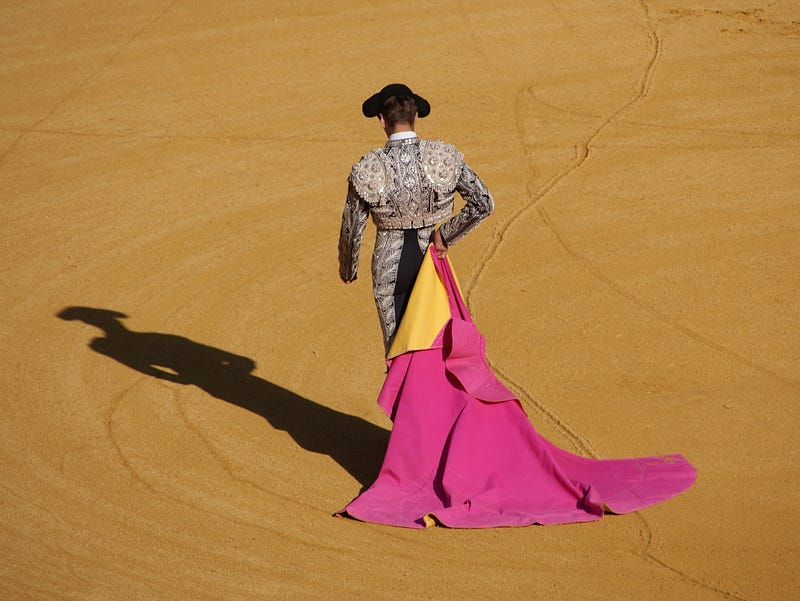
And spectacle it was. The colour of the fighters in their spangled suits, and the music that was played in the initial parade held before the fighting began, was electric. To a twelve-year-old English boy from London’s East end it was a magical sight.
I was told by my guide that Palma was not a major bullfighting venue. I think it was the equivalent of a third division football club in the bullfighting world.
For this reason would only see six fights, and no picadors, the mounted matadors’.
Perhaps the quality of the matadors’ was also reflected in the low status of the venue. In one stage of the proceedings, the matador is supposed to have so mesmerised the bull that he can turn his back on the animal and bow to the crowd, while the bull stands transfixed behind him.
Unfortunately, in the very first fight of the afternoon, no one told the bull this was the plan. As soon as the matador turned his back, the bull charged, and tossed him some six to eight feet in the air.
As you can imagine, all hell broke loose. People came running to distract the bull and the unlucky bull fighter was dragged to safety. Although injured, he did manage to complete the fight and kill the bull.
I was told that what I had witnessed was a very rare occurrence, people who have attended bull fights for years had never saw a Matador tossed in such a way. I was told I was lucky, although I don’t think the flying Matador would have agreed.
The rest of the afternoon continued without any more upsets for the human participants’, not so for the bulls.
Some two years later, I was in Barcelona, and attending another bullfight.
This venue was higher up the league. I was going to see nine fights and there would be Picadors.
The opening parade was more spectacular than the one held in Palma. There were more Matadors s, and mounted Picadors, a great show.
But as the afternoon wore on, I began to become disillusioned. I was no longer a star struck twelve year old, but a youth approaching his fifteenth birthday.
The sight of a horse being gored as the bull got under its protective armour, and the relentless killing of the poor bulls, began to make me look on the whole thing in a different light.
The sight of an exhausted bull dropping to the ground, unable to move, and looking bewildered as men circled around him, has never left me. For some reason, this bull was killed by a dagger into the back of his neck.
Many aficionados’ of bull fighting would put this down to my English over sentimentality for animals.
But I think it is more to do with the English habit of supporting the underdog. To me, bull fighting was a sport of one against many, and the one was never going to get out alive, no matter how many men he tossed or killed.
To me, perhaps a sentimental Englishman, it’s brutal.
I have never wanted to see a bullfight again.
Join Medium by using my referral link.
More of my articles.


