
When Grief Becomes a Suitcase You Can’t Put Down
This is how to carry it.
You are the kind of person who needs to find the usefulness in things. Even in things that seem to have none. Especially things you can’t dodge, things that simply come at you like the flu, or a flat tire. Obstacles, challenges, setbacks. You try to turn them around, find lessons in them. Make them useful.
What about grief? How can grief be useful? It can’t.
You know this personally. You know this first-hand.
Grief is useless.
Grief eclipses happiness.
Grief wrings the spirit right out of you.
Grieving doesn’t bring people back or reverse tragedy. It slows everything down. Nearly to a halt if you’re not careful. It bleaches out the color. It cancels motivation and enthusiasm. It’s exhausting.
You consider other emotions. At least they have purpose. They yield something.
Happiness is the most productive emotion of all. It’s inspiring and powerful. Happiness is strength and laughter and love and creativity and innovation and daring and unstoppable.
Even anger, for all its faults, can give voice when you have none, or strength when you’re weak. It can even spark progress when you feel gridlocked.
But grief? What good is grief?
Worse yet, grief is sticky.
Everyone else’s loss — the mother separated from her child, the man who helplessly watched his family drown, the doctor who died of her patient’s illness — sticks to yours. You begin to carry everyone’s.
What’s more, your own grief stirs up other sorrow, other regrets — seemingly unrelated — and it grows so heavy it becomes a hulking suitcase — over-stuffed and testing its seams.
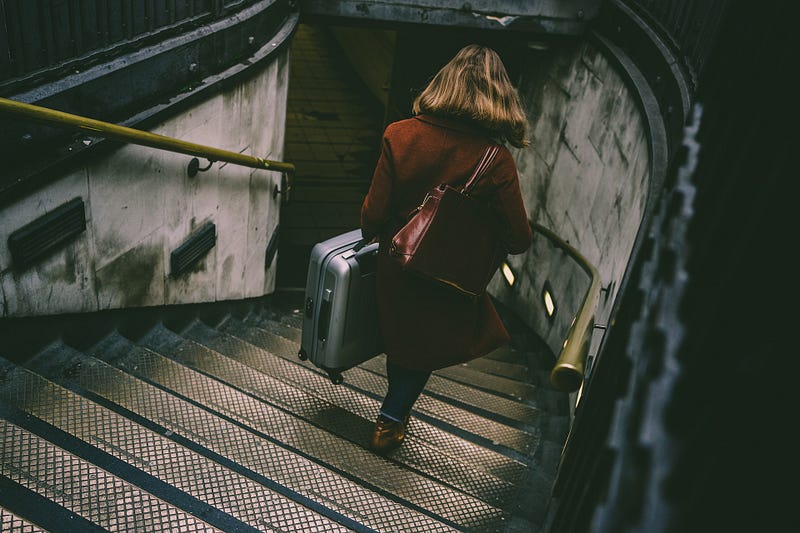
This suitcase starts to show up in the oddest places. Last night, at 3 a.m., when you couldn’t sleep, you rolled over, and there it was. This morning, it was in the shower with you. It’s at the breakfast table and at work in the meeting you organized.
Do people see your suitcase? At the graduation party you’re invited to, or the celebration to mark your friends’ engagement? Neither of which you’re feeling up to attending, but you go anyway, suitcase in hand. Hoping no one notices.
You carry it everywhere; it’s with you 24/7.
How did this happen?
It can’t be put down or left behind. You can’t walk away from it. You’ve tried.
Some days, you cradle it in your arms and press it against your chest, hoping it will dull the pain in your heart.
Some days, it’s too heavy to carry, and gratefully, you discover it has wheels.
Grief, still at hand, is a few feet behind. In the days to come, it grows more cumbersome and difficult to pull. The bottom sags and strains the wheels. The only solution is to drag it. This slows you down, but you do it anyway. At least you can keep going.
One day, you notice you haven’t seen anyone anywhere. Where are all the people you used to see? You can’t think about them now. You can only think about how your suitcase has become so unwieldy you can’t even drag it anymore.
You pull and pull, but it won’t budge. How will you go on?
You get down on your knees and shove it from behind.
Nothing. It’s stuck.
Out of nowhere, a person appears in the distance.
She’s walking toward you in a gait you remember walking yourself, not long ago. She gets closer, and you see something strapped to her back. A small suitcase — exactly like yours — but tiny. Her arms swing with each stride. She whistles a tune. Before you fully comprehend it, she’s right beside you.
“Oh,” she nods. “I used to have one of those,” examining your suitcase. “You can’t carry it yourself.” Without hesitation, she bends down and slips her hands beneath it. “I’ll take this end, and you take the other.”
You’re about to protest. You can’t allow her to help — it’s far too heavy. She’s got her own to carry. You don’t even know her. She’s a stranger. You can’t accept. It’s too generous. Too kind. No, this suitcase is yours to bear.
You think about how to tell her but can’t find the right words or what order to put them in. She stands to allow you a moment. You’re shoulder to shoulder — both of you study the massive luggage. You notice she smells like flowers.
When you turn to her, you’re stunned to see she’s cradling your suitcase in her arms. All on her own.
“Ready?” She smiles. “Let’s do this together.”
She stands in front, her hands extending behind her to carry the end with the handle. You take the end with the wheels. With each step, her own suitcase bobs softly on her shoulders. A melody she hums drifts back at you. You walk this way for a long time, but she doesn’t get weary at all.
To your amazement, the suitcase becomes lighter. She steps to the side to tie her shoe. You turn to look at her and realize she’s way behind. How long have you been carrying it on your own?
“You should open it,” she calls out. “Unpack some things.”
“Oh no,” you yell back, shaking your head. “I can’t do that.”
“Might be surprised what you find — ” She cups her hands around her mouth so you can hear her as she gets further away. “Could be useless stuff you can get rid of. Just take what’s worth keeping.” She says something else. But you can’t hear her over the sound of birds chirping.
You squint and use your hand as a shield, but you can’t see her anymore. The sun is in your eyes.
Eva Lesko Natiello is a novelist, book marketing and publishing consultant and speaker. She is certain art will save us. More from Eva.


