
When “Good” Schools Equal “White” Schools, Black Families Have a Real Problem
“Proximity to Whiteness is often both physically and symbolically violent to Black people.”
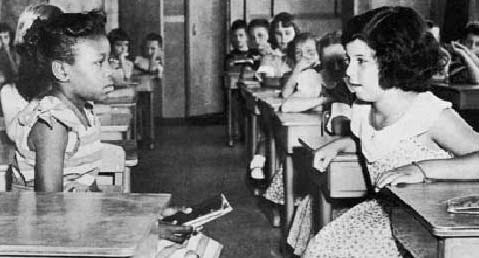
http://reuther.wayne.edu/ex/Brown/brown4.html
When I was deciding on where I should start my graduate studies, Palo Alto, California seemed to me like a good place to be. At the time, my children were 19 months old and newborn, and it would be years until I enrolled them and their younger brother in school. But my program would take at least seven years and thus it was important to me to understand the stock of “good” schools where we chose to live. On paper, to this new mother, Palo Alto schools looked perfect.
Until they didn’t.
Let’s back up. I grew up in a 95% Black neighborhood in Northwest Philadelphia. My local elementary school comprised 99% Black children with 100% of the students low-income. According to a popular school rating site, the school scores at a 2/10, indicating poor metrics about “year-over-year academic improvement … how well it’s serving disadvantaged students … and performance on state tests.” One of my strongest memories of my elementary school experience is not of a poor academic experience, however. It is of a White child showing up at our school one day and me feeling sorry for him. I remember thinking that his family must be pretty down on their luck. I thought this not out of a sense of self-loathing for myself and my Black classmates, but because I understood the racial hierarchy and White privilege. I understood that in our society, he was supposed to get more than we had.
I was not surprised, then, when my mother told me explicitly that if I was to get a “good” middle school and high school education, I needed to be educated around middle-class White people, people who were living the privileged experience of Whiteness. And she wasn’t wrong, as long as we understand what “good” means.
“Good,” for many Black families, means a school that we believe will prepare our children academically to lead prosperous lives. Like all Americans, we want our children to live the proverbial American Dream, to do what they want with their lives without racial roadblocks. We want them to attend college and maybe even graduate school. We want them to be able to financially support themselves, and maybe even buy a home where they can raise their children. We want them to have the white picket fence and all of that. And we believe education to be the great equalizer, the thing that will make our children equal to other children, White children.
Yet academics present only a small slice of what children experience in school. To be sure, schools present lessons in reading, writing, and arithmetic. But they also present intangible lessons in identity, democratic citizenship and national belonging. In Brown v. Board of Education, which decreed unconstitutional laws that enforced racial separation in schools, the Supreme Court suggested its agreement with the 3Rs view of schools, writing, “[I]t is doubtful that any child may reasonably be expected to succeed in life if he is denied the opportunity of an education.” But it also wrote, “[Education] is required in the performance of our most basic public responsibilities, even service in the armed forces. It is the very foundation of good citizenship. Today it is a principal instrument in awakening the child to cultural values, in preparing him for later professional training, and in helping him to adjust normally to his environment.” In other words, “education” includes lessons on how one fits into society.
While Black children in integrated schools are no longer subject to the physical violence of the desegregation era, today predominately White schools present lessons of second-class citizenship to Black children. For example, at a tony private school I’ve written about previously, Black identity engenders misery. While the school boasts of its graduates attending colleges such as Brown, Columbia, and Yale, its racial climate abuses to Black children. The school subjects Black children to racial abuse on a daily basis, where teachers ask Black students to speak for their race; where guidance college counselors abandon Black athletes; where fellow classmates tell Black children that their success will be because of affirmative action; and where one White “friend” threatened a Black student with a lynching. Indeed, one Black alum wrote, “I have repressed so much from my experience there because a lot of it is too painful to revisit.” My old middle-high school now finds Black students experiencing much of the same pain, and the New York Times recently profiled this exact type of behavior at predominately White schools across the nation, where Black children are subject to a “hostile learning environment.”
Proximity to Whiteness is often both physically and symbolically violent to Black people. By symbolic violence, I mean the means by which powerful groups exert dominance over less powerful groups, and where those means are in part accepted by the powerless. While Whiteness in schools brings things that Black parents want, such material resources, cultural capital and social capital, in exchange Black children endure racialized aggressions. I learned this first-hand as I engaged with my children’s school in Palo Alto. I learned that violence when I had to fight for my 5-year-old Black son to not be labeled as having a disability that he did not have. I learned that violence when I had to fight to remove “angry black women” stereotypes of non-cooperation and aggression in my daughter’s first grade report card. I learned that violence when the high school math department specifically refused to teach a class to the appropriate California standard even if doing so made it more likely that Black kids would be credit-eligible for California public colleges when they graduated from high school.
While admittedly a harsh indictment, Black parents who voluntarily subject their children to these violent environments are partially responsible for its effects. Of course, many Black parents may feel that they have no choice. They see their options as constrained to academically under-performing schools that may be better for their child’s self-identity, and predominately White schools where their children experience better academic curriculum but must also bob and weave to avoid racial jabs and uppercuts. But Black parents must acknowledge that is is actually a choice and honestly interrogate whether their choices are actually so constrained. We often do have good choices, if only we’d seriously consider them.
For myself, I have vowed to never again subject my three Black children to environments where their Blackness makes them feel less than fully and unapologetically themselves. I suspect that many more Black parents if engaged in a true soul-search, can make that same vow.