
Environment: The World Beneath
When Gardening We Must Be Considerate Of The Incredibly Diverse And Intricate Ecosystem That Thrives Beneath Our Feet
An ecosystem that works hard to keep us alive.
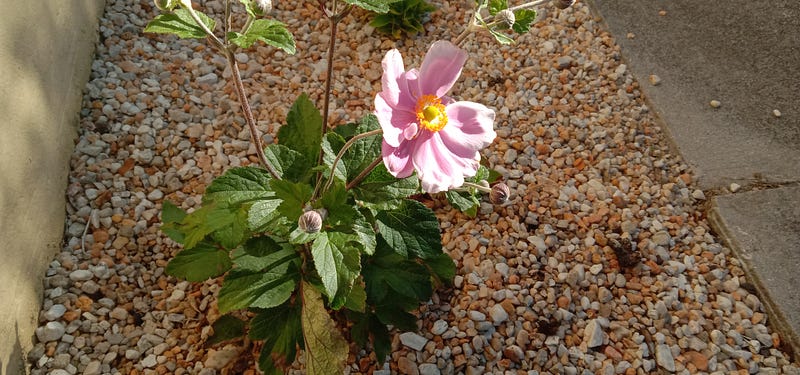
This inherited garden has turned out to be a challenge for me.
The original owners of the garden knew exactly what they were doing. There’s firm evidence of that, but over the years it has been ‘made over’ for convenience, with pebbles to block out the weeds, and thick black plastic to ensure it actually happens.
To remove all of these pebbles and the back plastic would take more courage and energy than I have right now, so I have been removing as I go in order to create a better environment for any plant I introduce.
In time I plan to get rid of all of it.
The soil beneath is miraculously dark and rich. The reason I suspect is the surrounding volcanic impact from long ago.
And then there’s the grass, a monoculture I simply can’t, in all conscience, keep.
The plan is to create a wildflower space instead.
In the last few months I have been trying to acquaint myself with the things we can’t easily see, the ecosystem, a world of complexity and admirable industry, that lies beneath us.
Something to know…
“Beneath our feet is an ecosystem so astonishing that it tests the limits of our imagination. It’s as diverse as a rainforest or a coral reef. We depend on it for 99% of our food, yet we scarcely know it. Soil.
“Under one square metre of undisturbed ground in the Earth’s mid-latitudes (which include the UK) there might live several hundred thousand small animals. Roughly 90% of the species to which they belong have yet to be named. One gram of this soil — less than a teaspoonful — contains around a kilometre of fungal filaments.”
When George Mombiot first closely-examined this world he was incredulous at what he saw.
“I immediately saw springtails — tiny animals similar to insects — in dozens of shapes and sizes. Round, crabby mites were everywhere: in some soils there are half a million in every square metre.”
That’s mind-boggling to say the least, and that was just for starters.
So many creatures came to light, ones he personally couldn’t put a name to.
Despite his degree in zoology, this was, as a world largely unknown to him.
What does that say about most of us?
Most of us pay so little attention to the soil that feeds us.
If even for a few minutes we stopped to consider this underground world, we would treat it with more care and attention than a cache of gold.
It’s vital to our health and wellness.
Beneath our soil is something absolutely wondrous, an astounding biological structure created intently by tiny creatures.
Imagine a mine put together by humans, created, not just for the acquisition of minerals, but cleverly designed and constructed by engineers and humans to subtract from the earth, yet at the same time, ensure all-round safety.
And there you have something of an idea of what is constantly and consistently being created by tiny microbes that make cements out of carbon (the glue of life) creating pores and passages through which water, oxygen and nutrients are able to pass.
The environment they create provides the platform for other animals to do their part, perhaps on a bigger scale.
The tiny clumps they build become the blocks the other animals in the soil use to construct bigger labyrinths.
These labyrinths wind and change directions, sticking mineral particles together as they do so, creating pores and passages in order to create perfect waterways through which oxygen and nutrients pass.
“The tiny clumps they build become the blocks the animals in the soil used to construct bigger labyrinths.”
A perfect ecosystem, wondrously and generously created.
Something to bear in mind
It’s the fact that soil is so beautifully and fractally put together that it is able to survive the horrors of environmental calamities.
The very complexity of, “Bacteria, fungi, plants and soil animals, working unconsciously together, (to) build an immeasurably intricate, endlessly ramifying architecture that…organises itself spontaneously into coherent worlds,” gives us immeasurable surety about the ability for the earth to recover in times of stress.
A fascinating world
So all of this is set up for our benefit, and theirs, so that we can survive, we can breathe freely and manage our resources, yet as George Mombiot warns, this can all come crashing down through the likes of irreverent, overused farming practices.
“When nitrogen fertilizer is applied faster than plants can use it, soil bacteria convert it to nitrate. Water-soluble nitrate is flushed out of soils in runoff, where it pollutes groundwater, streams, estuaries, and coastal oceans. In farming communities, it’s not uncommon for nitrate to render drinking wells unusable.
“It also reveals why soil can break down so quickly when it’s farmed. Under certain conditions, when farmers apply nitrogen fertiliser, the microbes respond by burning through the carbon: in other words, the cement that holds their catacombs together. The pores cave in. The passages collapse. The soil becomes sodden, airless and compacted.”
It’s a chilling scenario.
As for plants
In our better understanding of this we can dig further to understand the incredibly dependable relationship a plant has with the soil.
Consider soil bacteria, waiting for plants to send their signals to them, the through the chemicals any one plant releases.
“But none of the above captures the true wonder of soil. Let’s start with something that flips our understanding of how we survive. Plants release into the soil between 11% and 40% of all the sugars they make through photosynthesis. They don’t leak them accidentally. They deliberately pump them into the ground. Stranger still, before releasing them, they turn some of these sugars into compounds of tremendous complexity.”
Making such chemicals requires energy and grit, so why?
Why indeed…to be continued.
The garden that a thousand miracles, and some keen graft may restore, to some extent, if I can work on it every day.
Vidya Sury, Collecting Smiles, the beautiful, eternal optimist who knows that with the right mindset, anything is possible.
Linda Caroll has written this reassuring piece for all those concerned about ChatGPT….
Yancy Dennis poses: And how does your personal world view look to the public?


