
Three of the Most Spectactular Galaxies
When galaxies collide the results can be extraordinary
Since the dawn of our species we have looked up, and gazed with wonder upon the star strewn heavens. The night sky connects us to almost every other human who has ever lived, a shared experience of beauty unchanged and eternal like nothing else.
And yet the true magnificence of the cosmos has only recently become clear to us. We are fortunate to live in an era where our eyes on the universe are more powerful than ever before. Our telescopes peer across vast distances, look back billions of years, and unveil objects that no human has ever seen before.
Some of those objects are stunning. We’ve seen stars being born from clouds of dust, watched black holes rip their victims apart, and spotted the dying moments of supermassive giants. We see the dance of the galaxies, the mysterious effects of dark matter, and the grand overarching structure of superclusters, filaments and galactic walls.
In short, we see a lot of interesting things out there. In this article, and in others to come, I have selected a few of the most awesome things we know of. And though the pictures alone are incredible, I’ll give you the background of what you are seeing, how they came to be, and how astronomers capture them.
Today I’ve selected three of the strangest galaxies known to us. Though there are billions of galaxies out there, and we have catalogued millions of them, some of them stand out as particularly strange. They have drawn the attention of astronomers, who have gone to great efforts to examine them and explain what is going on, and why.
Centaurus A
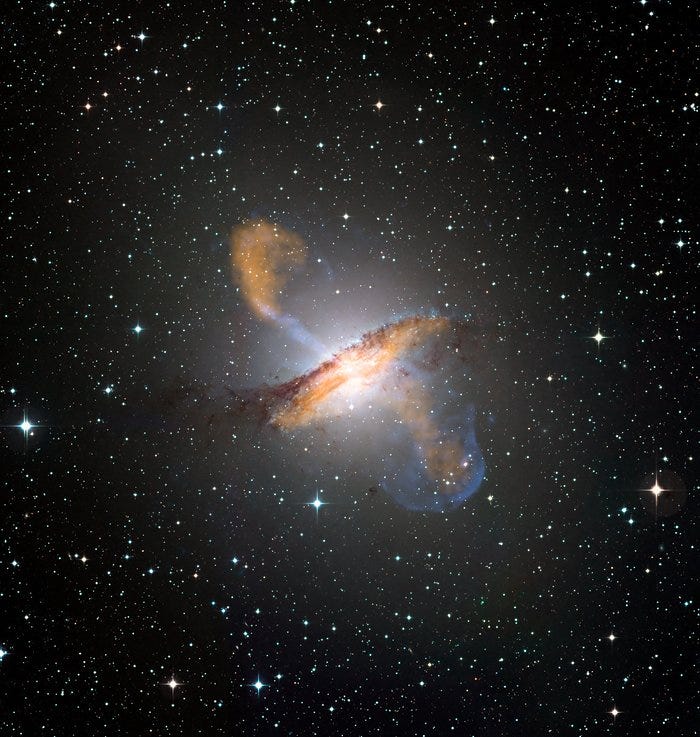
One of the closest and brightest galaxies in the night sky also stands out as one of the oddest. Not only is the shape of the galaxy rather strange — with a thick disk and jets of some kind shooting out — but it also gives out powerful radio waves.
These curious properties have driven astronomers to look closely at the galaxy. The jets, firing out at half the speed of light, originate in the galactic core. A supermassive black hole, a million or more times heavier than the Sun, is consuming vast amounts of dust and gas.
Not every atom that draws close to the black hole is doomed. Sometimes the powerful gravity of a black hole accelerates particles, instead of sucking them in, and hurls them into intergalactic space at enormous speed.
In the photograph you see the plumes in two different wavelengths. The orange part of the image was captured with an X-ray telescope, and represents intense radiation coming from the galaxy. The blue parts, by contrast, were taken with a submillimeter telescope, showing less energetic radiation. If the galaxy is instead imaged with radio telescopes, the jets reveal their full size, stretching over a million light years and covering a big chunk of the night sky.
Why is so much dust and gas falling in the black hole? The most likely explanation is a recent collision with another galaxy. Astronomers think the victim — a small galaxy rich in dust — was ripped apart, its dust spread throughout Centaurus A. The result was a sudden wave of star birth, creating the thick galactic disk and providing plenty of fuel for the black hole.
The Antennae Galaxies
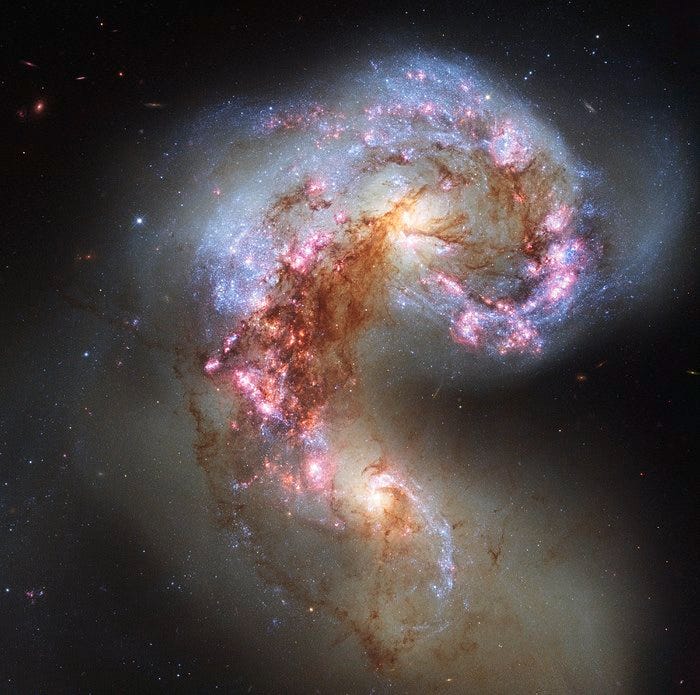
Galactic collisions are often long, drawn out processes. Pairs of colliding galaxies may often pass right through each other, spiralling ever closer until they eventually merge. The Antennae Galaxies are one such pair of galaxies caught in the middle of their long dance.
A billion years ago the two galaxies were separate spiral galaxies, slowly drawn together by the mutual attraction of gravity. Six hundred million years ago, as animals first appeared on Earth, the two galaxies collided, one passing through the heart of the other. They were travelling too fast to combine into one, and instead spun off into space, leaving a trail of stars between them.
Now once again the two galaxies are heading towards each other. In a few hundred million years time they will collide again. This time the collision will be more permanent. The cores of the two galaxies will merge into one, and gradually the structure will settle, forming a new giant galaxy.
The first collision triggered the birth of billions of new stars. Every blue spot in the image represents a cluster of newly formed stars. The pink areas are clouds of gas. The dark bands show dust, which often blocks our view.
The vast areas of blue show how powerful galactic collisions are in creating new stars. Though stars rarely collide in galactic encounters, gravitational disturbances and shockwaves spread throughout the galaxies. In their wake they leave chaos, collapsing clouds of gas and sparking vast nuclear explosions. This is a process of creative destruction, for in the end new stars and solar systems will emerge from the dust.
The Rings
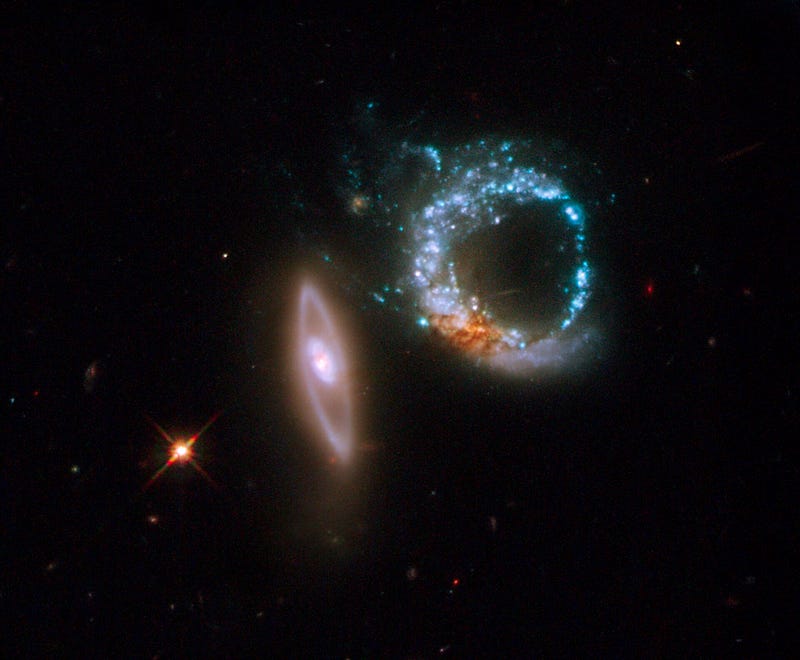
Not all galaxies take the familiar spiral shapes. Some, like the pair spotted here, form rings. Like the Antenna Galaxies, these two galaxies recently collided. But this time the outcome was completely different, drastically altering the colliding galaxies, but leaving no visible trail of stars between them.
Before the collision the galaxy on the right was probably a spiral galaxy, much like our own Milky Way. When the second galaxy impacted, shock waves would have radiated out from the collision. As in other galaxies, these shock waves left behind a burst of star formation.
In this galaxy the stars that formed were massive. Big stars die young, exploding in dramatic supernova and leaving behind neutron stars and black holes. Astronomers have detected at least nine massive black holes in the blue ring of the galaxy.
The original core of the spiral galaxy can still be seen towards the bottom of the blue ring. This slightly red region contains the bulk of the galaxy, probably accounting for half its mass. The ring will fade away as the remaining supermassive stars die off over the next few million years, leaving the surviving core and a halo of black holes and neutron stars.
What explains the different result of these two galactic collisions? It probably comes down to the angle of the collision, and our own view of the galaxies. While the Antennae galaxies appear face on to us, giving us a clear view of the collision, the two ring galaxies are angled away from us.
In the collision the two galaxies seem to have been moving perpendicular to one another. As the smaller galaxy passed through the larger one, shockwaves would have rippled out from the point of impact, much like waves spreading across a pond after a stone is thrown in. Such a disturbance would have caused an expanding burst of star formation — creating the ring structure.
To get notifications of my future articles, please follow me on Medium!