
When Fandom Was a Nerdy Subculture: An Ode to Outpost Daria
Today, people think of fandoms as groups of “stans” that can be milked by corporations or force change with their voices and wallets. But online fandom was once the realm of a dedicated few.
With my ADHD medication evaluation coming up, I had to fill out some paperwork that would expedite the process.
I laugh-snorted at one of the questions about memory. I went through it with a friend who also has ADHD, and I sardonically noted, “Please. I can remember entire plots of fanfiction I read on Outpost Daria and Lawndale After Dark over 20 years ago, but I can’t remember where the hell I left my keys.”
Then in true ADHD fashion, I found myself thinking about Outpost Daria and how I stumbled upon it in the first place around 2001 or so.
This essay actually isn’t about the show, though I could totally write a separate Fanfare piece about Daria and the wildly different media landscape of the 2020s. It’s amusingly ironic because Daria was one of those shows I wanted to watch in depth so badly, but my household didn’t have cable. I made do with a few taped episodes from friends who had MTV and constantly watched the two movie specials more readily available for rental, Is It Fall Yet? and Is It College Yet?
So don’t worry if you’ve never watched Daria, this is really about the fans and how the concept of fandom and superfans has radically changed since Outpost Daria’s heyday. The perception of fandoms is so much different, and it ties in with how Internet usage and culture evolved since Daria was in its prime.
I started writing this from memory, then stumbled upon truly wild things after doing a little research that made me even more excited to discuss it!
It also made me ponder, and ask you the reader, about fandom, Internet culture as a whole, and the preservation of sites and content from the Web 1.0 and 2.0 eras.
Outpost Daria was the peak of Web 1.0-era fan sites.
Today, there’s infrastructure for fandoms like Fandom Wikia. Social media accounts and groups have largely replaced fan-made sites, although the latter still exists. But at the turn of the millennium, fan sites could be ragtag collections of images, fan art, and thoughts about why they felt the way they did about that show, movie, or band. It was a time when the Internet was an escape, and professional-looking websites weren’t expected of the everyman.
Geocities, Angelfire, and Tripod often hosted these sites and view counters were lovingly placed at the bottom of the homepage. If the site was particularly pretty, interesting, or funny, it might be part of a webring for that fandom.
Outpost Daria was different. It had that genuine Web 1.0 feel, but it was more polished than the average fan site and clearly had a large community and enviable traffic.
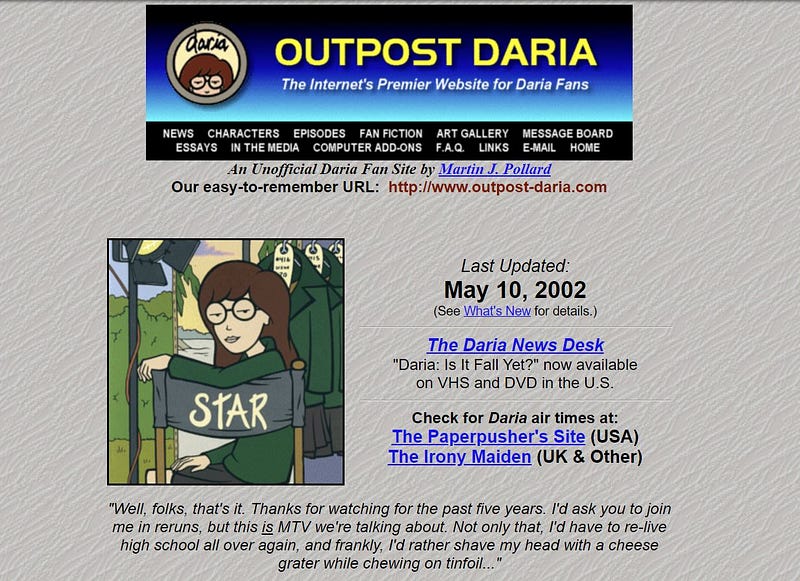
There was fan fiction, fan art, and behind the scenes content. You could see photos of the cast when image searches weren’t common! Reviews, production notes, and soundtrack lists exceeding IMDb quality were there to browse to your heart’s content.
The term supersite was used in the Web 1.0 era to describe a fan site like it, before the term “fandom” gained traction then started being used more ubiquitously. Before wikis, TV Tropes, and forum-lite social media like Reddit and Tumblr dedicated to fandoms.
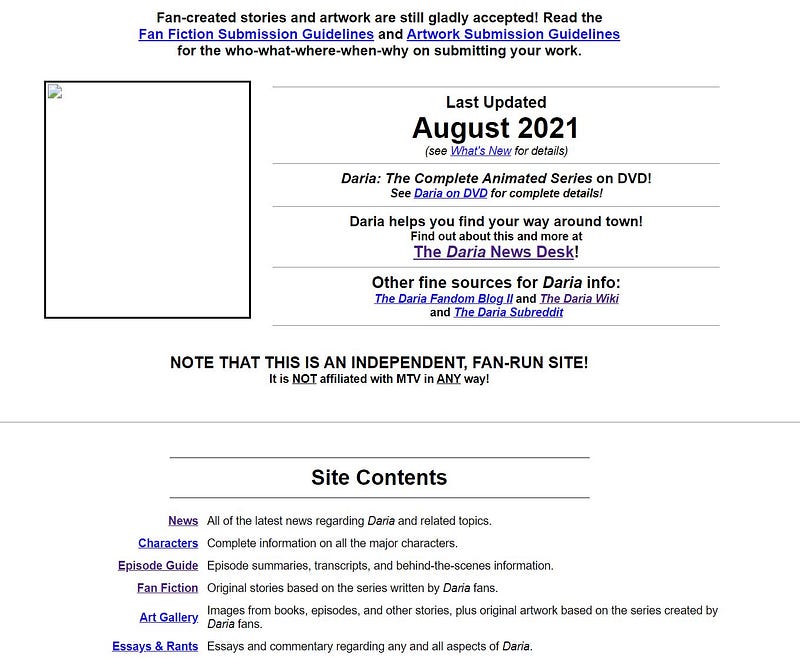
Daria has a Fandom Wikia page like most media these days that gathered a following, but there’s even a separate wiki for Daria fan works plus dariawiki.org. Interestingly, another fan picked up the reigns from the original Outpost Daria webmaster Martin J. Pollard after he pulled the site off life support in 2013, with Outpost Daria Reborn in 2014 and also including material from Planet Daria and alt.lawndale.com (both of which have long been defunct). At the time of writing, the last update was in 2021.
It truly feels like going back to 2002 as my 2023 self, and looking back at what a completely different world it was: Outpost Daria Reborn still has that original Web 1.0 feel with elements copied directly from the old site like those pink and yellow tables. Some of the content that was up there back then has also been rescued, such as the episode guides complete with song lists.
We use the term “lurk” nowadays to describe my behavior in visiting the site: I wanted to see so much more of a show I could barely access. I religiously watched Is It Fall Yet? and Is It College Yet? as the titles felt weirdly symbolic of my own life: I was a misfit who was constantly told I did everything wrong, that I was smart but using it the wrong way (oh that undiagnosed ADHD), and I just wanted college to hurry up and get there so I’d be able to make an escape. I hated seeing my youth as something I wanted to get over with, but so goes life in a country where minors have virtually no rights.
Nonetheless, I fell in love with the universe of Lawndale and its well-developed characters. There was this rich lore to it that unsurprisingly drew a large fandom of Millennials who felt the same. We badly wanted to participate in this culture created by the likes of MTV, yet we didn’t. Daria was a product of its time, when animated series for teens were somewhat uncharted territory: The Simpsons challenged the notion that cartoons were strictly for kids, and Beavis and Butt-Head relied on the duo’s music video commentary (remember when that’s what MTV mostly played?!) just as much as its sketches about Highland and adventures at Maxi-Mart.
The early 90s had live-action shows full of teenagers with the intended audience being young kids, like Saved By the Bell. Shows like 90210 and Dawson’s Creek were geared to teens in the early and late 90s respectively, and were often edgier and more mature than the saccharinely wholesome adventures of the Bayside gang. Daria didn’t get as unabashed as live-action and animated shows of the 2020s would, but it was certainly a smart and mature show with characters you came to care about. It delved into serious topics without feeling like some cringey after-school special that insulted young peoples’ intelligence.
It would be almost two more decades before my ADHD was diagnosed. But in a world where I was constantly told that I had to tone down my info-dumping about things, Outpost Daria was the first place I was exposed to such incredible info-dumping and where I saw it would be appreciated.
The care and detail that went into the essays definitely seems like a precursor to the countless media crit video essays on YouTube these days, and the types of retrospectives and analyses I’d go on to contribute here on Fanfare. Whether I had them pent up for years like my love of Wayne’s World, or random realizations like the Saturday Night Fever retrospective that actually attracted the attention of the director’s friend.
Others seem like they’d be more at home on Twitter or Reddit, such as this archived essay on why Daria-Trent shipper fics bother the writer. I don’t recall reading this one in Outpost Daria’s heyday, but as someone with a stronger degree of media literacy today, I enjoyed it. Aside from that iconic Comic Sans on an ad-free page that screams it was posted in 1999, it’s a rather timeless observation on how fanfic writers project their own desires onto characters rather than having them act in a way that makes sense for them. One counter-example is given where the author further developed Trent’s character and motivations.
But that’s the point of fanfiction: you’re playing in a sandbox someone else designed. Some people won’t like your interpretation or projection of the characters. It’s supposed to fun and provide an outlet without having to create a new universe from scratch with undeveloped characters. It can help you grow as a creator, or just be this fun thing you do that’s not related to slaving for the capitalist machine all day.
Fanfiction predates the Internet, but it’s also how people can build audiences nowadays: the Fifty Shades of Grey franchise that got several books and films all began as horny Twilight fanfiction. Harry Potter fic “My Immortal” became a notorious nugget of Internet culture that people still talk about over a decade later.
Nevertheless, the passion of the fic writers and critics alike was so evident throughout the site. Revisiting the archived version of the original took me back to how beautifully uncluttered the Web 1.0 era was: maybe this is just the ADHD talking, but there were no ads, no comment sections, no 60 other tabs open, no toolbars loaded with different things, and it prevented perpetual overstimulation.
I could just focus on those Daria-Trent shippers and how many fic writers kept Jake in character with “Burn in hell, old man! BURN IN HELL!”
The Passion of the DVDaria Campaign
The fandom’s passion wasn’t just in discussing and engaging with the show and its characters, and creating fan works. It was also in ensuring they could keep engaging with Daria long after the show went off the air.
I saw this image and suddenly got flashbacks of checking every few months for updates on whether DVD release plans would happen once the old episodes started airing on Noggin.
The DVDaria crusade went on for what seemed like an incredibly long time. It’s not surprising when you look back on how long it took movies and TV shows to get a box release, but it’s interesting because there’s a duality to how this is done today.
Beloved shows constantly get pulled by the streaming giants. In the content-ification of every damn thing, studios and creators fight over who has which rights. With more types of derivative works also being turned into streaming series and films today, such as memes, fan fiction, and games, there’s inevitably going to be teething issues in entertainment law and distribution.
But for shows where the ownership is clear, whether it was suddenly cut or in the case of Daria where it’s long been discontinued without a reboot in sight, fan outcry is more instantaneous today. Social media blitzes have killed and revived shows and movies, and made and broken entire careers.
The persistence of the Daria fandom who frequented Outpost Daria was admirable. The correspondence was private, curated to updates the webmaster posted (it wouldn’t be called a blog until a couple years later). But it was easy to see this for what it was: a grassroots fan effort against a faceless corporation that couldn’t see how it was shooting itself in the foot by not putting this notable series on DVD.
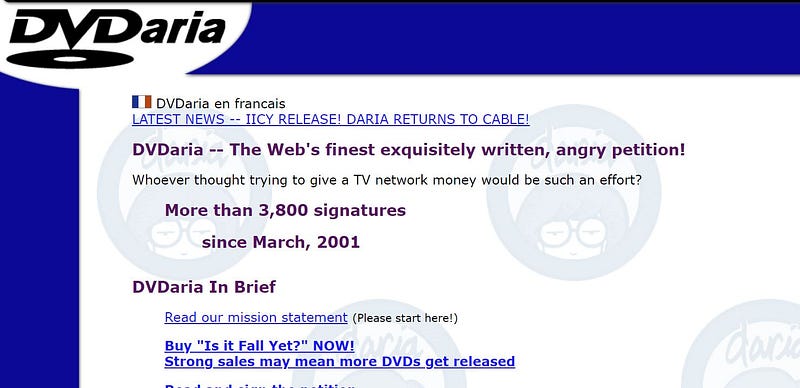
Common sense would dictate that the average person on the street isn’t going to reach the top executives of some media giant like Viacom through a series of politely-worded tweets and emails about how they want to access a beloved old show again. You’ll get a canned response from some underpaid comms department grunt who handles emails.
But Twitter has been an interesting social experiment, proving that wealthy and powerful people can be chronically online like us plebes. Some production SVP who makes $3 million a year can drop the axe on your favorite show, yet not have the same influence in the world around them as HornyMarxist420 going viral on Twitter.
Daria is also a special case because I don’t doubt MTV/Viacom wanted to capitalize on such a fervent fanbase throwing their wallets at them. But not only was DVD production and distribution of a five-season show a costly challenge as it was, Daria was a MTV show from the era when music videos were their wheelhouse. Easily hundreds of songs from a plethora of artists spanning all genres of the 90s were prominently featured.
Getting clearances for these songs to be placed in a physical product entails a different process than obtaining permission and paying royalties for TV broadcasts. By the time Daria went off the air and the DVDaria campaign waged, DVD and Blu-Ray had phased out VHS tapes as the primary mode of home entertainment but you torrented rather than streamed if you wanted to watch movies on your computer.
The show was eventually put on DVD in 2010, but with filler music from the in-house composers in places where they couldn’t get clearance for the songs originally used. There was even a change.org petition to get the clearances for said music!
Regardless of the fandom’s impact on Viacom’s decision, I was impressed at their dedication.
Fandoms Today: Modern Internet Overwhelm or Overt Corporate Flouting?
I found myself asking why I found Outpost Daria so compelling compared to modern fandom culture.
Some of it just harkens back to the “super secret cool but nerdy thing” that the Internet itself was back then, like the era in which Daria takes place. But it’s also because early Internet fandoms were purely labors of love before the Internet got walled off. I suppose we still have labors of love today: but it feels so much harder when the cost of living has spiraled out of control in comparison to 2002, and social media and headline news now grapple for your attention as we’re perpetually logged on.
Web 1.0 was an incredible Wild West I’m glad I got to witness before all the middlemen tried to turn it into a series of walled off gardens. Looking through the Wayback Machine took me back to exactly how it was when I’d stay up all night after getting home from Thompkins Square punk shows or hanging in the Village all day, reading the latest fic on Outpost Daria where everyone in the Fashion Club was gay (or exploring my overt sexuality that was even too much for the punk scene with the Daria-Trent erotic thrillers on Lawndale After Dark.)
Now the Silicon Valley Bank blowup revealed that tech bros are actually shocked people don’t like them because of how they colonized the Internet.
Outpost Daria was my first real exposure to fandom, Newgrounds would probably be my next one right after. Today, FanFiction.net is still going strong and AO3 has become the eminent way to archive decades of fan works.
But without the Wayback Machine and other means of archiving actual fan sites, supersites, and even original “illustrated magazines” predating the Internet, how will people see how the idea and execution of fan works have evolved?
On the flipside, it feels like corporate pandering when I see fandoms discussed as perpetual marketing opportunities rather than the engagement and passion I saw in Outpost Daria. I’m in the media industry, I get it! Large companies that have loremasters on staff and positions like community managers, Chief TikTok Officers (that’s a real job title, I shit you not), and social content assimilators do so because they’re skilled professionals who are emotionally invested in what they’re working with. Small creators are beyond jazzed when people are making fan art and writing fan fics about what they’ve created. In a world where blockbuster movies rely on IP instead of actors to draw crowds but indie games that get really weird unexpectedly find their flock, it does make it easier to know you have fandom infrastructure in place like Fandom Wikia and you put your Word of God into TV Tropes or an interview that will find its way there.
The late 90s and early 2000s definitely had their share of defining people by what they consume. But it wasn’t as ubiquitous as it would become by the 2010s, where engaging with brands is now part of life. But it also feels like faceless corporations have co-opted fandoms in a sense, and the endless barrage of comments and pageviews preside over just info-dumping your thoughts on different character dynamics and how the show about everyone’s favorite misery chick was blamed for Columbine when the media really just did the victims and future generations a disservice by ignoring the killers’ Nazi sympathies.


