
When Faith and Science Collide
Why scientific discoveries such as evolution, the human genome, and massive black holes in our milky way are not at odds with a faith-based worldview.
Did you know that Galileo Galilei, best known as “The Father of Modern Science” was arrested by the Catholic Church during the final years of his life for daring to make known his discovery that our planet, is in fact not, the center of our solar system? It was believed that this knowledge was an attack against the Church, dominating Catholic faith and the inerrancy of the Bible (or rather, the commonly held interpretations of scripture at the time). This is just one of many examples throughout history in which faith and science were seemingly at odds.
Francis Sellers Collins is the physician-geneticist responsible for discovering the genes associated with a number of diseases and was the leader of the Human Genome Project (the project that led to the complete mapping of the human DNA code). For the past twelve years, Collins has served as Director of the National Institute of Health. It should come as no surprise this amazing scientist grew up within the walls of a well-educated, pro-science household with forward-thinking parents. His parents saw no need for faith with science — assuredly, Collins self-identified as an atheist for many decades of his life. As a doctor, he was confronted by his lack of faith when treating end-of-life patients. Upon becoming a geneticist, he began to see intricate patterns, precision, and beauty that pointed towards a higher meaning. Collins went on to write about his story in a bestselling book — The Language of God: A Scientist Presents Evidence for Belief — in which he had the following to say about the relationship between science and faith;
“Will we turn our backs on science because it is perceived as a threat to God, abandoning all the promise of advancing our understanding of nature and applying that to the alleviation of suffering and the betterment of humankind? Alternatively, will we turn our backs on faith, concluding that science has rendered the spiritual life no longer necessary, and that traditional religious symbols can now be replaced by engravings of the double helix on our alters?
Both of these choices are profoundly dangerous. Both deny truth. Both will diminish the nobility of humankind. Both will be devastating to our future. And both are unnecessary. The God of the Bible is also the God of the genome. He can be worshipped in the cathedral or in the laboratory. His creation is majestic, awesome, intricate and beautiful — and it cannot be at war with itself. Only we imperfect humans can start such battles. And only we can end them.”
Evolution is yet another scientific topic that has been made needlessly controversial among those in the faith communities. Darwin’s Theory of Evolution remains our most evidence-based explanation for the origin of humans…and the rest of life on Earth! In fact, many of our subsequent biological discoveries are based on the assumption that this “theory” is true (in the world of science a theory is as good as fact — after all, we take the theory of gravitation for granted every day). Francis Collins developed an entire website and podcast series, The Biologos Foundation, devoted to the exploration of the potentially harmonious relationship between scientific concepts such as evolution and a thorough understanding of the Bible as God’s true word.
It may come as a surprise to many modern-day Christians that famous people of faith such as evangelist Billy Graham Sr., author C.S. Lewis and even Pope Benedict XVI (just to name a few) were upholders of evolution theory!
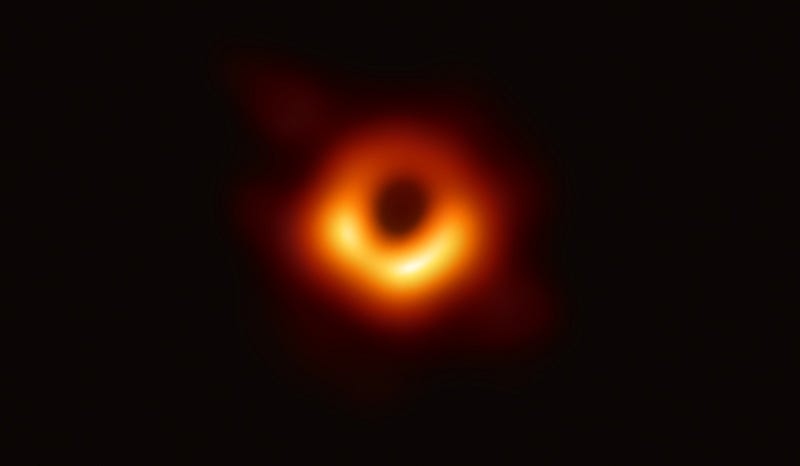
Heino Falcke is a Professor of Astroparticle Physics and Radio Astronomy responsible for pioneering imaging of the first black hole (the picture is included at the top of the article). The International Astronomical Union named asteroid 12654 (Heinofalcke) after him. New discoveries will always challenge and redefine our old frameworks of thought, but Falcke believes that it is a humbling reminder that our finite knowledge of the infinite God is always partial. Heino Falcke and his team’s image of the black hole at the center of galaxy M87 reminds us of a message from Paul — that we now see through a glass, darkly; then, face to face.
It is my hope that this article encourages both people of and without faith — to reach the realization that I have. The realization that in life so complex, it stands to reason that any Creator of that life would be all-the-more-so. Let us be careful not to place God in a box made of our own limited design. Let us not be quick to declare that faith and science have no part in one another. After all, in what was considered to be the greatest commandment of all time — Jesus called his followers to “Love the Lord your God with all your heart and with all your soul and with all your mind.’