When Everything Come at the Same Time, How Pilot Cope from being Overwhelmed
That very normal day when my scheduled flight from Medan, the metropolitan city of North Sumatra, to Nias Island, around 180 miles southwest bound. The flight went smoothly without any turbulence or significant cumulonimbus (CB) clouds, and everything went really well. Suddenly, Nias’ Air Traffic Controller (ATC) informed us that a huge CB cloud was present over the field, and rain was expected to begin soon. This was quite bad news for us pilots, as freshly formed clouds could produce numerous hazards, such as microbursts and poor visibility, especially when they exist above the airport. We waited for about 30 minutes in a holding pattern (when you feel the aircraft making a racetrack pattern, you know for sure the pilot is in a holding procedure), and ATC informed us that the weather had improved, so we conducted our approach.

Have you ever been on a flight when you are about to land, and you see the ground getting closer, but suddenly the engines spool up, and you’re back in the air again? That’s called a “Go-Around Maneuver.” This maneuver requires us to transition the aircraft from a landing configuration to a climbing configuration, with a significant workload that occurs in almost the same amount of time.
What did the pilot do?
- They increased the engine power by moving the power lever forward to a dedicated position (mine was at the “ramp” position).
- They pitched up the aircraft.
- Set the flaps.
- Retracted the landing gear.
- Reconfigured the flight management system.
- Reconfigured the navigation aids.
- Conducted the proper checklist.
- Coordinated with the Air Traffic Controller.
… and the list goes on.
Each of these steps has its own prerequisites to be conducted such as when the speed reaches a certain number, when you pass a certain altitude, or when a specific step has been completed. I won’t explain it here, as it would turned into a standard operating procedure (SOP).
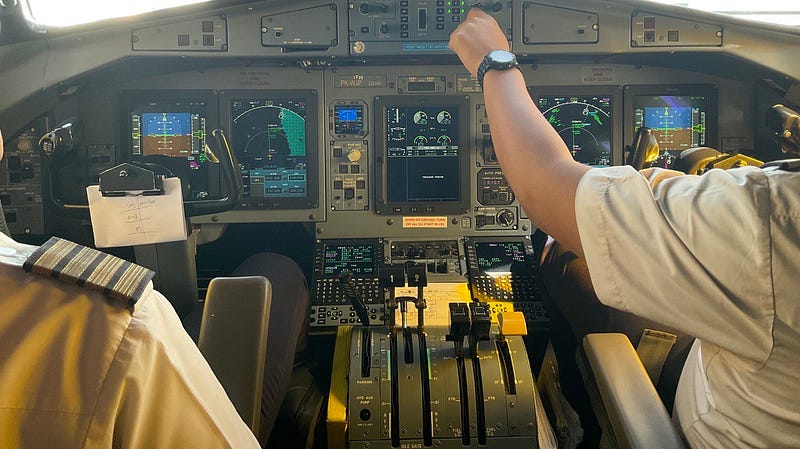
But thankfully, this maneuver is considered a standard procedure, and pilots are required to be properly trained every six months. With sudden high workload in a very short period of time, how do pilots manage to perform all the procedures like a well-oiled machine? The secret is:
PRIORITIZATION
In aviation, when unexpected things happen (which is highly probable), as a pilot, we’ve been taught a term called “ANCM”: “Aviate, Navigate, Communicate, Manage the System.” First, fly the aircraft, then control the aircraft to the desired heading (Navigate), and only after achieving these, contact the Air Traffic Controller to inform them of what’s going on and what your intentions are before running a checklist for system failures.
This term is highly useful not only in aviation but also in your work life. At some point in your life, you may find yourself in a position where your boss suddenly requires you to complete a task, while another deadline is approaching, a complaint call from a customer comes in, all within a short span of time. You may feel paralyzed, not knowing which task to tackle first.
Set your priorities according to your or your company’s vision (or if this isn’t stated in the manual, ask your superiors). For us pilots, safety comes first, then regularity, passenger comfort, and economical in that order.
Hopefully, with proper prioritization, you’ll get the best outcomes from all the effort poured into the project.
Hello, I’m Archi. If you like this type of article, please leave me some feedback so I can improve further and engage with my fellow Medium members.


