
When everyone’s “a brand” no one is authentic
The avatars we create often form a disconnect from reality
The world is as chaotic as ever. Energy and gas prices are soaring, the economy is doing summersaults, and, oh yeah, the Russian invasion of Ukraine hasn’t exactly died down. Truly, it is a wondrous time to be alive.
With trust in the existing structures crumbling and cryptocurrencies and, until recently, NFTs, booming, the once inherent acceptance of ‘the norm’ appears to be a distant memory. But as we move toward a new era of the internet, fancifully dubbed ‘Web 3.0,’ we see how crucial it is to have a social media presence. We also see the importance of being our own public relations manager.
Old tweets can and often do come back to haunt you. The internet never forgets.
Almost everyone online is fake.
With the socially-accepted mindset of “fake it ’til you make it” creating a half-million experts on everything from financial planning to entrepreneurship and epidemiology every five minutes, it can be difficult to sift through the muck and find truth.
This current era has been dubbed by many as “post-truth,” and while that may be more with respect to the dissemination of news and information, it’s not limited solely to reporting or corporations. Almost everyone is fake online.
This isn’t just a handful of people trying to project an air of expertise on a given subject matter, however. It goes far deeper than that. This is about amplifying narratives about strongly held convictions, many formed with a reflexive impulse that refuses to yield even in the face of newly presented evidence.
We readily adopt a perception of a thing or event in an instant and then proceed to parrot that viewpoint far and wide across the social landscape. Many who engage in this type of behavior do so from behind an alias, creating an even greater degree of separation and emboldening themselves to be as vile and audacious as they desire. But here’s the thing… This isn’t a new phenomenon. This mentality predates the internet.
Satoshi Kon’s Perfect Blue explored the dangers of not just celebrity culture but the social avatars people create and project to the world at large. While the internet may have been in its infancy in 1997, the year the film was released, Kon saw how it could be used as a tool to deepen existing societal ills.
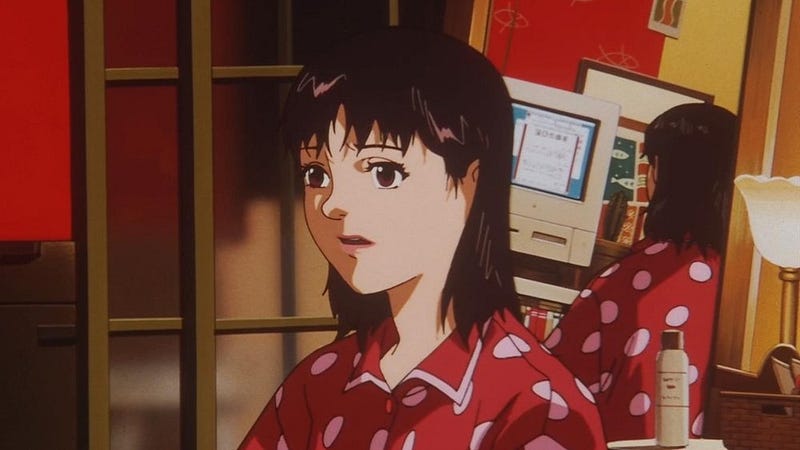
In Perfect Blue, a middling pop star retires from music to pursue a career as an actor. Her fans feel jaded by the decision, resulting in harassment and online backlash against her. Some are so taken with their idea of her that they struggle to differentiate that image from the one trying to shed the “pop idol” veneer by means that have become cliché today.
In Perfect Blue’s case, the obsession results in a series of psychological breaks for not just the protagonist but two of those fanatical fans, blurring fiction and reality in a series of bloody murders.
Modern online interaction isn’t… entirely like that, though you could say the intent of utter destruction remains.
Everyone feels the need to have and share a strong opinion on the latest thing, whatever said thing may actually be. That means either standing proudly amid an echo chamber or drawing one’s self into conflict in which insincere framing, straw-manning, or other psychological exploits can be weaponized in the name of social acceptance and clout.
We don’t listen to hear or consider but rather respond with predetermined, pre-packaged talking points, and we feel compelled to sound off on everything.
It seems there are two extremes: either everything is an unchecked stream of unfiltered consciousness, or everything must first run through the filter of one’s brand before any action can be taken or considered.
As much as I would love to outline some kind of solution to this endemic problem, I honestly have no idea where to begin. The anonymity and tribalism of the internet embolden people to act on toxic impulses. That won’t change. What we can change, however, is how readily we engage with these spaces.
As Bo Burnham puts it, the first step might just be to shut (and I’m paraphrasing here) the hell up instead of weighing in needlessly.
Not every article or news story of the day requires your input and thoughts — especially if you aren’t well-read on the matter going in. You aren’t adding anything productive to the discourse. Understand it’s okay to sit on the side-lines and listen, or perhaps to pay it no mind in the first place.
“You always own the option of having no opinion. There is never any need to get worked up or to trouble your soul about things you can’t control. These things are not asking to be judged by you. Leave them alone.” — Marcus Aurelius, Meditations
If you can do that then maybe you could take it a step further and disengage from social media for a spell. It’s easy to forget that’s not the real world when you spend all of your time there day in and day out. Just… take a break.
Beyond that, consider your own perspective and the implicit biases that make up your mind. Is the reasoning sound? Is it sincere and genuine or is it just some nonsensical vehement defense of a particular ideology, corporation, individual, intellectual property, etc, etc, or otherwise?
If it’s the latter, have you tried not being an unholy ass? You should probably give that a try first and foremost.
One of the things I’ve reflected on most in the past year is my relationship with social media and the things I give my mental energies to. Facebook, Twitter, Instagram, and TikTok are designed to keep you actively scrolling like an addict. If you think your feed is “clean,” congrats, you have yourself an echo chamber. If it’s not, be prepared to see plenty of fake news stories (which are also undoubtedly hiding in your “clean feed,”) and other toxic, heinous shit that’ll ruin your day.
You can’t control these platforms but you can control your willingness to engage with them. The eight months I spent away from social media was essential to my improved mental health over the past year. If I could, I’d stay away entirely, but part of being a writer and running an online business requires at least some degree of social presence. I suppose that makes me a bit of a hypocrite, but no matter.
Just drop the tribal act and engage with others from a place of good faith and decency. You can still choose to carry yourself with patience, kindness, and empathy for others, and you can always strive to be better and improve your understanding of the world around you.
“It is impossible for a man to learn what he thinks he already knows.” — Epictetus
If we can set aside our biases and better examine our own behaviors, we can be less superficial and more authentic. The majority may not follow the lead but what matters is being true to the highest virtues — those of courage, justice, wisdom, and temperance. How much more can you reasonably ask of yourself?


