
When Did Humans Start Using Money?
Tracing the origins of money
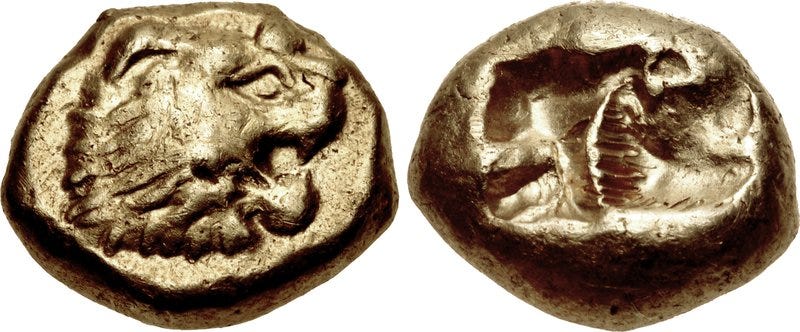

Money is like a sixth sense — and you can’t make use of the other five without it. W. Somerset Maugham
Money. We can’t live without it, yet some can’t get enough of it. Somerset Maugham, one of the highest-paid novelists of the 1930s, has a point. We can’t imagine living a normal life without money.
We can trace the earliest humans to 300,000 years ago, in the Jebel Irhoud archaeological site of Morocco. But the origins of money in the timeframe of human evolution are recent. Sometime during our evolution, we became reliant on money, and we can’t do without it.
So, when did humans first use money?
That depends on how you define money.
Are we talking about a system of exchange, where a tender stating “I owe you” was used? Or are we referring to money as a medium of commerce in the traditional sense?
Perhaps when you imagine the earliest use of money, you may think about the first coins before the rise of paper currency.
To prevent any confusion, we will not be discussing the speculative nature of prehistoric money, when barter was used as a medium of exchange for products. Several objects have been proposed as evidence for money with no consensus among scientists.
Early agricultural communities also used gifts as means of exchange, to settle debt, and to buy favors, which we won’t get into.
Our focus will be on the history of money, as we know it today, till the minting of coins.
The emergence of the monetary system

A monetary system that used credit, debit, loans, and accounting predates the history of coins.
Before we get into the first evidence of a complex accounting system, it’s vital to understand why the ancient world needed money.
Humans had a food surplus when they transitioned from a nomadic hunter-gatherer lifestyle to an agricultural one. Domestication of cattle increased the abundance even further. Humans no longer had to sit and worry about food security.
This paved the way for the evolution of pottery. Toolmakers expanded their knowledge. New metals were discovered. Humans started mining metals.
Agrarian communities gave way to urban societies. Grain, milk, and meat were kept in a temple’s storage room to ensure there was no shortage.
The farmers had to be given a receipt, usually in the form of a token, for the goods they supplied. The token would allow them to take other products from the temple.
Thus, money was born.
But why money? Why not simply give what the farmer wanted by weighing the commodity? The answer had to do with durability.
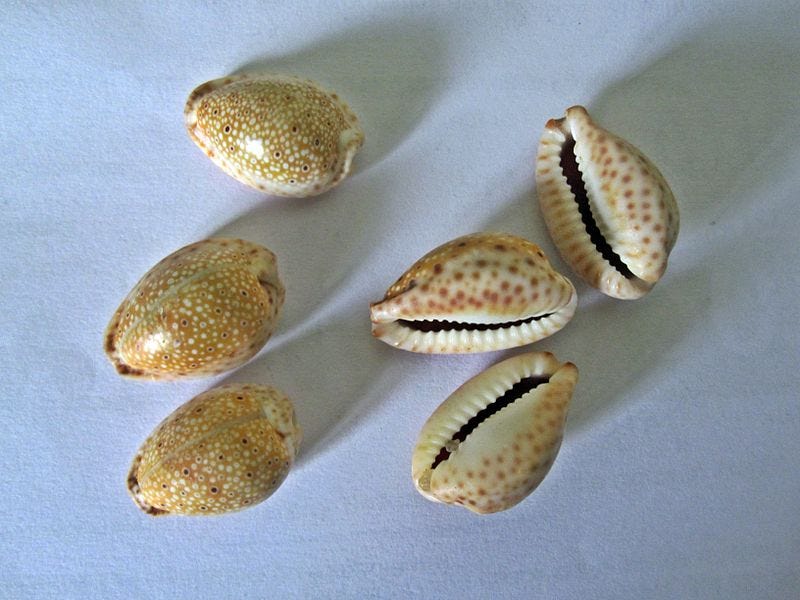
Metals and cowrie shells lasted for a long time and did not damage easily. Copper and bronze were in high demand as cultures transitioned away from stone-based tools.
Egyptians used gold as money as early as the third millennium BC. We should be cautious when using the term “gold” regarding ancient Egypt because the metal was unrefined. Most of the gold discovered between 5000 and 2000 BC was electrum, a gold-silver alloy.
The unit of currency in ancient Egypt was called the deben. A deben weighed 91 g of gold.
However, it is debatable if the deben was merely a weight measure or a type of proto money.
Given the sophistication of the Egyptian grain storage system and the fact that it was one of the few civilizations where employees were paid, it’s difficult to assume Egyptians didn’t have a currency system.
The Mesopotamian shekel was a more well-defined kind of coinage that appeared around the end of the third millennium BC. The first shekel was a clay token handed to a farmer in payment for his crops or goods.
As barley was the most common commodity in Mesopotamia, the shekel would be in the weight of barley. The scribes extensively recorded the accounts in clay tablets.
We can consider the usage of a shekel in ancient Mesopotamia as the first known evidence of the use of a monetary system.
Mesopotamian temples, which controlled most of the trade, soon started using copper and then silver to exchange goods. Fixed exchange rates based on the weight of barley and silver became the standard currency.
The law codes of Ur-Nammu ( c. 2050 BC), the oldest law code in history, Lipin-Ishtar (c. 1870 BC), and Hammurabi ( c. 1870 BC) show Mesopotamia, had a proper monetary system.
In these legal texts, we may find the earliest documented interest rates set by kings. They also specify fines, penalties for failing to pay debts, and compensation for damages.
The oldest accounting systems originate in ancient Mesopotamia and Egypt. A bonus invention, thanks to accounting, was writing.
Money isn’t all bad, it helped us discover writing! The earliest writers were accountants. Because, you know, how long could individuals keep track of the number of products coming in and going out using their memory?
Standardization of currency based on weights and the emergence of an accounting system soon paved the way for the minting of coins.
Earliest coins and the birth of minting
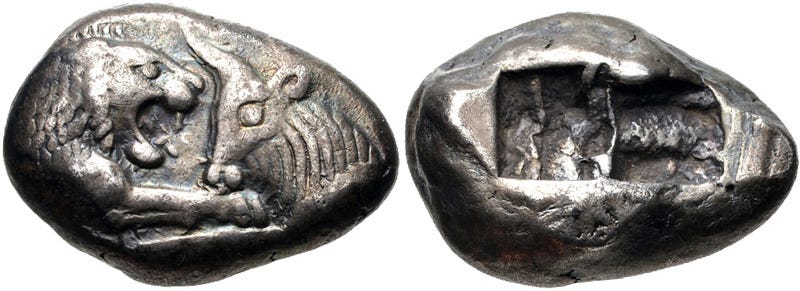

The first known coins appeared in the 7th century BC, during the early Iron age. The coins appeared independently in Anatolia, China, and India.
In India, they punched metal discs in the center to make coins.
In China, they made coins using bronze castings with a hole in the center. The coins resembled their Indian counterparts but were strung together.
We can trace modern coinage back to the Lydian kingdom in modern-day Turkey. Lydian coins were made of bronze, silver, or gold, and both sides were stamped, just like modern ones.
The first known Lydian coin with a roaring lion’s head dates back to circa 600 BC. Historians believe the Lydians paid their warriors with coinage. King Alyattes was the ruler of Lydia from 610 BCE to 560 BCE. During his reign, we find the first modern-minted coin.
Coins were the default legal tender for exchange in ancient Greece, Rome, Persia, India, and the Islamic world. They’re still around, although not used as frequently as they were in ancient times.
Kingdoms could issue more coins and increase the size of their armies thanks to the discovery or seizure of silver and gold during battles. One famous example is Athens’ domination. The Greek kingdom began paying its troops in silver. Athens could build a huge naval fleet thanks to a major silver discovery near Attica in Greece. This led to the rise of Athenian hegemony over the Aegean and the Mediterranean.
Coins would continue to dominate the ancient world and the Middle Ages until paper money, the next big disruptor in the world of finance. The Song dynasty of China invented paper money, but the Mongol empire popularized it as a legal tender from Siberia in the East to Poland in the West.
Despite the best efforts of the Mongols, large parts of their empire, especially the Islamic world, were resistant to paper money, and the move was a colossal failure.
Coins remained the de facto currency of the Middle Ages. We would have to wait till the rise of centralized banking systems for paper money to gain worldwide acceptance.
From the earliest barter systems to bitcoin, the history of money is full of innovations and violence. Humans have resisted change and accepted novel forms of currency with time.
As digital finance grows, cashiers still dish out and change the way one would have 2500 years ago.
Are we on the brink of another major financial revolution? Can we get rid of coins and paper money?
Time will tell.
The Lydian coins are an important archaeological find which has helped us to trace the history of money. If you like stories hidden in objects, check out the following write-ups.
Enjoy reading tales of the past? Do you wish to share your stories? Subscribe to Medium, and get paid to write! You will have unlimited access to stories on Medium. Never miss an update by subscribing to my stories.
Sources
- Angus, Ian. Coins & Money Tokens. Ward Lock, 1973.
- Weatherford, Jack. The History of Money, 1997.
- M. Mitchiner, Ancient Trade and Early Coinage, Hawkins, 2004.