
When Cultures Clash in the Emergency Room
Insights from the ER department: How can we bridge language and culture gaps when dealing with our physical and mental health?
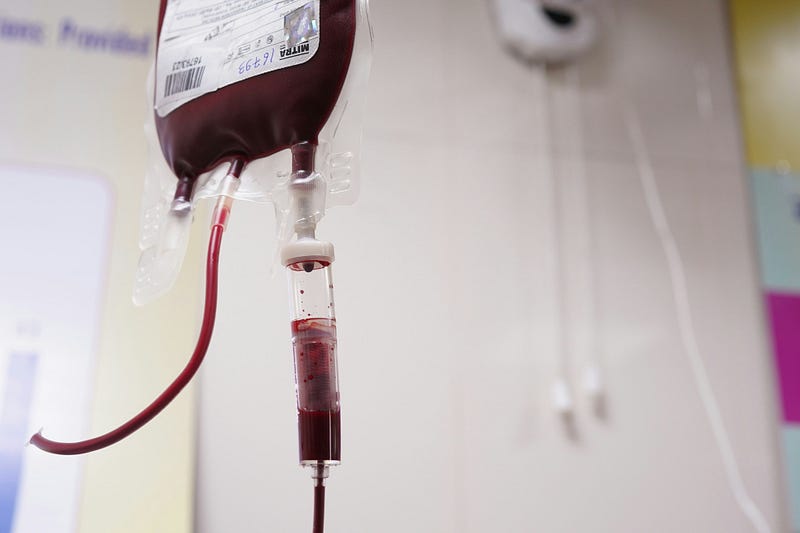
The pager in my pocket flashed the four-digit extension of the intensive care unit, so I stopped what I was doing and called the number.
“Mr. Washington is refusing the blood transfusion you ordered,” said the nurse taking care of him.
I may have rolled my eyes and cussed a little under my breath. That person had dangerously low blood counts from intestinal bleeding and needed to get more red blood cells into his body. Our critical care team had ordered the transfusion of two units of blood to prevent Mr. Washington from having heart failure or a stroke. Why couldn’t he just follow the plan?
Physicians have long thought that we know what’s best for our patients. This has been termed “the paternalistic” model for the doctor-patient relationship. A high expectation was placed on shared language and cultural values for setting and implementing the plan for treatment. In other words, physicians traditionally treat their patients and make recommendations based on the physician’s values and culture, not the patient’s. As a trainee in an emergency medicine residency program in the 1980s, I had this one memorable clash with the religious beliefs of one of my patients. Mr. Washington was admitted through the emergency department with anemia (low blood counts) due to blood loss from the gut. Red blood cells carry oxygen that is vital to the function of the brain, vital organs, and muscles. If a person with a very low blood count faces some sudden episode of bleeding, the strain on the heart and organs can cause death.
As part of the medical team treating Mr. Washington, I ordered for him to be cross-matched and transfused with two units of packed red blood cells. That treatment was refused. The gentleman was a practicing Jehovah’s Witness. The Jehovah’s Witnesses are an evangelical denomination of Christianity that, among other practices, refuses blood transfusions.
I explained the dangers and consequences of refusing the transfusion. The patient was not going to budge from his stand of refusing any blood products. These were the days before artificial blood, and we did what we could to make sure he had the iron and vitamins to make his own blood. Unfortunately, a healthy person can only replace ten percent of his blood volume in a day. The patient accepted the risks, and I documented all of our conversations in the medical record.
Today, the rights of patients and their families to share in medical decision making is widely recognized. Perhaps one of the most famous cases of culture clash was documented in a classic of medical literature, The Spirit Catches You and You Fall Down: A Hmong child, Her American Doctors, and the Collision of Two Cultures by Anne Fadiman.
Ms. Fadiman tells the story of the Lee family and their clash with the medical establishment of Merced, California. Lia Lee was born in central California’s Merced Community Medical Center, or MCMC, in July of 1982, to mother Foua and father Nao Kao. Her parents were newly arrived Hmong immigrants from Laos.
The Hmong were originally highland farmers in central China who clung to their unique language and culture after centuries of attempted assimilation and migration. An army of Hmong guerrilla fighters were recruited, trained, and armed by the CIA in the 1960s to fight against communist forces in Laos.
At three months old, Lia experienced her first seizure, the resulting symptoms recognized as “quag dab peg,” translating literally to “the spirit catches you and you fall down.” In the language of Western medicine, this is epilepsy. For the Hmong people, treatment of quag dab peg would involve shamanism and animal sacrifices to bring back a lost soul.
For American doctors, treatment of epilepsy would involve a cocktail of anticonvulsant medications, antibiotics, and sedatives. The clash of American and Hmong cultures resulted in tragic misunderstandings on both sides, with a poor result for Lia.
Anne Fadiman analyzes both perspectives — Lia’s family and the community of Hmong on one side and the Merced doctors and nurses on the other. She spent years getting to know both the family and the caregivers and treated them both with affection and compassion. Useful questions are raised but no real blame is laid on either side.
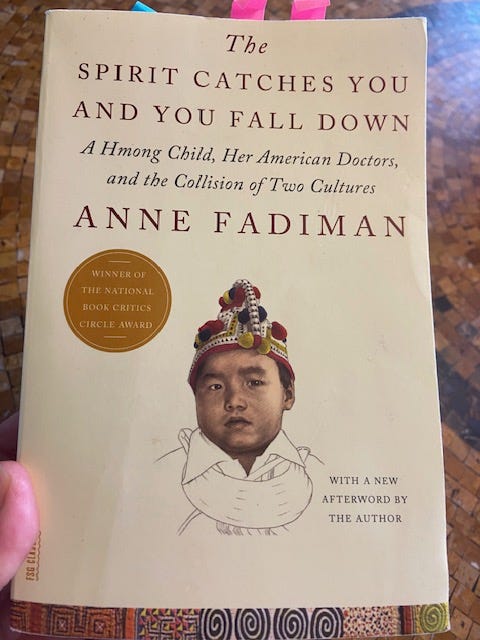
Published in 1997, The Spirit Catches You and You Fall Down is a remarkable masterpiece that feels just as significant today, more than 20 years after being published, for its commentary on cultural differences, social construction of illness, and most important of all, empathy. The 2012 edition contains an afterword by the author that updates the readers on all the characters they get to know and love in the book. She also reflects on the lessons that she learned and the feedback from readers that she received over the years.
This is a heartbreaking and beautifully written work of non-fiction that should absolutely be placed in the standard curriculum next to our anatomy and histology texts. The fundamental misunderstanding that arose between the Lee family and the doctors at the Merced Community Medical Center serve as a metaphor for every cross-cultural, multi-lingual interaction experienced by nurses and physicians on a daily basis. Invariably, the instructions and intentions conveyed by the English-speaking social workers, doctors, and nurses were interpreted with the precise opposite meaning by the Hmong-speaking family.
The language and cultural barriers encountered by the family and medical staff felt insurmountable and frustrating. Near the time that the medical staff was arranging for the Lee’s to take their daughter Lia home after she suffered partial brain damage that left her in a vegetative state, Fadiman describes the agonizing reaction of the family, when asked to sign a piece of paperwork stating that the child might die after leaving the hospital. The family perceived that the physicians and nurses thought Lia should die. This violated a Hmong taboo against foretelling a death.
“When Nao Kao thought he was being forced to sign a paper that said his daughter was going to die in two hours, he did what any Hmong in an impossible corner… might consider doing: he fled. He grabbed Lia who was dressed in her funeral clothes, from her bed in the third-floor pediatric unit and started running down the stairs.” (The Spirit Catches You and You Fall Down p. 178) Security guards had to bring the two back.
The message here for physicians and nurses is clear and profound. I dare say every one of us has encountered a patient from another background or culture so different from our own that we can hardly get through to them. I remember that there was a sizable Hmong population in Philadelphia when I trained there as an emergency physician. There was much hand-wringing over their refusal to get their children vaccinated.
With much guilt and self-reflection, the following paragraph punched me right in the gut. Another of Lia’s treating physicians commented on the attending physician’s actions as he reviewed the circumstances of Lia’s catastrophic admission, seemingly one more time, with non-stop seizures. The diagnosis of septic shock was totally missed.
“If it had been a brand-new kid walking off the street, I guarantee you Neil would have done a septic work-up and he would have caught it. But this was Lia. No one at MCMC would have noticed anything but her seizures. Lia was her seizures.” (The Spirit Catches You and You Fall Down p. 256)
This hit me hard. How many times had I, and perhaps every one of us, reduced our patients to a diagnosis or a symptom? What signs and symptoms do we miss from this callous habit of confirmation bias? How many times has this sort of cold-hearted categorization robbed our precious patients of their humanity and the correct diagnosis?
Fadiman goes to the experts to suggest how the immense gaps in understanding between the cultures could be bridged. She includes the work of Arthur Kleinman, a psychiatrist and medical anthropologist at Harvard who chairs the Department of Social Medicine at Harvard Medical School. He developed a useful set of eight questions designed to elicit a patient’s “explanatory model” in cases of cross-cultural medicine.
The author quotes Dr. Kleinman’s three retroactive and retrospective suggestions for the physicians caring for patients like Lia, whose parents could or would not comply with giving their daughter anti-seizure medications because of a totally different belief system regarding illness and treatments.
Dr. Kleinman says,
“First, get rid of the term ‘compliance.’ It’s a lousy term. It implies moral hegemony. You don’t want a command from a general, you want colloquy.
Second, instead of looking at a model of coercion, look at a model of mediation. Go find a member of the Hmong community, or go find a medical anthropologist who can help you negotiate. Remember that a stance of mediation… requires compromise on both sides. Decide what’s critical and be willing to compromise on everything else.
Third, you need to understand that as powerful an influence as the culture of the Hmong patient and her family is on this case, the culture of biomedicine is equally powerful. If you can’t see that your own culture has its own set of interests, emotions, and biases, how can you expect to deal successfully with someone else’s culture?” (The Spirit Catches You and You Fall Down p. 261)
So there you have it. Lia’s physicians could not release the culture and biases of Western medicine and Lia’s parents could not or would not compromise the belief system of the Hmong people. Fadiman tells the story of truly good-hearted people from all sides who did everything they could to save Lia. Many times, the actions of one group conflicted with the beliefs of the other group.
This book serves as a lesson: as much as cultural barriers may be difficult to overcome, they are never insurmountable. Healthcare professionals and their patients can find some common ground to work with and expand.
Fadiman’s master's work has literally become one of the textbooks in college courses on medical anthropology. It is moving and very readable. Physicians and nurses in training can learn a lot from what went wrong there.
Little Lia got caught in the middle of this tragic story, and I daresay her story is one you will never forget.