
When Crowds Become Mobs
What I never want to encounter on my travels — is a mob.
In the course of these BLM protests, a couple of disturbing videos came my way via Twitter. Ignoring ‘who’ it was against ‘who else’ (the videos omit the context, and the second one may have been a response to some weird behaviour), what disturbed me was seeing mob mentality.
I’ve traveled a lot. Not quite to a hundred countries yet, but if it wasn’t for this Covid thing, I’d be there by now. In those travels, I’ve been robbed, I’ve had cerebral malaria in Africa, I’ve woken up to the sound of machine gun fire in Iraqi Kurdistan, missed death by minutes or millimetres on a couple of occasions, and of course, done the usual crowded buses, trains, hot, cold places and homeless nights. You have to take those things somehow, as they come. In a sometimes weird sense, they are a predictable part of travel. Being dumped in a foreign culture doesn’t scare me and neither does spending days and nights alone in the mountains.
But one thing does scare me — and that’s the thought of being caught in a mob. Mob behaviour escalates very quickly. One second there’s a group of individuals, all thinking for themselves, and the consequences of their actions. Next second, they are doing things without much thought, only because everyone around them is doing the same thing.
It’s just like dogs. And as a traveler, they are the most likely mob you will encounter. One dog spots an unusual person in its domain, and starts barking. You’re bigger than it, so there’s probably no danger. But this barking alerts another one, who comes rushing in to see what’s happening. And it starts barking. Bolstered by each other, the barking becomes more savage. And then the next couple of dogs arrive. Very quickly, you’re looking for a big stick….
But you thought I was talking about human mobs, right? Well, touch wood [Mike knocks himself on the head], I’ve avoided human mobs so far. But the last time I was in Istanbul, I missed being in a serious mob by … 1487 years, 5 months, and 6 days*.
Ah, Istanbul…. the great city of Constantinople in ancient times. Growing up in New Zealand, my sense of time was that a building from the 1850s was really, really old. It’s the way things are here (There are the ramparts and ditches of much older Maori forts, but no actual buildings).
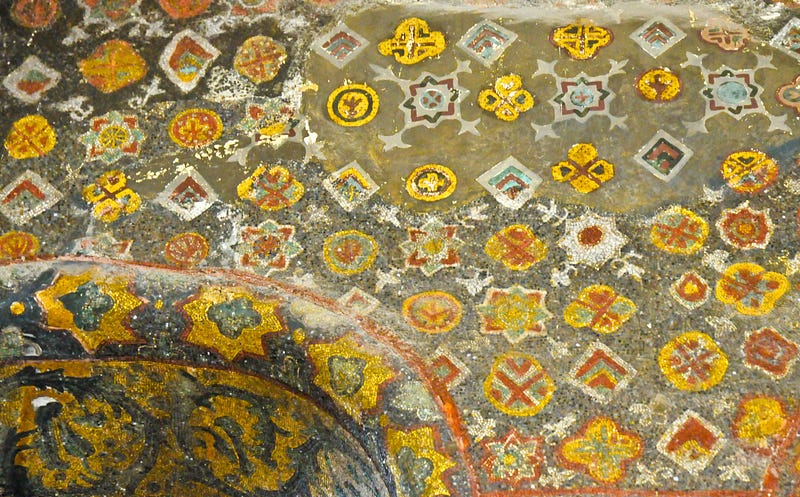
So traveling to a place like Istanbul in Turkey, where I can walk into a building- the Hagia Sophia, which has sat there, basically as-is, for over 1,480 years, just blows me away. The Hagia was built as a Christian cathedral, but when Muslims later conquered Constantinople we can be grateful that they didn’t wreck it or blow it up. Instead, it was converted to Islam with some pretty minor re-branding, like covering over the mosaics. When Turkey became officially secular much later, the Hajia became a monument — and efforts were made to uncover the old Christian mosaics. As Turkey now veers towards an overtly Muslim government again, the management of the Hajia will surely become more delicate.
But it’s not just the Hajia that astounds me in Istanbul. The basic city plan hasn’t changed from Roman times. The street that the tram runs along is the same main road from the Roman city. Smaller streets are probably Roman as well. And directly opposite the Hagia, the huge open space is the site of the Hippodrome — the venue where chariot races took place. It was where Constantinoplians let off steam. Rather than go to soccer matches, or get on Twitter and have a rant, they backed their chariot teams — the Reds and the Greens (Remind you of anything?)
Now it seems like there has long been a human propensity for forming two main teams. That may have some biological basis — i.e. the apparent underlying cause why some cultures tend to string out along a ‘conservative’- ‘liberal’ axis. Political leaders are probably quite happy for this to happen, and see the masses vent their spleen at each other over relatively trivial differences, rather than unite and confront leaders about more important things.
In ancient Constantinople, the populace had polarised behind two different teams, or ‘factions’, the Blues and the Greens. Although it’s sometimes thought that these had some basis in political views or religions, it was probably more random (Cameron, 1976). The Hippodrome was located immediately adjacent the main palace of the emperor, and it seems like the chariot races were far more than just sporting events — they were a core part of how and where the emperor interacted with his subjects.
Just like worked-up soccer fans, thousands of chariot-race followers could be quite a force. Remember, as an every-day citizen of Constantinople, chariot-racing was pretty much ‘it’ as far as having an outlet for your emotions, meeting mates, slagging off whatever the emperor had or hadn’t done lately. The emperor, for his part, had to politically manage these crowds as best he could. The emperor wielded ultimate power, but was expected to exercise some give and take regarding any demands from the crowd. And everyone knew the hippodrome was no stranger to riots.
In AD 532, the emperor did not manage a situation well. The details can be found elsewhere, suffice to say that it began as a protest, then became a riot — with many buildings being burnt, and at some point the riot turned into a rebellion. The word that the crowds yelled during the chariot races was “Nika!”, something like “Victory!” So the events of several days in AD 532, are now called (take your pick) the Nika Riots/Revolt/Sedition, etc…
Crowds have power — mass protests can make a difference. They are a valid part of a functioning democracy. Astute politicians can watch and see which way the winds are blowing and make changes. It’s a political balancing act of course, but with the ever present danger that crowds can become mobs.
I’m sure that at one point, many of those people milling around the Hippodrome and adjacent streets just thought that it was an exciting time. It was great fun to run around in the crowd with everyone else, and maybe keep their distance when someone else was torching a building. But somewhere in there was that impossible to define point where parts of the crowd became mobs. The energy of the moment and the sense of invincibility likely made a few people do things they wouldn’t normally have done. In Constantinople, the mobs set fire to many buildings, and nearly half of the city ended up destroyed one way or another.
Emperor Justinian eventually took decisive action and sent the troops in — and some 30, 000 people were massacred in the Hippodrome. It’s said that inevitably, many entirely innocent people lost their lives. They were just in really bad places at the wrong time. In this case, it’s sort of the opposite of what’s going on in those two videos, where some lone soul is suddenly set upon by a mob. But the broader point is, either encountering a mob, or becoming part of one, things can go very badly.
The take-home message? I guess it’s a little like the old days when you had trouble picking that point when you were about to become too drunk to know that you were becoming too drunk. But if you are in a crowd, and you sense that the crowd is about to become a mob — do a reality check, and, preferably, bail from it ….
***
One of the buildings that was burnt to the ground in the Nika Riots was a church that was opened in AD 415. The present Hagia Sophia was built to replace that. In an odd sense, it’s a memorial to that mob of nearly a millennium and a half ago.
Notes
- I’m not sure if this calculation (using timeanddate.com) will take into account the change from the Julian calendar to the Gregorian calendar, when Thursday, Oct. 4, 1582 was followed by Friday, Oct. 15, 1582.
Cameron, A. 1976. Circus Factions: Blues and Greens at Rome and Byzantium. Oxford: Clarendon Press.