When Cancel Culture Clashes With Feminism It Affects All Women
Is J.K. Rowling really a threat to feminism?
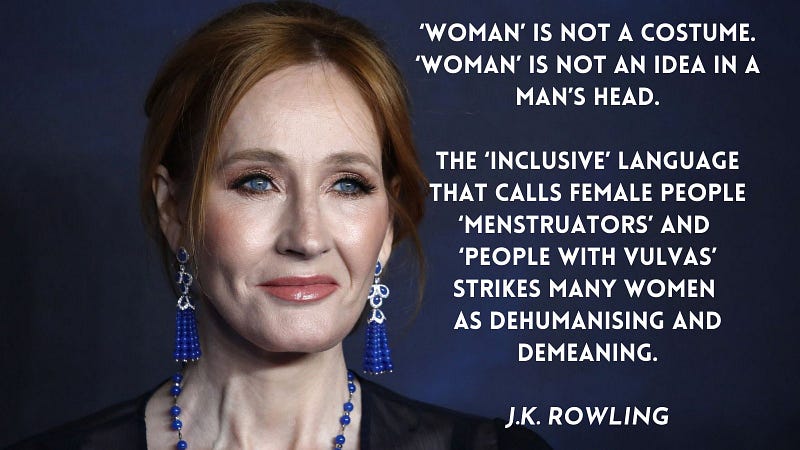
I’ve avoided this debate because it’s a can of worms, but it’s become necessary to address what’s written in the picture above. J.K. Rowling’s legacy is under threat by cancel culture, and as someone who’s enjoyed Harry Potter, and a feminist, this public trolling both puzzles and angers me.
It no longer seems to be about J.K. Rowling and what she actually said.
It seems to be yet another attack on a woman in a public space.
Her opinions about trans women are troubling, yes, but I’m a liberal feminist and, therefore, interested in issues that involve women and equality.
Although J.K. Rowling has made several social faux pas as a public figure, the focus of this article is not whether she is transphobic or not.
It’s about whether we need to talk about sex and gender.
It’s about the label ‘woman’ and what it means if we stop using it.
And it is about people on public forums threatening to shove male genitalia down a woman’s throat for voicing an opinion.
So, what did J.K. Rowling say?
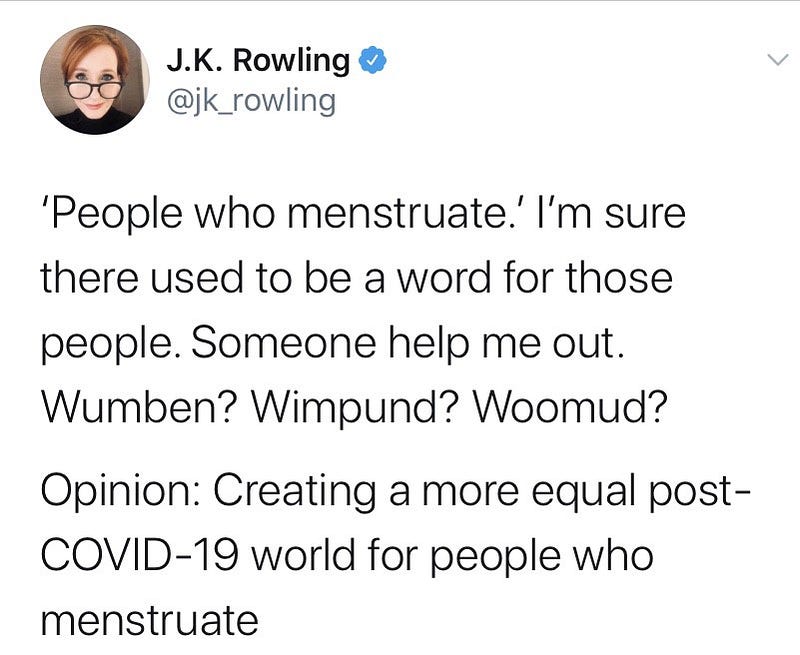
This became a green light to subject J.K. Rowling to horrific abuse online (boodleoops collected some of the horrible tweets in this article and this one about Margaret Atwood, which I recommend you read if you want to know what cancel culture looks like.)
(Hint: it’s a group of people arguing ad hominem and threatening a woman with their penis or using derogatory female terms to invalidate her argument.)
Sometimes we have to wonder what the cancel culture activists hope to achieve by spreading their hatred in public spaces.
Tolerance?
Acceptance?
It’s a genuine question. What are you hoping to achieve when you threaten a woman with your male genitalia if she doesn’t shut up?
Gender Inclusivity Can Be Problematic
We try to accommodate the entire LGBTTTQQIAA community to make everyone feel accepted and loved, but it has gone too far when it turns into a witch hunt.
It’s gone too far when I’m called a ‘menstruator’ or ‘person with a vulva’.
I’m a woman.
If I took birth control pills, had a radical hysterectomy or went through menopause, I’d still be a woman. No Twitter trolls or gender diversity policies can take away that label.
What’s Wrong With ‘Menstruator’?
Jo is right about one thing; calling someone a ‘menstruator’ (who came up with this?) is demeaning and dehumanising.
For centuries, women have been told that their bodies must be sanitised, deodorised and exfoliated. It took us a long time to be comfortable as women.
This is why I object to ‘menstruator’.
Menstruation has already been labelled unclean. Feminists fought for decades to destigmatise menstruation and take women out of ‘menstruation huts’.
We’re not going back in.
We are women, not menstruators.
Yes, trans women are women, but they do not own nor have the right to redefine the term ‘woman’, nor do I believe this is what they want.
The Big Gender vs Sex Debate
We tend to use these terms interchangeably. Sex is normally assigned at birth based on physical characteristics, but gender is a social identity and is based on lived experiences.
The biological argument is that there are only three possible variations of sex: male, female and intersex. It comes down to chromosomes. Biological sex is determined by the presence of gametes, not choice or surgery.
This doesn’t mean that you can’t change your gender, should you so decide, but J.K. Rowling argues that you’re born with one of those sexes. It’s a reductionist view but not an uncommon one. Even psychological research can fail to distinguish between sex and gender.
If we go by the biological argument, then sex cannot exist on a spectrum. Only gender can. Femininity and masculinity also exist on a spectrum. We know this because we’ve had masculine females and feminine men for as long as humans have existed. Sexuality exists on a spectrum.
So, it seems clear that gender is not predetermined by biology (unlike sex).
You can also change your gender expression (clothing, etc.), but only surgery will change your genitals, and what happens after seems to be the root cause of the argument.
This is why labels matter.
If you undergo surgery to change your genitals, do you become another sex? Do you become a woman because you dress like one?
Do you become less of a woman if you dress like a man?
Not if you decide sex on a binary level, and this is where opinions differ. It’s okay to have different opinions on this matter. It doesn’t mean anyone has to be ‘cancelled’.
You can change your gender, but J.K. Rowling claims it’s impossible to change your sex.
But she also argued that the concept of changing sex is harmful to feminism.
Let’s table the gender vs sex debate and explore that.
When Is Gender Fluidity Problematic For Feminism?
It becomes an issue when you don’t want to be called a ‘person who menstruate’ and people send you vile threats.
It’s problematic when you’re asked to share a public bathroom with someone you perceive to be a threat (whether they are a genuine threat or not — I’ll deal with that issue in another article).
It’s also an issue when you cannot talk about males and females anymore. I could never have written articles like this one without using labels like ‘boys’ and ‘girls’:
So who benefits if we cannot speak clearly about men and women?
It benefits those who want women back in menstruation huts.
It benefits those who don’t want trans women to exist.
It definitely benefits Twitter trolls threatening J.K. Rowling with their penises and calling her a c*nt.
There is no collective agreement on these labels. It doesn’t mean anyone is right or wrong, simply that there are different perspectives.
It’s not transphobic to want to be called a ‘woman’ if you’re a cisgender female. It is, however, transphobic to deny trans women the right to call themselves women or exclude them from ‘women’s spaces’.
We Need An Open Discussion On Gender
We should talk about gender identity to understand one another instead of pointing fingers (or penises).
I identify as a woman. If you were born a man and now identify as a woman, fine, I’ve no issue with that. You’re welcome in our public bathroom.
But no one is allowed to threaten anyone with their penis.
The reason why I stand up for J.K. Rowling is that the war on Twitter has very little to do with trans women anymore. If it was, I’d leave her to deal with this can of worms. She’s the one that opened it.
But what’s happening on Twitter is more about her being a woman who refuses to be silenced.
It stopped being about trans women when people wanted to shove their penises down her throat.
It’s 2022 and it should be unnecessary to say this, but:
We need to stop using penises as weapons to silence women.
This is the real threat to feminism and equality.


