
When Bullying Becomes Too Much
Some survive, some do not.
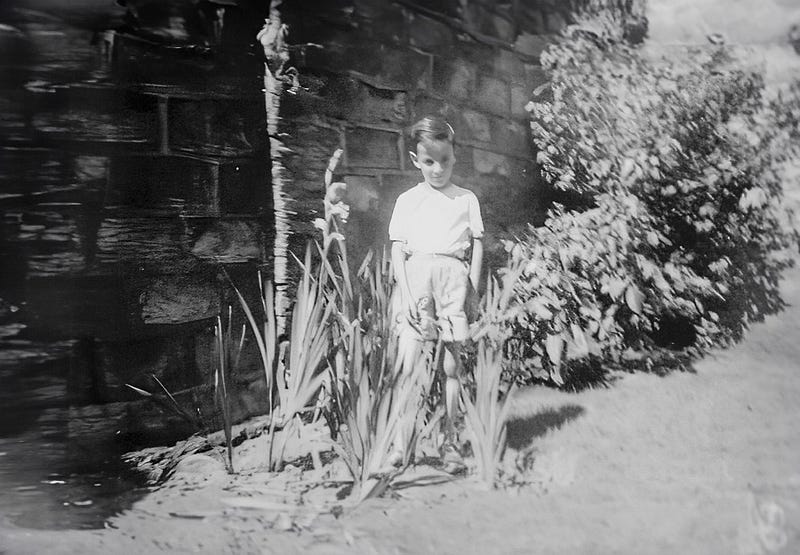
I was an easy target. Small, skinny, gentle, defenseless. Being born three months premature made me tiny. My legs were like a pair of chopsticks with bony knees. My ribs were as visible as strings on a guitar. I had no muscle structure of any kind. Flexing my arms to display my biceps was fruitless. There was nothing there.
What I lacked in brawn I balanced with brain. I was a smart, precocious little tyke. I learned to read way before I entered school. My language skills were off the charts. That was probably due to being an only child growing up surrounded by adults.
I had just started attending school when my family moved to Lima, Peru. We had left Spain after living there for a year. My father was offered a top managerial position in a hotel in Lima. My parents enrolled me in public school and that was where my nightmare began.
I entered the school partway through the year, so the social cliques had already formed. I was an outsider in every sense of the word. I was a foreigner. I was light-skinned. I spoke differently. I had no support group.
I was an easy target.
I was mocked. Ostracized. Pushed around. Constantly made fun of due to my large ears. I looked like a car with the doors open. I was not physically harmed, but the psychological toll was massive. I felt very alone. I was not a happy camper. I didn’t like going to school.
I do not recall if there was a specific kid who instigated my misery, it felt like the whole world was against me. I had no friends to lean on. I have probably mentally blocked much of that experience to protect myself. Many details from those days have faded from memory.
To put an end to the trauma, my parents sent me home to Chile, all by myself, after I expressed my reluctance to return to school after the summer break. My sister, who was twenty years older than me, welcomed me to her home. I moved in with her family. My nightmare took a break.
I cruised through elementary school. My body caught up with my ears, so they did not seem so out of proportion. I grew tall for my age, although I was still a rack of bones. I made friends and found my groove. It felt good to be back home in Chile.
By the time I entered high school, I had a supportive circle of friends. I also attracted a new bully. The blonde kid holding the IIE sign in the photo is my cousin Richard — who lived one floor below me in the same apartment building. The kid next to the bully is my oldest buddy, after 60 years we are still friends.
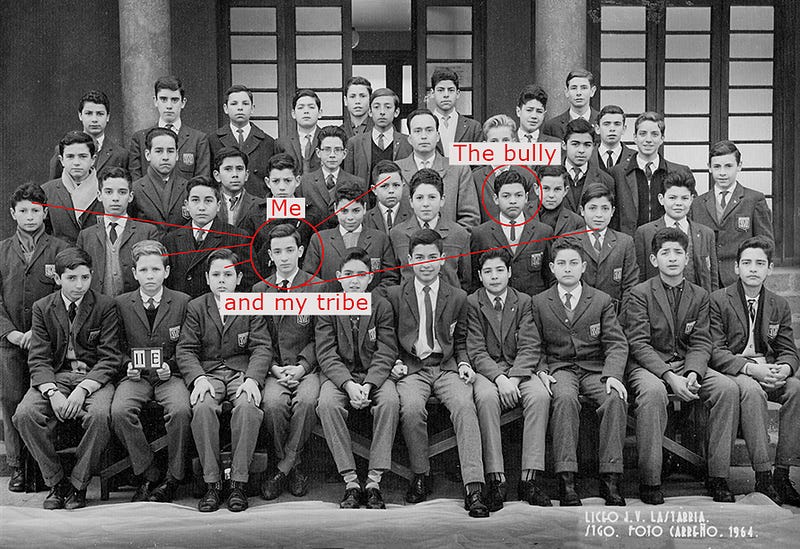
By coincidence, the bully who made my life miserable was from Peru. No joke. He was dark-skinned, sounded different, and had a tough time fitting in. I could, at some level, relate to his situation. I had experienced some of those same feelings of alienation when I lived in his country.
He was solid as an ox. Pure muscle. An intimidating figure although he was not particularly tall. His constant scowl made him difficult to like.
He was a sneaky bully. He would push me around and threaten me when my friends were not around. He would follow me home after school and challenge me to fight.
I’ve always been a lover, not a fighter. I have never in my life hit anyone. I was not interested in taking up the challenge. Until I was.
The bully followed me home one day and kept taunting me. It got on my nerves. I had had enough. I stopped, turned around, took my jacket off, rolled my sleeves up, and assumed a boxer’s stance.
The bully was surprised. He took his jacket off and faced me. We shuffled in place like two miniature boxers imitating Muhammad Ali. The workers from the tire repair store we were in front of, came out and cheered us on. That’s what you got in a macho culture in the 1960s. They didn’t come out to stop the fight, they were egging us on.
Nobody threw a punch. After a while, we felt foolish. Neither of us wanted to fight. It was all posture and pretense.
We picked up our jackets and walked away huffing and puffing.
That incident stopped the bullying. His charade had been exposed. I had called his bluff. The incident went unreported. There were no witnesses to spread the news at school. It was a way for both of us to save face.
There is little doubt in my mind that bullies are inherently cowards. Yet they have the potential to do significant psychological damage.
Recent studies on the long-term effects of kids who had been victims of bullying (but never bullied others) show they have a greater risk for depressive disorders, anxiety disorders, generalized anxiety, and panic disorder as adults. (source)
The lead author of the study, a professor in the Department of Psychiatry and Behavioral Sciences at Duke University concluded that they “were surprised at how profoundly bullying affects a person’s long-term functioning. This psychological damage doesn’t just go away because a person grew up and is no longer bullied. This is something that stays with them.” (source)
Learning this made me question what, if any, are the consequences of my experience. I certainly don’t feel like I suffer from any of the disorders identified in the study, yet the memories remain and the uncomfortable feelings return when I travel back in time.
I also project forward, as my grandchildren prepare to enter high school this Fall. Will those two kind and gentle souls manage to avoid the very real threat of not just bullying, but the more insidious and cowardly wrath of cyberbullying?
What has changed over my lifetime is the public awareness of the problem. I suffered alone. Bullying wasn’t even a concept in those days. At present, there are efforts and resources available to both prevent and deal with the issue. Parents and teachers are much more aware of the problem.
I don’t wish that experience on anyone. I may have been lucky to have been able to withstand the experience without major consequences. Others have not. The tragic story of Amanda Todd, the 15-year-old girl who hanged herself in her home after experiencing relentless cyberbullying touched me deeply. She lived not far from my home.
A month before her death, Todd posted a video on YouTube in which she used a series of flashcards to tell her experience. It is heartbreaking to watch. It has been viewed more than 15 million times since it was posted.
Amanda’s mother Carol established The Amanda Todd Legacy Society to focus on prevention, education, and awareness related to bullying, cyberbullying, online safety and most importantly exploitation/sextortion.
In my years of teaching, and as a parent of a single child, I learned to keep an eye out for tale-telling signs of bullying: Mood changes. Frequent illness or injuries. Falling grades. Aggression. Changes in eating habits. Trouble sleeping. Low self-esteem. Changes in computer use.
Awareness breeds change. Let’s do what we can to collectively put an end to this harmful behavior.