
When Boys Cry: A Lesson in Love, Loss, and Breakfast
Recently, the love of my son’s life informed us that she would not return to class this year. She is moving to another school.
I gasped.
“This is not going to go well,” I thought to myself.
You see, my son loves this girl.
About six months ago, he proposed.
At first, she said, “No.”
Undeterred, one month later, he proposed again.
She said, “Yes.”
He was happy. She was happy.
All was right in his world.
His six-year-old world.
Now I have to tell him he will not see her in class when he returns this year. Although I’ve endured many painful events and things in the past (hello, giving birth to two children without pain medication) — I couldn’t bring myself to tell my son the news. This news, for me, just felt — way — too–painful.
Being a brave soul, I asked my husband to break the news to our son instead.
My husband shared the news with our son before bedtime a few days later. He then triumphantly walks into our bedroom, shares that our son took the news well, lays down and sleeps.
Ten minutes later, I heard our son whimpering.

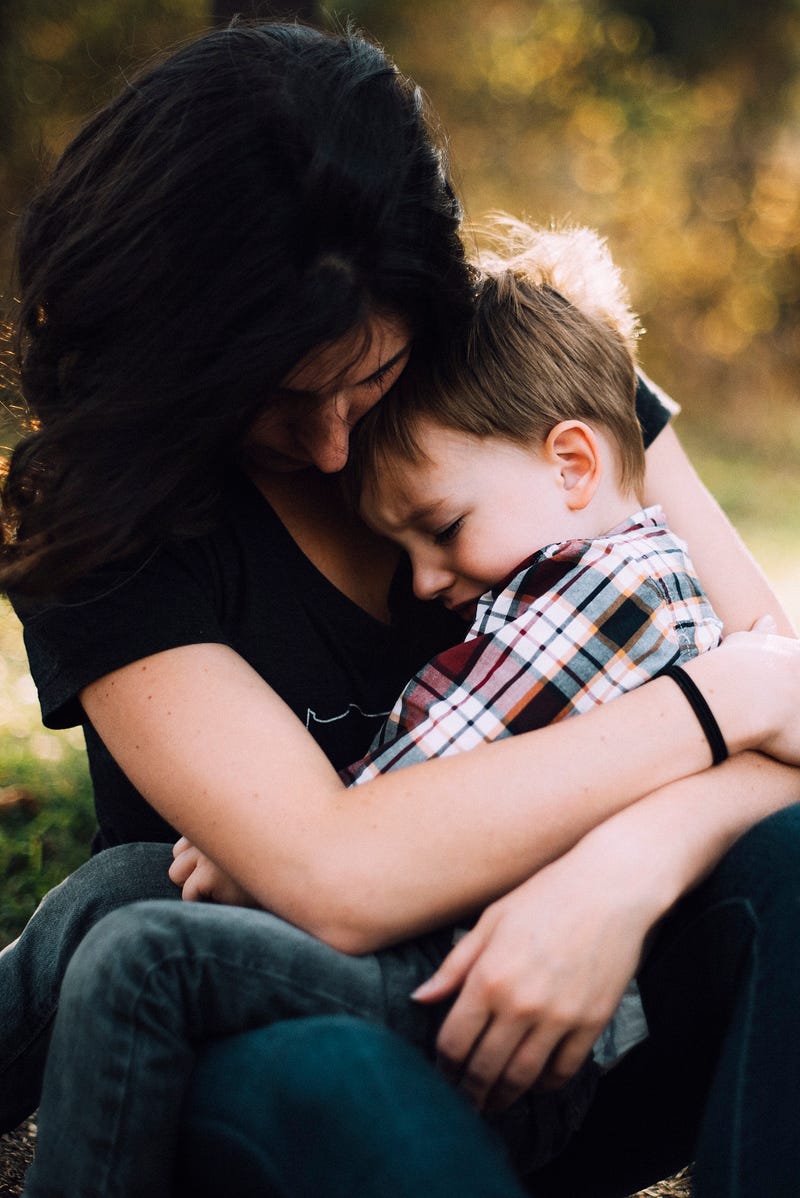
I walk into our son’s bedroom, and even though it is dim, our son’s night light softly illuminates the streaks of tears on his cheeks. I ask him what is wrong — silently hoping his warm tears are for another reason. We both know the answer when his eyes meet mine in the darkness. He crawled into my arms without words, and his tense body gradually softened. Then, I noticed my shoulder was heavy with the warm wetness of his tears.
As a health psychology researcher and owner of a digital wellness practice, the human mind has always fascinated and surprised me. When I lecture at universities, I often work to infuse my lecture with psychological concepts juxtaposed with real-life scenarios. Usually, I can create a solution to any situation — or at least explain its psychological origins.

In the past, I have taught developmental psychology and child psychology. The book publishers usually write about the development of children’s brains and emotions. I recall reading chapters about how children’s sense of “love” still develops at the young tender age of six. In the past, society would have deemed this “puppy love” as something “not that deep” or encouraged a child to “get over it.”
Before becoming a mother, I would have subscribed to these theories wholeheartedly. If you could have visited me ten years ago and told me that I would be holding my six-year-old son in the darkness in complete silence as he cried over his “love,” — I would have looked at you as if you had lost your mind.

Because, honestly, in our society, how often have we heard the old expression, “Boys don’t cry.”
I’m writing this article today to encourage parents (or at least one parent) to give our boys room to cry.
No matter what their age.
No matter the issue.
No matter how we feel about the issue.
Give our children room to feel. To express their feelings without judgment.

Be your child’s “safe zone.” It will help them process their emotions much easier — and I hope (in time) to expand their emotional intelligence and capacity.
The following day, I was surprised by our son standing at the top of the stairs. He had been watching me as I brewed a fresh batch of loose-leaf tea for the household. I looked at him as he stood there, wondering what would happen next.
“How do you feel, buddy?” I asked.
He didn’t say anything for a while.
At first, my thoughts fragmented. Inside, I panicked. “Oh no, he’s still sad from last night. What can I do?”
“Mommy?”
“Yes, sweetie?”
“Can you make some crepes?”
“Okay, sweetie?”
So, I guess all is well.
As I stood over the stove, preparing the crepes, my mind wandered back to the warm weight of my son’s tears. This seemingly trivial moment was a turning point — not just for my son but for me as a mother, a researcher, and an advocate for emotional intelligence. I realized that love, grief, and resilience are not confined by age, and our children’s feelings deserve our deepest respect and understanding.

In my practice, I’ve seen countless adults wrestle with unprocessed emotions from their youth. This simple request for crepes was my son’s way of processing his feelings, finding comfort in the familiar, and moving forward in his own unique way.
It’s a lesson for all parents: Let’s give our children space to feel, to cry, to love, and to heal.
Let’s allow them to find their own crepes — those simple, unassuming remedies that can make the complex world feel right again. Let’s guide them not just with theories and books but with empathy, presence, and a listening heart. Because in those silent moments, bathed in the soft glow of a nightlight or the sizzle of a crepe pan, we are shaping not just their childhood but their lifelong relationship with themselves.
And as I watched my son’s face light up at the breakfast table, his heartache eased by the simple pleasure of a favorite meal, I knew that all was indeed well. We had weathered this storm together, and in its wake, we found strength, connection, and a profound understanding that will guide us through whatever comes next.
With much love,
Dr. Kirsten Grant
If you like the content I’m sharing, please follow and subscribe!


