
When Barbara Walters Mentored Me
I was never the same after crossing paths with that Wahwah woman
Barbara Walters did not ask me what kind of tree I would be, but she did ask me a bunch of questions:
Where was I from? Why did I get into journalism? What were my goals ?Which news did I watch?
But that was after I’d asked her questions, after she’d dressed me down for not asking the right questions, after I asked her some more.
It was early March 1976, when Florida was getting ready to hold its Presidential primaries. The network news operations — CBS, NBC and ABC — had each made their hub of operations Orlando, where I was the TV columnist at the daily newspaper, the Sentinel Star.
My editors wanted me to interview a big-name news personality from each network, so I phoned my contacts, put in my requests.
One the first day, I sat down with CBS’s revered anchor Walter Cronkite over coffee, asked my questions, then rushed back to the paper to pound out a story for the next morning’s edition — Page 1.
The next day, I breakfasted with ABC’s Harry Reasoner, asked my questions, hightailed it back to the Sentinel and knocked out a piece, also Page 1.
The next morning I was escorted into the suite of Barbara Walters, then co-host of NBC’s Today Show, at a downtown Orlando hotel overlooking lovely little Lake Eola. She greeted me warmly in a silk robe over pajamas. We sat, and she poured our coffee.
After a bit of introductory chitchat, I began asking her questions, glancing at my little cheat sheet. I was still pretty new to this. Two, maybe three questions into our session, she stopped me cold.
“You asked Walter and Harry about Presidential politics and the state of the nation,” she said. “Why are you asking me about celebrities and fashion?
I could have said, “Uh, because they’re evening news anchors and you’re on a morning show where they do cooking demonstrations and shout-outs to 50th anniversary couples?” But I didn’t. Not because I was too polite, though. Because I was so taken aback that I could only sputter and stammer until I regained my balance.
When I did, I apologized and posed to her the same sort of questions I had asked Reasoner and Cronkite. She answered enthusiastically and as perceptively as either of them.
When I was done, she peppered with questions. I was charmed. It was almost like she was flirting.
I rushed back to the Sentinel Star and knocked out another Page 1 story.
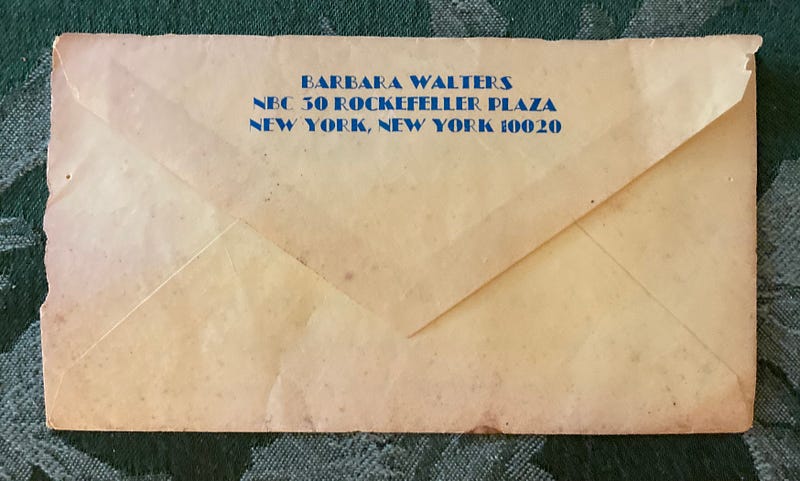
One afternoon about two weeks later, I collected my mail and there, among the press releases and the video cassettes for review and letters from readers was a small yellow envelope embossed with Walters’ name.
At my desk I opened it and read this:
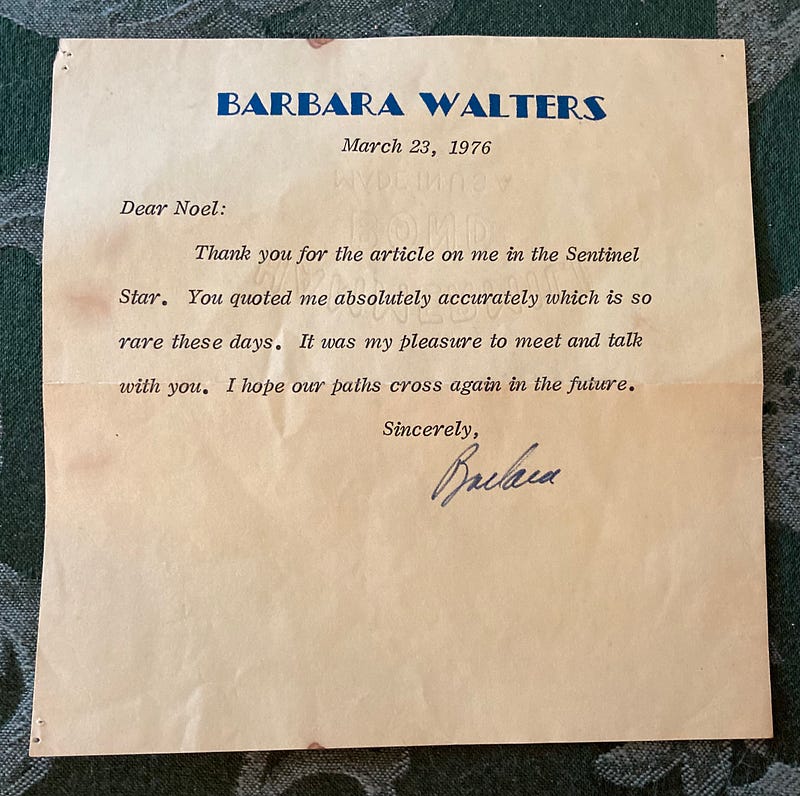
I was, in a word, thrilled. I’d gotten notes a few times before from people I’d interviewed or whose program I’d praised, but this was special. I was getting mail from someone I’d been watching on TV since I was in middle school.
I called my mother in Mississippi. We were an NBC household. Bonanza. Tonight. Today. Laugh-In.
“Mama, guess who sent me a thank-you note?”
She had wanted me to be a banker. This may have been the first time she considered that my running off to join the circus wasn’t such a bad idea after all.
Not long after I got Walters’ note, the ABC Television Network with maximum fanfare announced they’d lured her away from NBC and that she would become the first woman to anchor a nightly news broadcast, sharing the ABC Evening News desk with Reasoner.
In July, I flew to Los Angeles for the annual dog-and-pony shows at which the networks screened their new fall offerings and make cast members and producers of returning hits as well as new series available for interviews. Walters, set to make her Evening News debut in the fall, was the special guest at ABC’s big closing bash.
Halfway through the party, an ABC News PR man pulled me away from a gaggle of reporters chatting with Happy Days costars Henry Winkler and Ron Howard.
“Have you met Barbara yet?” he said. I told him I had already had the pleasure, but he insisted.
Walters had her own cluster of reporters, but the ABC guy butted in and made the introduction. “Barbara, this is Noel Holston of the Orlando Sentinel Star.”
Walters offered her hand and smiled. “Orlando?” she said. “I was just down there for the primaries. The paper did a really nice article on me. Front page.”
“Yes,” I said, smiling, still holding her hand. “I read that. It was terrific, really well-written.”
My feelings weren’t hurt. I wasn’t insulted. Indeed, I have always been grateful for the lesson that Walters unintentionally taught me.
From that moment on, I understood that whether I was quizzing Barbara Walters or Bob Denver, Burt Reynolds or Gilda Radner, I should never flatter myself to believe we’d bonded or established a personal connection. It was a business transaction in which their job was to promote themselves or some show they were in, and it was mine to elicit the freshest information from them that I could, perhaps get them to let something slip they hadn’t meant to say. It was a business transaction and a bit of a game, and only rarely — very, very rarely — anything more.
It served me well in the years thereafter, made me warier and more professional.
I should have sent her a thank-you note.
Excerpted from SCRAPbook: Odds and Ends from a Lifetime of Writing, coming in 2024 from Burnt Bridge Books.