
When are Stereotypes Funny and When are They Just Offensive?
‘Kim’s Convenience’ is hilarious but I feel bad for laughing
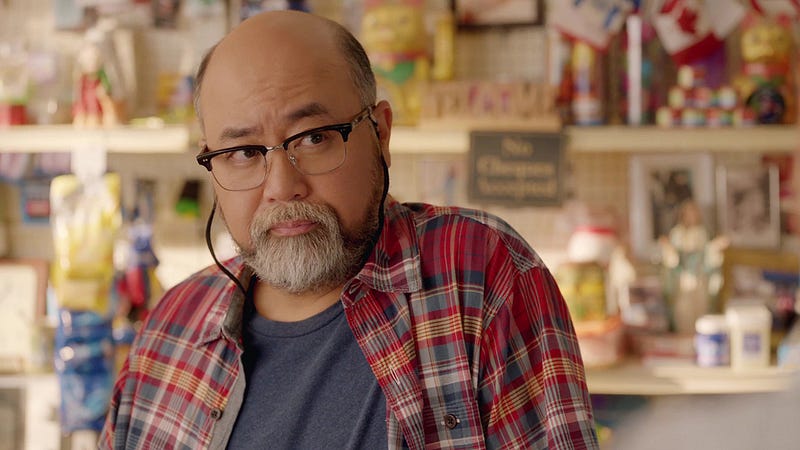
The beginning of Kim’s Convenience makes two things abundantly clear: the sitcom is going to make you laugh, and you are probably going to feel a little weird about it.
In the very first scene, two gay men enter the store and ask Mr. Kim, the store’s proprietor and a first-generation Canadian immigrant, if they can hang a poster in the window for Pride Week. After critiquing their poster and telling them to get a refund, he goes on a diatribe.
Mr Kim: I have no problem with the gay, but I have a problem with the parade. Traffic, garbage, noise — if you the gay, why can’t you be quiet, respectful gay? Like Anderson Cooper? Neil Patrick Harris? They is all the gay, but they don’t yelling to me ‘taste the gay’.
The ensuing exchange tiptoes the line of propriety without somehow stepping completely over — said the white heterosexual — but as I laughed, a tremor of doubt-tinged guilt niggled the back of my mind: should I be? On one-hand, comedy has always been a sort of fun house mirror, distorting reality even as it reflects and illuminates certain truths. On the other, less certain, hand: I am laughing entirely because Mr. Kim has a funny way of putting words together. ‘Taste the gay’ sounds hilarious. It puts me in mind of the old Catholic hymn Taste and See, which frankly makes it even funnier.
This dichotomy pervades Kim’s Convenience entire five-season run. The show is heartwarming, reaffirming the importance of family in a world that seems to have largely forgotten. I love the Kim family. But whenever I watched the show gently poke fun at Mr. and Mrs. Kim’s way of speaking, I couldn’t help but wonder: where is the line between laughing at how something is said and laughing at the person saying it?
How do we embrace representation without falling back on stereotypes? Going to church is very important to Mrs. Kim; an early episode has her instructing her daughter to find a good Christian boy. It’s reminiscent of Gilmore Girls’ Lane Kim and her mother 20-ish years ago, which begs the question: is it lazy writing or is it really like that for westernized Koreans?
When is a stereotype not a stereotype? I’m posing a lot of questions here and scant few answers because I’m not the right person to provide them. My only real point of comparison barely registers.
When we were growing up, my dad liked to call my brother and I ‘Polacks' (also dingleberries, which, if you didn’t know, are those little balls of poop that get caught in the dog’s fur; the 80's were a different time). Polack is a derogatory term referring to someone of Polish descent, a culturally-loaded version of idiot or numskull or moron, but somehow worse.
We were Polish, distantly — my dad’s mom was entirely Polish — but our blood had been watered with Italian and English and other places from my mom's side. Dad seemed to think being Polish was the punchline of a joke made at our expense, even though he was actually more Polish than we were.
Grandma dragged us to extended family get-togethers in dimly lit basements where sauerkraut flowed like honey and polka jangled from speakers; some stereotypes really are true to life. Outside of these reunions, nothing about my family suggested we were Polish. When she’d married, Grandma traded her Polish name and its proliferation of vowels and awkward z’s for an American-sounding name. Nobody spoke with an accent. The natural, desired outcome of this great melting pot is to eventually dissociate you from wherever your people came from and so we had been. Americanized.
Dad never came to the reunions.
I didn’t really notice it at the time, but looking back, it’s clear he felt disdain for his Polish heritage. I’ve heard plenty of jokes over the years where the punchline involved a Pole doing something stupid. I’m sure he had too. Maybe he’d gotten tired of being laughed at and decided to strike preemptively. Maybe he felt he was entitled to use the derogatory term, like a perverse sort of birthright. Maybe he just didn’t care.
I am a very distant fourth-generation Pole. This Polack business is the closest I've ever come to being stereotyped. As I said: a weak comparison. But at the same time, some of the Polish stereotypes — love of polka, sauerkraut, and liquor — have proven true, at least in my experience. If I were making a show about Polish immigrants, it would feel disingenuous to exclude such things simply to avoid the prospect of cultural cliché. The trouble comes when the stereotype is an end unto itself. No people are monolith; to act otherwise denies our very humanity.
Thankfully, the strength of Kim’s Convenience comes from its characters, who are well-drawn and three-dimensional. The heart of the show is absolutely in the right place. It is uplifting and reaffirms many of the things we hold most dear. But for everything good about Kim’s Convenience, it still feels weird laughing when much of the funny comes from the way someone talks. Even when it’s clearly what the show wants you to do.
Eric writes about pop culture and honestly thinks most things are funny. Not a Medium member? Join today and help fund content such as this.