
Stories from my travels
When a Tsunami Strikes, Do You Stay by the Sea or Head For the Hills?
The screams were coming from all directions and there were boats floating inland….
This is a continuation of the story that began here.
The beginning of the story in a nutshell: I felt a big earthquake early in the morning and sensed that something bigger was coming, but I didn’t know what. After returning to rest in our room, my partner was showering while I lay down with my toddler. Suddenly, there was the sound of gushing water and screams from outside.
“The sea is rising!” I thought. “We need to get out of here!”
I had been hearing people talking about the sea levels rising for years; how large areas currently above sea level were going to be covered, and our landmass would shrink.
I had no idea it would happen this quickly or suddenly!
As you can probably tell, I had lost most of my powers of reason and was convinced that this was the demise of the planet unfolding before our eyes. In my mind, the scales of global warming had been tipped and it was all coming crashing down now.
Speaking of things coming crashing down, my thoughts now went to the build-quality of the fifteen storey building we were currently on the top floor of. I had heard terrible things about Indian standards of building, with little to no foundations. Plus, this peninsula seemed to be made mostly of sand that, in my mind, would be washed away in an instant by the vast quantity of water that had washed over the land.
So, for the second time that day, I picked up my sleeping child, put her in the hip sling, and grabbed my bag, still with our passports and travellers cheques in.
I rapped on the door of the bathroom.
“Something’s happening,” I yelled. “We need to get out of here!”
My partner, Tristan, came out of the shower, wrapped in a towel, looking bewildered. I pointed out of the window.
“Something’s happening,” I repeated. Wordiness wasn’t my speciality at that moment.
“Oh my god,” was all he said. He was as lost for words as I was.
He got himself dressed hurriedly while I packed a few more essentials; namely, a potty and a plastic toy shopping basket filled with plastic bricks. For some reason, spare clothes didn’t occur to me. As long as my daughter’s potty training wasn’t interrupted and she had some toys to play with, all would be well.
Perhaps I never had any power of reason in the first place.
“We need to head for the hills,” I said.
My determination to get out was quickly overshadowed by the many people milling around in the corridors and on the balconies of our building. Everyone had been instructed to come into these buildings and await further instructions.
I started to ask if anyone had the foggiest what the hell had just happened. Most people were as clueless as us but little fragments of information were starting to be pieced together.
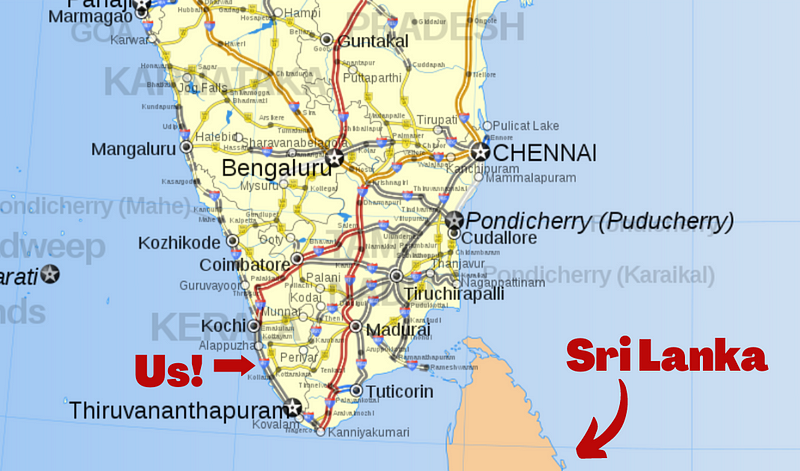
I heard that a large earthquake had been recorded in the morning (finally, official confirmation) and that Chennai, on the east coast of South India (we were on the west coast), had been hit by a ‘tidal wave’ at 9 o’clock that morning. The coast there had suffered enormous devastation, with many dead or missing. That same wave had then hit the Keralan coast several hours later.
Why had we not been told this? Why had no one warned us?
Now, all we could do was bide our time in this building and wait until we were given the go-ahead to leave.
Across the raging backwaters
We were then told that there had actually been two waves — not just one — that had hit our coast, and that there might be a third one. Amma wanted to get everyone across the water onto the mainland before the third wave hit, and she was organizing people to get those of the highest priority off of the peninsula first.
After an hour or so of waiting, we were told that it was time for the foreign guests at the ashram to make their way out of the building and onto the boats. We descended to the ground floor and exited the building to find an enormous crowd surrounding those heading out. Amma was there, hugging people as they passed and asking them if they had all of their family with them.
The water had now receded, but the ground was sodden and the backwaters were high with fierce currents. Hurrying down to the boats, I was carried by a sense of urgency among the many Indian visitors that joined the throngs of people.
We passed our friend, Carmina, with her young son, Noah. Carmina was from Spain and we had become good friends in the short time that we were there, connecting over the fact that we both had high-energy children of similar ages.
She was standing, holding Noah, and seemingly searching for someone. It turned out that she was waiting for her friend, but this friend was making no move to cross the water. She was preoccupied with whatever conversations were taking place in the huge crowd outside the building we had just exited, oblivious to Carmina’s frightened self.
Noah was becoming restless and Tristan took him from Carmina’s arms.
“Come with us. We will stick together.” He said. Carmina let him take Noah and she followed after.
At the water’s edge, there was mayhem. The boatmen were shouting, helping people onto the boats while trying their hardest to control them in the torrents that were whispering a song of death down the backwaters.
I looked at the different boats lined up. Our favourite boats were normally the dugout tree trunks, which stick-thin yet surprisingly strong men punted across the water with long poles. However, these looked like a death wish in these risen waters, and we opted for the larger motorboat.
Even the power of the engine struggled to make headway in the currents that threatened to take us with them, and the motors were revved to the max while the men shouted urgent orders. But, once we were going, we crossed the river painlessly.
Onward and upward
Disembarking on the mainland was much less dramatic. The question that now hung over us was: where should we go?
Ashram residents were waiting to guide all international guests towards the partially-constructed Engineering College belonging to the ashram. I could see that the place was nothing more than a construction site and if anyone thought I was going to spend the chilly December nights on a concrete floor covered in building dust, with no mattress or blanket, they had another thing coming.
Besides which, who in their right mind would stay this close to the sea with the threat of a third wave coming?
I walked towards the town and the others followed. I had no idea how we would get out of there but I was still determined to head for the hills, one way or another.
What happened over the next twenty minutes was a blur. We found ourselves caught in throngs of people, making their way hurriedly and urgently in one direction, down the main street of the town of Vallikavu. People were shouting at one another in Malayalam, the main language of Kerala, but we couldn’t understand a word.
At one point, the shouting became panicked and people started running. There were so many people that it could easily have turned into a stampede. I tried running, but doing so while carrying a heavy two-year-old was pretty impossible, and only made me more anxious and vulnerable to a possible stampede, so I stopped trying and kept my focus on the road ahead.
We came to a place where jeeps were waiting to take people to Kollam, the nearest city. We managed to leap into the back of a moving one, thankfully getting all five of us in.
And away we went.
After being dropped in a small town that boasted a lot of taxis, we secured ourselves a lift to the only place I could think of where someone might take some pity on us — the Sivananda Yoga Ashram at Neyyar Dam, in the hills above Kerala’s capital city, Thiruvananthapuram.
It finally dawned on me that none of us had a change of clothes; that three out of the five of us were also barefoot — having lost our sandals to the sea — and only two of us had passports since the others had put theirs in the safe at the ashram, now far behind us on our journey. As for money, neither Carmina nor I had more than a small amount of cash, although I also, thankfully, had my traveller’s cheques. What use they would be in the Sivananda Ashram, however, I wasn’t sure.
Gratefully, Tristan had a wad of cash, so we knew we would be okay for a few days.
In the hills, at last
After a long drive, we pulled into the area known as Neyyar Dam. As the name implies, it is a large dam with a wide, expansive reservoir, catching water as it comes off the hills above. The town and the dam attract many Indian tourists, and beyond the town, surrounding the largest proportion of the reservoir, was a thick jungle.
Darkness had now fallen. The taxi pulled up outside the ashram and Tristan, the only adult in sandals, volunteered to go in and ask about somewhere to be put up for the night. He soon returned to tell us that it would cost us all the cash we had for dormitory beds and that no food was served in the evening, so there was no chance to eat.
So much for the empathy I had hoped for!
Fortunately, there was also a government-owned ‘Tourist Home’ — Indian-English for a guest house — and so the taxi driver took us onward there.
They had a room big enough for all of us, at a fraction of the cost of the accommodation at the Sivananda Ashram. And they had a restaurant! This was looking promising.
The manager signed us in, asking to see our passports. I explained that we only had two because we had run away from the ‘tidal wave’.
This was met with blank stares. I said in surprise:
“You heard about the big wave?”
He shook his head.
I pointed up at the television above the reception desk.
“The news? Big wave?”
Understanding seemed to slowly wash over him, and he didn’t press for any more passports.
We showered and then put our grubby clothes back on to go down to eat. The manager looked at us in horror and asked if we couldn’t change our clothes and put shoes on our feet. I shrugged.
“No shoes. No change of clothes,” I said. And then, as if to reassure him that we weren’t just dirty tramps, “tomorrow we will buy clothes and shoes, but for now we have nothing else to wear.”
For a moment he looked unsure of whether to allow such a ragged-looking bunch into his restaurant but then decided to let us pass. We ate and then settled ourselves in our beds to fall asleep to the sound of lions in the jungle beyond the dam and the reservoir.
That night, I slept fitfully. The peace of the hills lulled me into an exhausted sleep, which became punctuated by cries of wild animals. The roars of the lions entered my dreams and became huge waves on the reservoir that dragged me back to their lair.
But the morning brought a fresh, cool breeze, sunshine, another day, and another chance.
We were the lucky ones!

This was a true story from my travels. I didn’t even know what a tsunami was until I read the word in the papers the next day.
The following is the first of two videos that documented that day, and the immense relief effort that was funded and facilitated by Amritapuri Ashram:
You can watch the second video here.
On 26th December 2004, hundreds of people in these fishing villages along the Keralan coast lost their lives. Globally, hundreds of thousands of lives were lost to the tsunami. Amma’s charities organized and funded the construction of safer homes for all those who lost their homes, new boats for the fishermen who lost their means to earn a living, and even offered free Tubal Ligation Reversal in the charity’s hospital, to women who had lost their children to the tsunami.
She also organised and funded the construction of new homes on the east coast, in Tamil Nadu, Andhra Pradesh, Pondicherry, Andaman and Nicobar Islands, and on the island of Sri Lanka. These areas suffered destruction on a much larger scale than Kerala, and many thousands of lives were lost.
When visitors were allowed to return to the ashram, we stayed for another month to help with the relief effort.
If you enjoyed this, I recommend…


