
A Painting that Lets You Do Your Own Storytelling
A view of Naples through a window
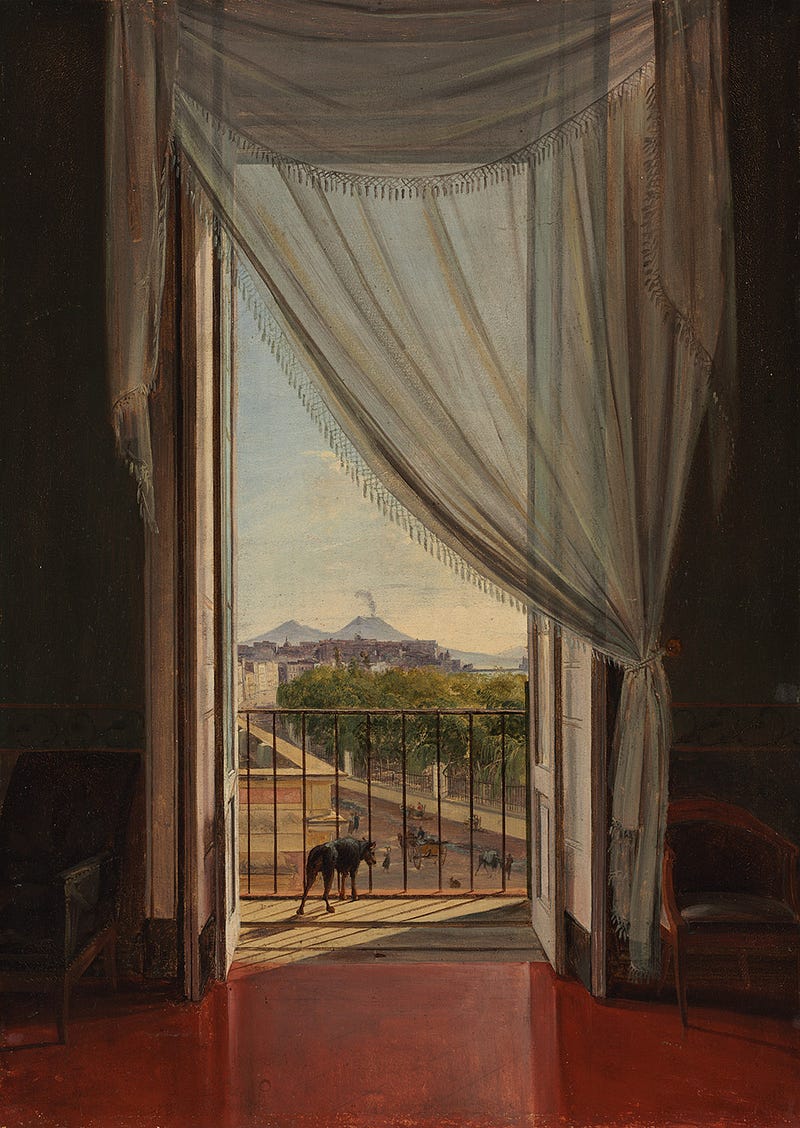
Storytelling in art comes in different forms. Some paintings lay out a profusion of narrative signs for you to read as if decoding a puzzle. Other artworks present their story in less prescriptive ways — offering an open invitation for the audience to supply their own imaginative reading.
What I really like about this painting, A View of Naples through a Window, made by the German artist Franz Ludwig Catel, is that it invites you to make your own speculative venturing. The work nudges us in different ways, but much of the meaning — and pleasure — comes simply from the act of looking and imagining.
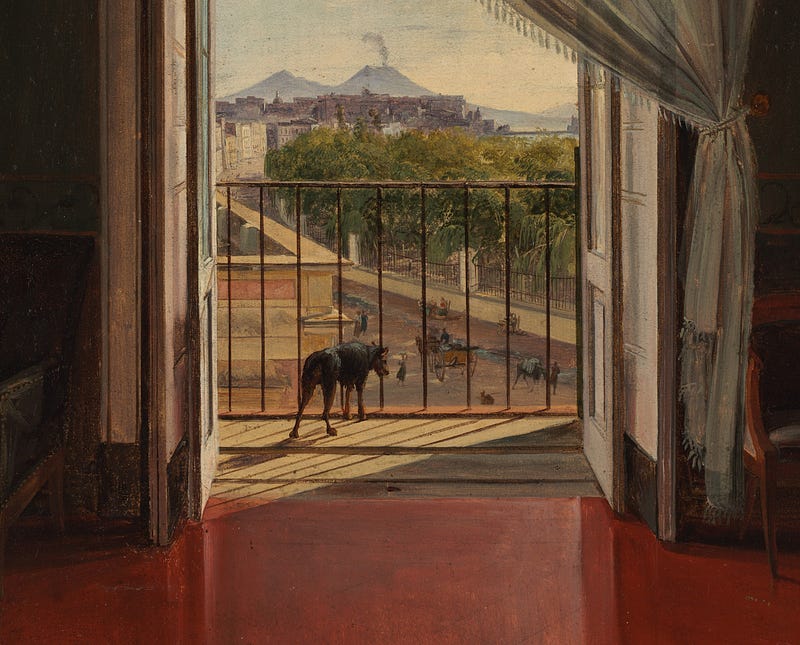
Through an open door we see a balcony overlooking a city, and in the far distance is a mountain range. From one of the mountains, a plume of smoke tells us we are looking at a volcano. And since this is Naples in Italy, the volcano is of course Mount Vesuvius.
Speaking personally, my eye is first drawn to the sheen on the stone floor — polished terracotta? — that perfectly asserts the riddle of this painting. The glowing band of red, an overture of high colour, works as a kind of prelude. The sheen of the floor — so simply painted — unfurls before us like a greeting or beckon.
Franz Ludwig Catel was born in Berlin in 1778, but spent the most successful years of his career living and working in Italy.
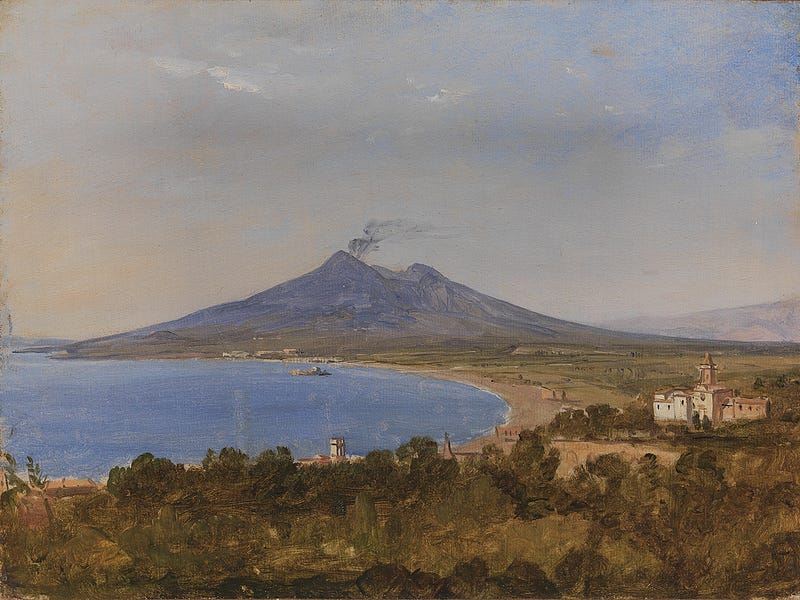
A few years before he painted A View of Naples through a Window, Catel made a sketch in oils of the Gulf of Naples with Mount Vesuvius in the background.
The comparison brings out the fuller meaning of the Window painting: it becomes more notable how the viewer is set back from the mountain — deliberately so — firmly contained within the room. In this way, the meaning of the enclosed space of the room takes on a further purpose, as a place of sanctuary or refuge.
Layers of Invitation
Beyond the gleaming floor, A View of Naples through a Window works through the superimposition of layers, all of them transparent in some way to allow us to see through and beyond.
First is the curtain drape that partially obscures the view but is crucially pulled aside and tied up to reveal what it might otherwise shut out. Whilst curtains have often been used in art as a theatrical prop to invite viewers into the scene, a sort of half-open door, in this painting the effect is reversed: the curtain pulled aside permits us out of the room, back out into the public, from the intimate into the wider world.
In Catel’s painting of Naples, the drawn-aside curtain is also reinforced by the open shutters, and with them, the balcony doors. These help frame the view, working alongside the dark shadows of the interior space to prompt a sense of a bright, lively city beyond the enclosure of the room. Rays of late-afternoon sunlight cast diagonal shadows across the balcony, giving greater form to the arrangement of the doors.
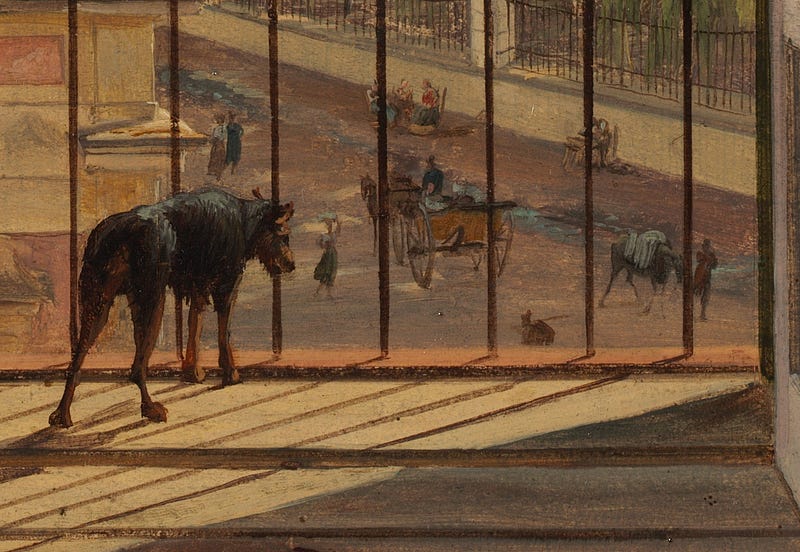
Next, we encounter the balcony ironwork, which much like the curtain, plays a role of invitation. A small dog does what we are perhaps tempted to do: it approaches the balcony and peers down to the busy street below.
It is thought that Catel painted his work from inside a hotel room — and it’s not difficult to imagine him having stood against the balcony railings himself and looking out.
Smoking Vesuvius
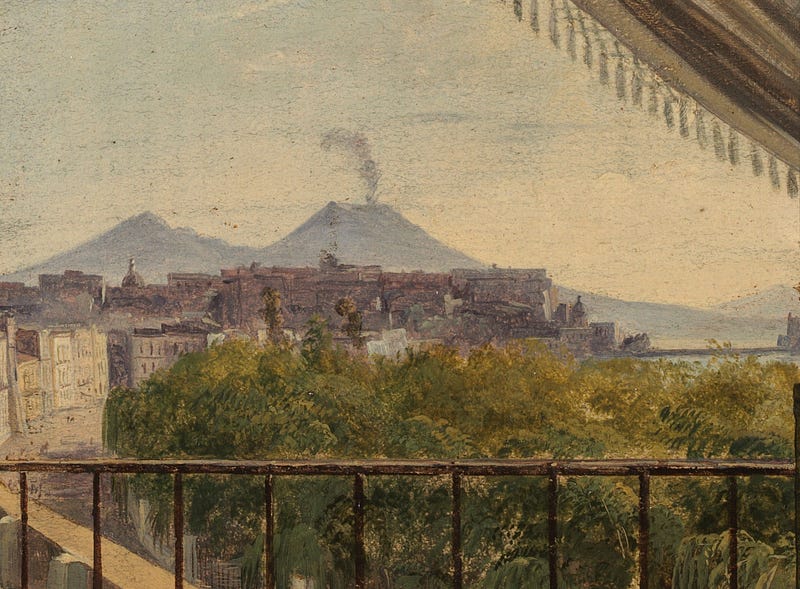
One of the great emblems of romantic sublimity that Italy had to offer — along with the remnants of its Classical past — was Mount Vesuvius near Naples. Many artists painted it, partly admiring and partly fearing its destructive power.
This painting was made in 1824 — the most recent eruption of Vesuvius was only two years before in 1822. The next would be in a decade’s time. All told, the volcano erupted 8 times during the 1800s, making it one of its most active centuries.
Yet what Catel gives us is not the violent aspect of the volcano but its agreeable tranquility. The potentially devastating force of Mount Vesuvius is contrasted with the shelter offered by distance and the sense of orderliness in the hotel room.
Above all, the painting is an invitation.
Perhaps we are sat on the bed; perhaps we have made plans for later, when the sun has set and the summer air has cooled. A light breeze moves the curtain. The sounds of horse hooves and conversation drift up from the street below — beckoning you to make your own speculative journey into Naples via the window.

If you liked this, you may also be interested in my book Masterpieces of Art Explained, an examination of some of art’s most enthralling images.
Would you like to get…
A free guide to the Essential Styles in Western Art History, plus updates and exclusive news about me and my writing? Download for free here.
Join me…
On Instagram for more great paintings on the go!