
What’s the Point of St. Patrick’s Day, Really?
To get drunk on green beer, obviously.

As a kid, I always felt special on St. Patrick’s Day. I was proud of my Irish heritage, thanks to my parents and my grandmas with Irish maiden names (Hagan and Cryan).
Even though I have green eyes — which gives me pinch immunity, of course— I always made sure to wear green on March 17th.
No, I didn’t pinch anyone (well, my little brother), but I’d tease them in my authoritative way. I understood the holiday better than most, even as early as 2nd grade. It was about celebrating your Irishness, even if you weren’t Irish.
Being Irish was a state of mind. Because I was actually Irish, I felt like the ambassador of Irish-American-ness among my peers. Pitifully, I wasn’t yet aware of how common it actually is to be Irish in America.
The Man
March 17th is a Catholic saint’s feast day, and a saint who wasn’t even Irish — unlike Ireland’s other patron saint, Brigid, but that’s another article.
Patrick was born the son of a well-to-do Roman-British family before the fall of the Roman Empire, and within the same century Emperor Constantine converted to Catholicism.
A few popular saints come from the first few centuries between the beginning of Christianity and the fall of the Roman Empire. Some were persecuted by the Romans, like St. Lucy and St. Valentine.
Luckily for Patrick, Rome had already come around to Christianity by the time he was born, so he got to live to a ripe old age.
The reason Patrick is associated with Ireland is because he is held responsible for converting all of Ireland from pagan druidism to Catholicism.
He was actually kidnapped by pirates as a teenager, and spent about six years herding sheep. During this time as an enslaved shepherd, Patrick became ultra-religious.
At some point he escaped back to his family in Britain, but he eventually returned to convert all of Ireland into good and proper Catholics. That’ll teach ’em.
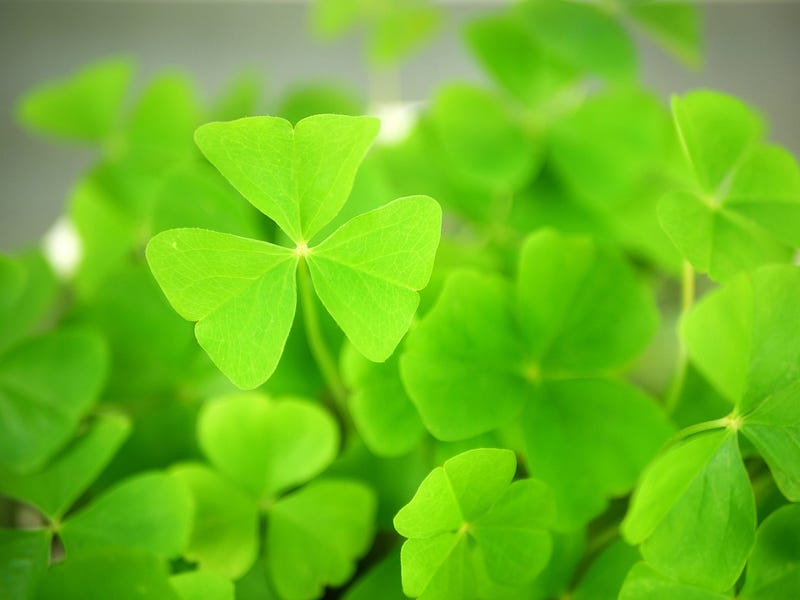
Shamrocks are associated with St. Patrick’s Day because a legend holds that Patrick used the three leaves of the shamrock to demonstrate the Holy Trinity to the Irish people — three beings in one.
The Famine
The Irish people have held St. Patrick in high esteem as a religious figure for about 1,700 years, but during the 19th century, Patrick took on a new role.
The reason St. Patrick’s Day is such a big deal in the United States is due in large part to a little thing called the Great Potato Famine. Although Irish immigration had already been going on for decades, the 1840s brought a sudden flood of Irish to the United States.
To understand the Great Famine is to understand the political turmoil going on between Ireland and Britain for centuries. Not to go into too much detail here, but the Brits were not kind to the Irish.
Britain and the Crown regarded Ireland as the red-headed stepchild of the British Empire.
A huge portion of Ireland’s population was taxed into poverty.
When the potato was introduced to Europe in the 16th century, it was a bizarre new food that slowly became recognized for its true value.
Many Enlightened rulers around this time were actively encouraging the cultivation of the new potato due to it’s versatility and plentiful harvests. It was cheap to grow, and farmers could produce twice as much food crop with potatoes than they could with cereal crops like wheat on the same piece of land.
Famine was a common problem for Europe in the 16th and 17th centuries, and potatoes appeared to be a solid solution.

By the end of the 18th century, the potato had become a relied-upon staple in the Irish diet.
So when the potato blight hit in the late 1840s, disastrous was an understatement. In fact, some cite it as the worst catastrophe of the 19th century.
The potato blight — a disease that rots the vegetable from the inside out before it can be harvested — spread all over Europe and destroyed everyone’s potato crops. The reason we associate it so closely to Ireland is because, unlike in the rest of Europe, it’s estimated a million people died as a direct result of the potato crop failure.
Ireland lost a third of its population in the middle of the 19th century.
The New Home
A million Irish starved to death and another million emigrated from about 1847 to 1853, a number that only grew in subsequent years.
The United States was the obvious choice to flee. Emigrants from all over Europe were going. The land of hope and opportunity.
It can be argued that St. Patrick’s Day wasn’t really a thing — at least not as we know it — until sometime after the mass influx of Irish started working to carve out an identity in their new home.
So many Irish came over within a short amount of time. Americans screamed about immigration laws — you know, like how some Americans do now about Hispanic immigrants.
Ah, some things never change.
The Irish were heavily discriminated against in America in the decades following the exodus from Ireland.
Few places would hire them, so Irish immigrants mostly worked the manual labor jobs no one wanted (that also sounds familiar).
Irish immigrants built much of the railroad in the East.
I reference this subject in a blog post discussing the Irish immigrant presence in my neck of the woods.
Despite the roughness the Irish experienced, anything was better than starving to death; they made the best of American life.
They eventually became a huge political force in New York and Massachusetts when Irish-Americans realized their numbers alone could swing votes.
St. Patrick became a rallying symbol, an identity, for Irish-Americans who missed their homeland.
St. Patrick’s Day — the feast day of Ireland’s patron — became a day when it was okay to be Irish again and celebrate the shared values and heritage that made Irish-Americans different from other Americans.
It became Irish party day.
Irish is second only to German as the biggest heritage demographic in the U.S. According to data from the last census, about 31.5 million people have Irish roots in their family.
So, no, I probably wasn’t a minority as an Irish-American in my peer group as a kid. If your family has lived in the United States for more than a couple generations, chances are you, too, have reason to celebrate Irish-ness on St. Patrick’s Day! Yes, drink green beer if you’d like, but don’t forget to eat a potato — and thank heaven it isn’t your only source of food.
Thanks for reading! For more from me, grace me with a follow. I also write for The Customs House Museum & Cultural Center. You can find me on Twitter and Instagram as Meggiebeth_Writes.