
THE NUANCE
What’s the Minimum Amount of Movement You Need to Offset Your Sedentary Lifestyle?
Just a few seconds of activity once or twice an hour may be enough, research finds.
Last weekend I watched the movie Wall-E with my kids. I hadn’t seen it in years, and I’d forgotten how it depicts humans of the future as hovercraft-bound blobs who spend their days staring at screens, relying on AI-powered robots do all the work.
The movie is set in 2805, but it feels like we’ll get there a lot sooner.
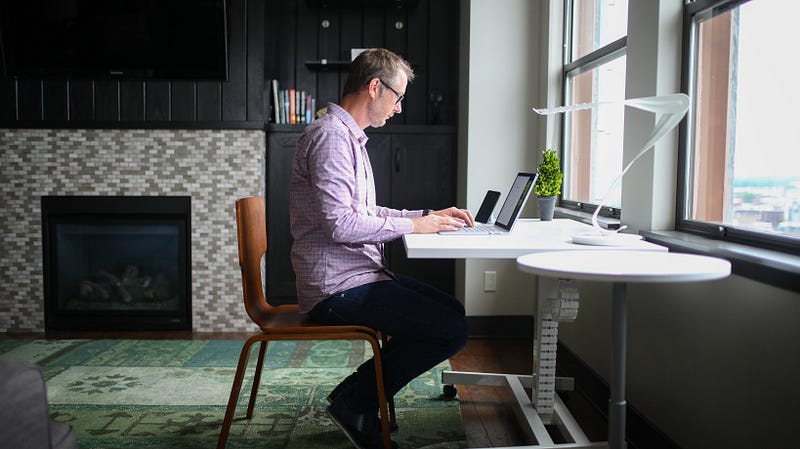
For many Americans (and I’m one of them), movement has already become a matter of choice rather than necessity. Over 80% of U.S. jobs are now predominantly sedentary, which represents an 83% increase since the 1950s, according to research in the Journal of the American Heart Association. The rise of online social networks and streaming services, home grocery delivery, remote work, telemedicine, and countless other shifts in the way we live have obviated most of the need to move body parts other than our fingers and eyeballs.
“Humans’ way of life has changed dramatically,” observed the authors of a 2018 paper in Frontiers in Public Health. “A sedentary lifestyle has become the default modern lifestyle in most societies.”
‘While sitting motionless, our bodies and minds degenerate and age quickly, leading to chronic disease and premature death.’
We’ve known for a long time that exercise is healthy. But it wasn’t until recently — around the time Wall-E came out — that medical science started to recognize the independent dangers of prolonged sitting and other sedentary behaviors.
To date, research has strongly linked excessive “chair time” to an increased risk for pretty much all the major diseases — heart disease, cancer, type 2 diabetes, etc. — as well as for premature death, depression, and declining cognitive capability.
“While sitting motionless, our bodies and minds degenerate and age quickly, leading to chronic disease and premature death,” says Emmanuel Stamatakis, PhD, a professor of physical activity, lifestyle, and population health at the University of Sydney in Australia.
Unfortunately, working out a few times a week may not be enough to negate these threats.
“Something is generated with prolonged inactivity that affects a number of the body’s systems, and these bad effects seem to be separate from the good effects of exercise,” says Edward Coyle, PhD, a professor and director of the Human Performance Laboratory at the University of Texas at Austin. “You can be an active couch potato, as they call it, where you’re meeting all the guidelines for exercise, but you’re still at increased risk for heart disease and death because you’re sitting still the rest of the time.”
A lot of Coyle’s recent work has examined how different forms of movement can counteract the bad stuff that happens to a body at rest.
“We’ve been studying fat metabolism because it is rapidly responsive to both inactivity and exercise,” he says. “I think inactivity is affecting a lot more than just fat metabolism, but we’re using [fat metabolism] as kind of the canary in the mine.”
For a 2020 study, he and his colleagues had people either sit for eight hours (mimicking the average office worker’s day) or get up once an hour to complete a series of five very short (four-second) sprints on a stationary bike. Those 20 seconds per hour of “non-fatiguing” movement were enough to block the kind of fat-metabolism impairments observed among the sedentary group, he says.
‘Break up prolonged sitting every 20 or 30 minutes.’
“It raises the question as to what is the least amount of exercise that can acutely improve fat metabolism and other aspects of health,” he and his study co-authors wrote.
He says that if you’re moving more frequently — say, every half hour, as opposed to every hour — even very brief and mild forms of movement might be sufficient to reduce or eliminate the risks of prolonged inactivity. “Running up a flight of stairs might be more practical than a stationary bike,” he says. Going for a fast walk, or doing a few lunges or jumping jacks, are some other options.
Another study, this one from 2022, found that just four minutes of vigorous non-exercise movement, spread out throughout the day, were enough to reduce (by more than 40 percent) the mortality risks linked to a sedentary lifestyle. That study considered brisk walking and stair-climbing as activities that count toward the four-minute total.
U. of Sydney’s Stamatakis was one of the authors of that 2022 study. Asked what advice he would offer for people who want to avoid the risks of a sedentary lifestyle, he says, “Break up prolonged sitting every 20 or 30 minutes.”
Does simply standing up count for much? (I have a sit-stand desk, and I wanted to know if being up on my feet half the day was doing me any good.) “Regularly alternating between sitting and standing will involve some muscular work and would be better than continuous sitting,” Stamatakis says. “But on its own, standing is unlikely to lead to substantial benefits.”
Coyle offered a similar take. “We had people either sit for 12 hours or stand for 12 hours, and we found the responses were about the same, sitting or standing,” he says. (There is some work that finds standing may be better than sitting for insulin sensitivity, which could lower a person’s diabetes risks.)
‘The healthy thing to do is to move enough throughout the day, and then also exercise on top of that.’
After speaking with these two researchers, I started using the timer on my phone to remind myself to move every 30 minutes. Sometimes I just jump up and down a few times. Sometimes I do a dozen pushups. Once in a while I walk around my block.
Apart from helping me break up long bouts of inactivity, I’ve found that these short timeouts pay off in other ways. They give my brain a quick breather from work, and I often come back to my computer with a fresh idea or a bit more clarity of thought.
There are still a lot of gaps in the research on sedentary lifestyles. But at this point, no one doubts that the risks are real.
“The healthy thing to do is to move enough throughout the day, and then also exercise on top of that,” Coyle advises. “So it’s really two components — one to prevent the bad, and another to gain the good.”
Thanks for reading the Nuance. If you appreciated this piece, please share it with others. If you aren’t already a Medium subscriber and you plan to join, please use my referral link. You pay the same thing but Medium gives me a cut. — Markham