
What’s the Meaning of Eternal Life?
Confronting Christians’ vision and longing for heaven

When engaging with Christians, they often ask me what is the point of this life if I believe there is no afterlife. It’s a good question worthy of exploring. To start, I usually reverse their question and ask them:
What is the point of this life if you believe there is afterlife?
Some Christians would stare at me with a blank face as if the question I pose has never previously entered their minds. But of course, seasoned Christians know how to respond: to preach the gospel to the unsaved people (Matthew 28:19); to accumulate rewards in heaven (Matthew 6:20), etc. Some Christians take bodily resurrection seriously and believe that heaven is actually the same place as the Earth (Revelation 21:1–3). They might say that the purpose of this life is to take care of the Earth and the fruits of their labor will manifest when the Earth is transformed during Jesus’ second coming.
As one can see, all of those activities revolve around enriching believers’ future life in heaven, which supposedly will last eternally.
Then I ask a follow-up question.
What’s the point of spending eternity in heaven?
If the significance of this life is tied to the afterlife, which is a belief held by the majority of Christians, it becomes necessary to demonstrate the meaningfulness of that afterlife. Christians need to establish this first before they can argue that this present life, when dedicated to preparing for the afterlife, holds meaning.
In this short article, I argue that there is actually little point in living an eternal life in the Christian version of heaven. You will not find the ultimate meaning by living like that.
What is a Christian’s purpose in heaven?
To worship God
The book of Revelation presents a picture of people constantly worshipping God in His kingdom. I am not sure if this act of worship is scheduled 24 hours a day, 7 days a week or something, but I hope Christians would not object if I say worshipping God takes a large chunk of time in their daily routines in heaven.

But what is the purpose of worshipping God, praising His glory? Does the act of worship increase God’s glory? No. God already possesses infinite glory. So no amount of worship will add to what He already has.
Perhaps the act of worship soothes God’s mood? But surely that can’t be the case. The notion that our worship can affect God’s mood is contradictory to the Christian understanding of God. If worship were capable of improving God’s mood or self-perception, it would imply that God can be influenced by humans, which is not in line with the concept of God presented by most Christian churches. Furthermore, the question arises as to why God would require constant worship if He is already self-sufficient. After all, a person who is confident and secure does not rely on constant flattery from others to feel good about themselves.
So basically Christians will engage in futile labor in heaven, which produces no tangible results and makes no real difference. Their presence will be superfluous and there is nothing they can do about it. And they will continue this for millions and millions of years, into eternity.
That doesn’t sound too exciting, does it?
To know God
Some Christians say we will get to know God in person, learning about His greatness. Since God is infinite, we will spend eternity in heaven getting to know Him, always finding new things about Him.
But what is the point of that? I may be curious about who God is now, but after a million years of meeting Him in person, surely my curiosity would be satiated at some point, and want to spend more time doing more constructive things.
While some naturally curious individuals may derive great enjoyment from continually deepening their understanding of God, surely there are others who will reach a point where they feel they have acquired sufficient knowledge about Him. From that moment onward, they will become bored for the remainder of eternity. As I type these words, I can sense the weariness that accompanies the thought of enduring such an experience.
While it’s not terrible to feel bored, it definitely does not feel like a meaningful life to have. What is the point of living this kind of life anyway? What constructive things can result from us knowing more about God? I can’t think of any.
To rule over the Earth

The New Testament talks about the faithful Christians reigning with Christ in God’s Kingdom (2 Timothy 2:12; Revelation 5:10). However, the specific duties or responsibilities individuals will have in heaven are not clearly outlined in the Bible. Despite this lack of clarity, some Christians find the idea of participating in God’s Kingdom appealing.
Let’s get this straight. If God is already in complete control of His Kingdom, what can you possibly contribute? To reign with an omnipotent and omniscient God means your tasks will inevitably be redundant or unnecessary.
Imagine working as a software engineer in a tech company where you’re partnered with a highly advanced and fully automated AI. Your task is to develop software together with this AI. Whenever your team receives an assignment from your superior, the AI swiftly creates flawless code within a second. While you have the option to review the code, the AI’s superiority ensures that you won’t find any flaws. You can attempt to write your own code, but the AI, recognizing imperfections, will correct them before submitting the final product to your manager.
How would you feel in such a working environment? Will you find a sense of purpose, feeling that your job is meaningful and fulfilling? Or would you feel useless, and perhaps worthless?
The latter seems more probable.
That is how you will probably feel when you reign with Christ in heaven. And guess what? You are stuck with that job! You don’t have any other options.
To have pleasure
In this life, indulging oneself in pleasure is discouraged by the teachings in the Bible, but in heaven, faithful individuals will have the remarkable opportunity to indulge in an array of boundless pleasures and forms of entertainment. What makes it even more extraordinary is that God will transform us in such a way that we will not grow numb to the constant excitement, unlike our experiences in this present life. That has to be something that everyone eagerly looks forward to, right?
Not necessarily.
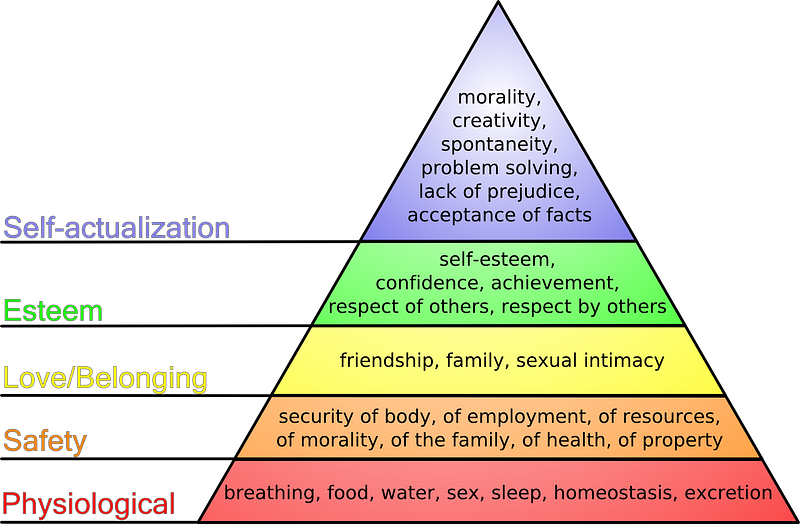
Based on Maslow’s model, it can be argued that the Christian concept of heaven addresses only the first three levels of human needs. However, if you find yourself as the sole Christian in your family and with few Christian friends, there may likely be an emotional void in the third level that cannot be filled even in the heavenly realm.
To allure people to believe in Jesus by promising that they can have all their desires fulfilled in the afterlife is an act of promoting self-centeredness, to say the least. While having constant fun is better than experiencing pain, it falls short of giving meaning to having eternal life. If heaven is all about fulfilling one’s own desires, there is no higher purpose involved.
Christians usually don’t say that fulfilling one’s needs is considered the ultimate meaning of life. If heaven offers nothing more than fulfilling desires and engaging in futile labor, such as reigning with omnipotent Christ and worshiping God whose glory is already infinite, then it raises the question of how Christians can claim that the ultimate meaning of life can be found in God’s kingdom.
Are you still you?
Some Christians may raise objections to the points I have discussed above, asserting that I am evaluating the concept of heaven from an earthly perspective. They might argue that God’s transformative power will shape us in such a manner that we will find contentment in heavenly life, regardless of our current perceptions. While it may be true that worship in heaven does not generate additional glory for God, they claim that we will no longer be concerned about it. Similarly, although the constant fulfillment of our desires might appear trivial from our current vantage point, according to Christians, our perspective will shift once we inhabit that realm.
Under such circumstances, it appears that the aspect of my individuality as a human being would be stripped away. The freedom to determine my own identity and make personal choices would no longer be within my purview. Instead, my primary purpose would revolve around worshiping God and obediently following His commands.

If God were to command me to be joyful, I would automatically experience joy. If He were to instruct me to jump, my immediate response would be to ask, “How high?” without entertaining any other thoughts or considerations.
In other words, our minds will be “standardized”, programmed to want the same things. We will never feel negative emotions, never feel something is missing, and never be sad because of the lost family members and friends.
We will no longer be ourselves. We will become robots! Forever and ever!
Do you really look forward to becoming like that?
Conclusion
It reminds me of Howard Stern’s question to me. “Tell me, governor, what happens to us when we die?” I said, “Nothing. You’re 6 feet under. Anyone that tells you something else is a fu**ing liar.” — Arnold Schwarzenegger
The concept of heaven found in the New Testament becomes more understandable when we consider the historical context in which it was developed. Back in ancient times, extreme poverty was the norm, making it natural for people to long for a heaven that offered endless gratification and relief from pain. The idea of “reign” within this heavenly context can be traced back to the experiences of first-century Jews who lived under the rule of the Roman Empire. It’s no wonder that they eagerly longed for a future when they would be free from such oppression and could exercise authority over their own land.
The concept of heaven is entirely man-made. Life in such heaven is not as meaningful as you might be led to believe. You don’t have to fall for it.
If you are not a Medium member yet, please consider signing up using my referral link. I will get a small commission at no extra cost to you.


