
What’s the Key Factor Supporting Equity Returns?
The negative real interest rate support the risk asset, i.e. Equity/Commodity/Corporate bonds/Alternative market.
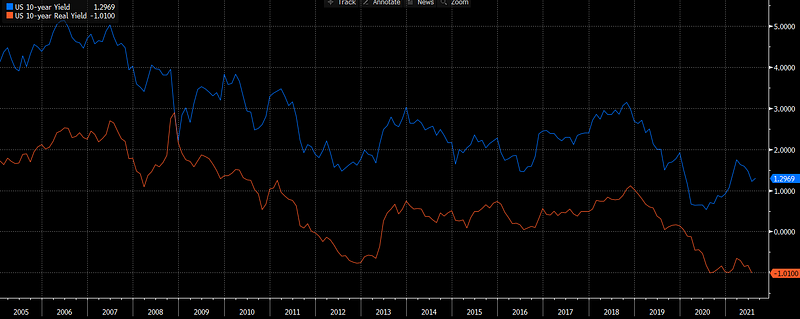
Quantitative easing brings the nominal rate and real rate lower. It could take a long time to go back to pre-COVID level. The ease monetary policy fuel the risky assets, and in the same time reduced the attractiveness of save heaven assets, i.e. treasury bond.
Jan 2020, right before COVID, the 10y real interest rate was around 0.07%, while it’s -0.15% now (Aug 2021).
Pls join our real time market update via Telegram! https://t.me/+W03xzPl3C9c5OGE1
Why we need to care about the Real Yield?Relationship between Negative Real Yield and the Stock Market
For stock prices valuation via discount free cash flow model, lower yields help pull down the discount rate and drive the share price higher.
All else equal, the decline in the nominal US 10-year Treasury yield from 1.9% to 0.7% could be seen as providing a 25% boost to the S&P 500, according to a report by Michael Sneyd and Kaushik Banerjee of BNP Paribas. The effect of falling real yields on stock prices should be similar.

👍 For more stories, pls follow my Future Playbook facebook page! 👍
Real Yield
Real yields are what you get on U.S. government bonds after compensating for inflation.
Yields on inflation-protected government bonds are considered proxies for so-called real yields — or the expected return that investors can get on either nominal or inflation-adjusted government bonds when accounting for expected inflation. - Sebastian Pellejero, WSJ
What’s Negative Real Yield means?
At current levels (-1.0%), it implies that holding 10-year government bonds to maturity would loss money after taking inflation into account.
It pushes investors to buy riskier assets such as stocks, commodities, corporate bonds or alternatives in search of higher returns.
TIPS
TIPS are notes and bonds, issued by the U.S. Treasury. The value linked with the Consumer Price Index (CPI), which measures the inflation.
When inflation rises, the TIPS goes up. On the other hands, when inflation declines, the TIPS’ value and interest fall together.
During COVID outbreak in March 2020, the stimulus made by the Fed delivers a Dovish message to the market, such that increase the inflation expectation by the market. At that moment, TIPS outperforms US Treasury.
However, then the inflation expectation is peaked out at 2.3%, the market speculators change the expectation again. They expects that the Fed may control the inflation, in order to prevent overheat of the economy.
The Fed announced a Average Inflation Targeting framework (AIT), which anchor the inflation at 2%.
At this situation, as inflation expectation is going to fade out, the TIPS begin underperforming the US Treasury.
What’s the difference between investing in TIPS and US Treasury?
When the market expects the inflation is going to rise, then the TIPS outperforms the US Treasury, and vice versa. That means TIPS is trading the inflation expectation and the expectation of US monetary policy. That’s why the FOMC meeting notes is critical to investors.
*** This article is NOT an investment advice.