
WRITING
What’s the Difference Between a Memoir and a Personal Essay?
Confused? Get in line!
Memoirists,
One question.
We are inundated by one question all the time. And we constantly do our best to answer it. But to even the most seasoned writers, it’s confusing and vague. And with good reason. Because it is. The question:
What’s the difference between a memoir and a personal essay?
It’s vague because there is a fine line between the two and some overlap. After all, a memoir is a personal essay while a personal essay is not necessarily a memoir. A memoir is a story, while a personal essay is not necessarily a story. Both are creative nonfiction. Confused yet?
Memoir focuses on a specific event from the past through the personal viewpoint of the author; a personal essay uses the author’s personal experience, whether current or from the past, to explore themes with viewpoints relative to the reader.
Still unclear? Let’s try it this way. I created an infographic that may help.
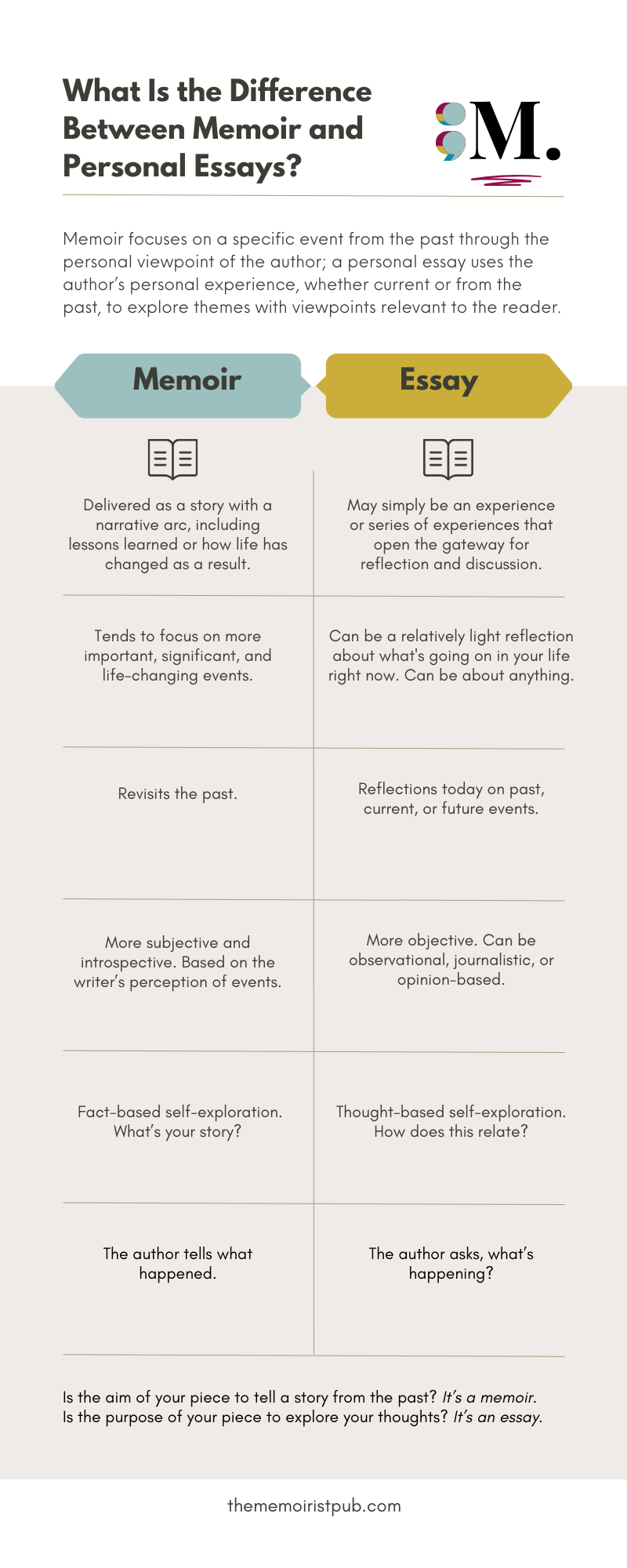
Does your piece tell a story with a full narrative arc? Does your piece happen in the past? Are you telling a true story that happened to you, rather than someone else? Is the piece told through your thoughts, feelings, and perceptions of the event? — Then your piece is most likely a memoir.
Is your piece less of a cohesive story and more of a thought-provoking experience or series of anecdotes? Is your piece about a current or future event? Is there a universal theme? Can others relate? Is the primary focus of your piece to provide insight, reflection, or commentary on your topic? — Then your piece is most likely an essay.
Memoir is based on the me in a memory. It tells a story. Personal Essay is based on my thoughts about a theme, event, or memory.
Either way, there is beauty to the art of creative nonfiction and sometimes we need to get our words out to the world, whether through telling a story from our past or reflecting on the funny things our kids do.
Art is art all the same.
My point? Don’t fret too much about it. Our editors are here to help you with this. Luckily, we have sister publications for memoirs and essays; sometimes we have to do a little shifting around, but we do our best to place your piece in the right home.
One last thought.
Just write.
Just write what you feel. At least for your first draft. Get it out. Your thoughts, your feelings. And build the foundation for the piece you want to create. Sometimes shaking it off and not worrying about the technical aspects of writing, including what a publication is looking for, is the best thing you can do for your creativity. At some point, you’ll need to decide if you’re telling a [true] story or sharing your reflections. Make sure that point comes so you’re clear, but it doesn’t need to happen during your first draft if it trips you up.
It’s all in the way you communicate it. You can have the same topic. Same memory. You may either want to tell the story from beginning to end with your feelings from the time, or you may want to reflect on what happened, interjecting with your thoughts today about it.
Either way — you’re a storyteller. Now, go write.


