
What’s The Big Deal About Calling Yourself A Writer
Your imposter syndrome is tackling the wrong issue.
New or struggling writers come into my orbit from time to time. I read their pieces on Medium or their blogs. They ask me for editing or writing advice. Or, birds of a feather, writers just find each other.
More often than not, these individuals reveal their reluctance to identify themselves as writers. They will say things like Some day I want to be a writer. Or, I’m an aspiring writer. Maybe, I have a dream of being a writer.

And then there’s the declaration that makes me want to throw something at the wall. “I’ll call myself a writer when I get published.”
How do you think you’re going to get published if you’re not a writer, for chrissakes?
Yes, I get impatient. I know it’s something I have to work on. I hope it doesn’t show because writers have enough baggage. Don’t believe me? Try writing a compelling opening sentence to a story that will hook your reader to the end.
I’ll be here filing my nails when you’re done.
Seriously, the biggest wall to unleashing our creative powers is the one we construct ourselves. The refusal to identify as writers, the very thing we work so hard at doing.
I’m not being a crotchety old lady about this, snapping at young people because my corset’s too tight. I’ve been there, afraid to tell people I’m a writer, and I know what a consummate waste of time it is.
Here’s how you know if you’re a writer. Get a piece of paper. Write something on it. Boom. You’re a writer.
Seriously, it’s that easy. Or hard, depending on how resistant your muse is to coughing up words for you. But once they emerge from your subconscious and you capture them on paper or your phone screen or wherever you write, you’ve got the title. I’m serious. Here’s a story for you to prove my point.
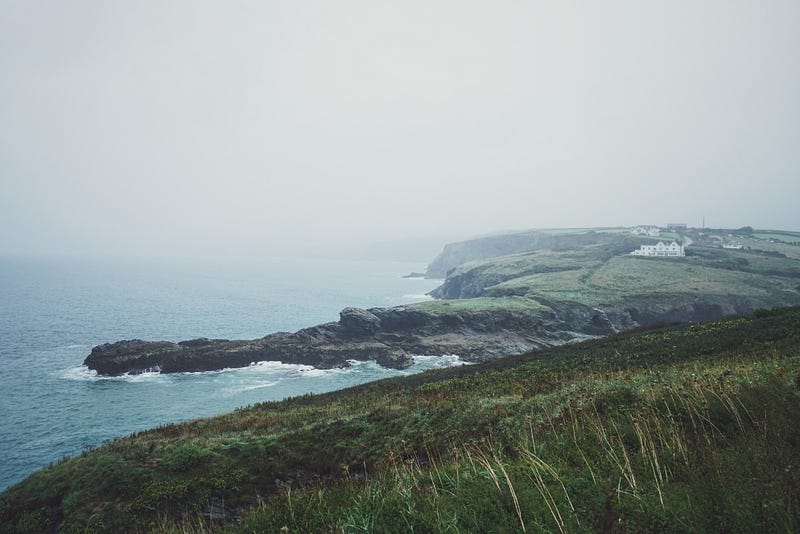
Many years ago, I lived in a house that was the ideal writer’s retreat. It perched on a cliff overlooking the ocean and enticed wonderful people to come and visit. One memorable weekend, we hosted a group of friends, all of them writers or readers and deep thinkers. In the middle of a conversation about the difficulty of writing, one guy popped up with , “Oh for god’s sake, how hard can it be?”
Now David, I don’t recall his last name, was basically a big brain that walked. He had many degrees in science and was one of those highly educated, extremely articulate Brits who’s read everything worth reading. If he hadn’t been funny and very good company, he would have been insufferable to those of us struggling to master the basics of our native language.
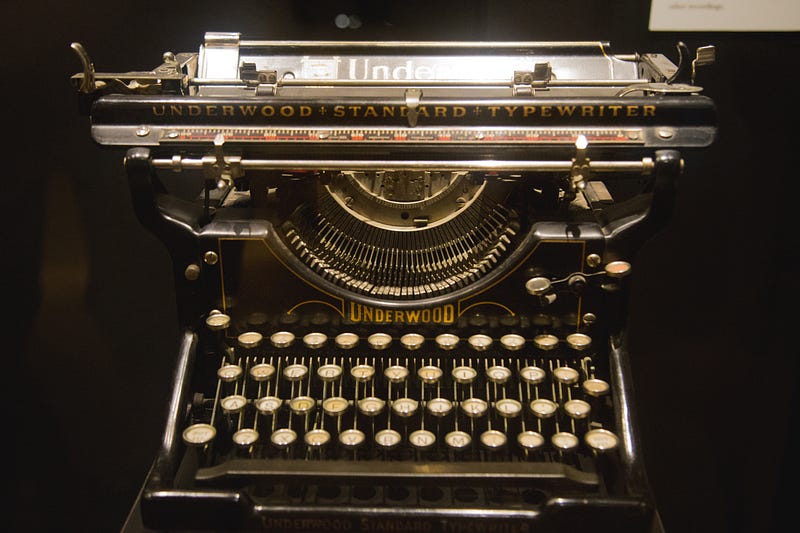
The writer with whom I cohabited at the time, had had enough. “Okay,” he said, leading David to his precious, aging Underwood. (I said this was a very long time ago. An Underwood is a typewriter, this one an antique. See photo above. Yes, he wrote books on it.} So my co-host stuck a sheet of paper into his old-fangled machine and said, “Write something.”
Arrogant as all get out (that was David down to the ground), our guest smugly sat down to write in the privacy of the back room, and we resumed our railing and whining and drinking in the living room. Some time later, David emerged with the blank sheet of paper in his hand, somewhat abashed.

“I couldn’t think of a thing. This is hard.”
So there. If you come up with a few lines of anything, and you’re serious about it. Not doing it as a joke, please, call yourself a writer and be done with it. It’s not like accepting the label assigns you the world’s greatest muse, and you’re on your way to Pulitzers, Bookers, and the Naughty Novel of the Month awards.
A writer is simply someone who puts words to paper. I have an idea why people have a hard time naming themselves as the thing they most admire.
I struggled with it for years myself. That is why I’m so impatient when I hear someone choked with embarrassment or insecurity when they have to tell people what they do. But impatient in the best possible way. Impatient because I care, because I understand the road writers must walk. The impediments in their way. The many heroes we have that can inhibit us.
I think back to all the years I wasted worrying about whether I was a writer. And I mean worry with a capital WORRY. At times I couldn’t move on with my life because there was this thing I wanted more than life itself. It was my purpose in life, to be a writer, and yet it was beyond my reach because something in me could not say the words, Yes, I’m a writer. I could not let myself believe the truth in that.
I‘d’ think things like, what was I doing with myself? What was I worth if what I longed for, my reason for being was impossible? And I suffered all this angst after I’d published a book. Go figure.
I worked myself into thinking I wasn’t a real writer because my first book was a cookbook. As if nothing in that book had to do with writing.

The pleasure and excitement I got from writing about food and cooking, the instructions on how to prepare the recipes, the information about health and good habits. All that stuff was in there. I’d written every word under the guidance of a doctor and nutritionist, yet I still refused to call myself a writer.
It wasn’t fiction. It wasn’t a short story or a novel, so I made up this thing that it didn’t count. Even though newspaper critics loved the book and wrote glowing reviews and book clubs named it Book of the Month.
It would be years before I finally choked out the words, not believing them, but determined to get over this block I had. So determined to prove my sincerity to myself about wanting to write, that at a cocktail party, when someone said, and what do you do, Helen, I managed for the first time, in some gargled, strangled voice, to utter the words, “I’m a writer.”
And it was done. I never went back. Sometimes I would answer,”I’m a secretary.” I might not admit it at times, but I never evaded the subject again because identifying myself with my craft and my art intimidated me. Or because I believed I couldn’t have the thing I wanted so much.
It would take more years, after many writing classes, reading every book on the craft I could find, after writing draft after draft of story after story, that I realized calling myself a writer was not the point.
And this is why I’m writing this article today. This is my message, if I have one for new writers. Suddenly, I realized I’d been struggling all this time with the wrong question.

Of course, I was a writer. I was a writer before I’d ever written a word. I remember curling up with books on my couch at a young age and getting irritated with a beloved author’s word choice, or lack of description. I was so into reading, books and language from the time I could read that before I’d even begun to write, I was an editor.
I was a storyteller because I was my mother’s daughter.
I couldn’t add 2 and 2, but I aced every reading comprehension and English class I ever took.
How could I not be a writer? That was the easy part.
All those years I worried over the wrong question. I shouldn’t have been asking, am I a writer. Anyone can be a writer. Everyone has the right to call themselves a writer if that is their passion, their calling.
Calling yourself a writer will not free you of doubt, if doubt plagues you. That’s tied to issues that have nothing to do with writing. Doubt just seems to attach itself to things we care about. But identifying yourself with your passion frees you up to buy any book on writing, take any class, close the door to any distraction in pursuit of your craft.
Instead of worrying about whether I was a writer, I should have been asking, how do I become good at it?
Yet, in a way, that’s even the wrong question. On a given day, we might master structure or dialogue. The next, we might find our language failing us, and we can’t put a simple sentence together. Our work is learning the craft.
It’s up to the reader to decide if our work is good. And in fact, in the end, nobody knows what makes a good piece of writing. Some people revere Chekov. Some people don’t. But those people might like what you write.
The question that is most useless to me, next to Can I call myself a writer? is Am I any good? The ego will answer for us, and we know how untrustworthy an oracle that is. It leaves us asking whether we should believe it when it says we’ve written the best thing since Proust, or give it up, this is garbage?
We should be asking, How do I crack the code to believable dialogue? Who should I read to teach me narration? What should I write to practice tightening my prose?
These are questions that take a lifetime to answer. I realized long ago that my passion for writing would keep me young because I would never master any of it, much less all of it. So I’m always learning, and that process constantly rejuvenates me, no matter my age. No matter what I call myself.
The effort to become good at writing is my daily labor, my life’s work, my reason for being.
I’m an editor and writer on Medium with Top Writer status. I’m also an editor for the publication, Rogues Gallery. I’ve published 55 titles on Amazon and edit for private clients. If you’d like to hire me as your editor for fiction, non-fiction, or business writing, please contact me here. If you’d like to read more of my work on Medium, click here to sign up for my newsletter. I’ll make sure you don’t miss a word. Thank you for reading.


