
What’s Love Got to Do With Marriage?
How You Define Love Matters
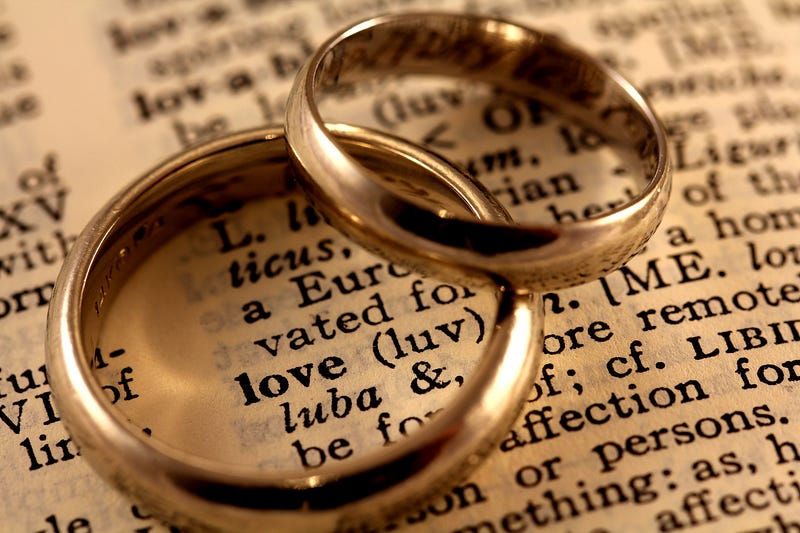
I recently celebrated my 28th wedding anniversary. I’m not just married, I’m blissfully married. I fantasize about my husband when he is gone. Our frequent tit-for-tat power struggles last approximately two minutes before we’re back to holding hands. We spend most evenings dreaming together about our next travel adventure.
Love and Marriage
According to Pew Research Statistics, the value of marriage is declining as more Americans over the age of 55 divorce. Americans are also waiting longer to get married. My husband and I were in our early thirties and late twenties when we took our vows. Neither of us had been previously married.
Among couples who get married today, only 60% of those unions involve two first-time partners. In 20% of the unions, one spouse is previously married. That rate is equal for both spouses being previously married. Unfortunately, practice does not make perfect. The likelihood of a long-lasting marriage decreases with each nuptial.
Although the majority of couples identify love as the motive for marriage, love has its own motives. Love is a relatively new concept as a marriage motive, which may contribute to the increase in uncoupling.
Marriages used to be arranged based on family compatibility and resources. Love was more about the actions people took toward one another, like providing finances, personal services like cooking, caring for offspring, and sharing social and religious affinities.
Relationships were scripted, and divorce was not part of the script. The script, however, has changed. Not only is divorce in the script, but the idea of love has become more abstract. The actions that people expect their partner to do in the name of love may have little to do with love.
“Need” is the Understudy for Love
Many people enter into committed relationships to fill a void. When the void is filled, they feel loved. Unfortunately, voids have a way of being insatiable. The unsuspecting partner can get frustrated by trying to meet the demands placed upon them.
Three common voids show up in relationships. The voids are unconscious but drive conscious behavior. Voids impose roles upon partners that manifest as unhealthy expectations. Conflict arises when expectations become the focus of the relationship rather than growth.
The Need for Distraction: Some people have difficulty being single. They feel incomplete like something is missing. They are uncomfortable without intimate companionship to center their life around.
People who use love as a distraction may sacrifice everything to be with someone. They give a lot to their partners and may feel more love for their partners than for themselves. Herein lies the problem.
The relationship is likely to stagnate because there is little room to grow as individuals. The relationship does not allow in new excitement because one person is holding on too tight to the other. If one partner tries to do something that takes the focus off of the relationship, conflict arises. Loneliness is triggered.
Use little imagination to guess what can happen when loneliness is triggered. The search for another distraction is initiated. In the best-case scenario, the new distraction is something that can benefit the relationship like going back to school. In a worst-case scenario, the new distraction is a “love” interest.
The new love interest has little responsibility compared to the spouse. All the love interest has to do is distract. The spouse is still responsible for building a whole life, including negotiating extended family boundaries, raising children, budget planning, and making education decisions.
There’s hardly a spat with the love interest. Which brand of butter to buy, whose house to visit first on Thanksgiving, and when to let the children date don’t come up in conversations. There’s no fuss about who should wash dishes, leaving the shower on scolding hot, or not putting down the toilet seat.
The love interest can easily become favored over the spouse. The needy person gets caught up in an illusion that the love interest fulfills their needs. They don’t consider the fact that there was little need left for the love interest to fill.
Divorce is eventual when distraction is the expectation of the marriage. In healthy relationships, each person is responsible for their own joy. When two people bring joy into the relationship, the pleasure is magnified for both of them. But, when one person brings a void to be filled by the other, there will eventually be too little joy to go around.
Need to Feel Protected. Adverse life experiences can lead to a sense of emotional or physical insecurity. The insecurity can manifest in relationships by showing up with a victim mentality. An insecure person may continuously remind their partner that they were victimized in some way. The focus is not on healing or resilience, but on victimization.
The entire relationship may revolve around the past victimization. The partner is assigned the role of protector. The protector often walks on eggshells to avoid causing further harm to the victim. The victim may have no boundaries in the relationship because of their need to feel protected or rescued. If their victimization occurred during childhood, they might never have learned healthy boundaries.
Sometimes, the codependency bond between victim and protector is interrupted when children come along. The mother, often the victim, transfers her dependency from her partner to her children. The mother-child bond may feel more protective than the partner bond. No matter how strong the bond, it is not healing.
The protector is not a healthy role and is usually taken on by someone who has codependency issues. They thrive on enmeshed relationships. They need someone to be dependent on them. If this codependency bond is broken, conflict arises.
Need to Feel Validated
Relationships should feel validating. Partners should reflect back the beauty they see in one another. The reflections come in kind words, caring acts of kindness, and consistency of healthy patterns.
The need for validation, however, crosses healthy boundaries. Typically, validation elicits arousal of some kind. Some couples use materialism, gifts, houses and furnishings, jewelry, or vacation packages to validate. Sex is often a source of validation. Time spent together is another source of validation.
Any of these sources may become an unhealthy expectation to fill a need. The absence of it creates conflict. Ironically, conflict is also a significant source of validation. Let me explain with a reminder that validation requires arousal.
When conflict arises, the brain perceives it as a threat, which is neurological arousal. In the absence of all other validation, conflict serves the purpose. Here’s an example.
In new relationships, many couples tend to have frequent sex. It builds intimacy quickly. As the relationship settles, most couples adjust. They move onto other ways to build intimacy, not just physical. However, if sex is the source of validation, something else happens.
If a couple had sex five times a week and now they only have sex three times a week. That’s two days of arousal no longer being received for validation. So, the couple may find themselves in arguments twice a week. The arousal of conflict replaces the missing arousal of sex.
Validation relationships can exist for a long time because of the reliance on conflict for arousal when the preferred arousal is absent. But, conflict relationships take a toll on individuals. Perpetual conflict can result in poor mental and physical health. When the conflict peaks, divorce is imminent.
1 + 1 = 2, Not 1
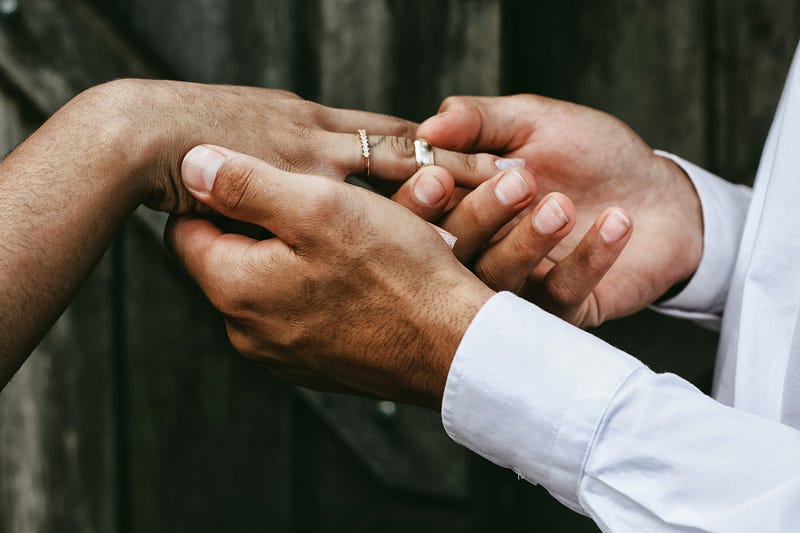
Many relationships start on the path of divorce. The path to long-lasting love is about self-awareness and a willingness to work on self. Compatibility won’t last if compatibility is based on unhealthy needs. Need is an understudy for love, not the real thing.
Love is an internal state of being that is reflected through our relationships with other people. Looking for love instead of being love short changes the experience of love. Loving relationships are based on growth and support, not static roles. People are given room to come and to leave without being negatively charged.
Fluid and Flexible Love
My marriage has been traditional in some ways and quite untraditional in other ways. Our relationship has been fluid and flexible. We remain two separate individuals with separate lives that converge. We learned early that the “two become one” ideal meant that at least one of us would always be unhappy.
We have different interests and different emotional needs. So, we support each other in getting our needs met outside of the relationship. My husband sometimes teases me about my 2-hour phone visits with girlfriends. I am patient when he chooses football over spending time with me. I don’t wait for him. I satisfy myself with other interests.
We make dates to spend time together. We’ve been dating for 28 years. He rarely brings flowers anymore. But, I still blush when he takes me by the hand. He lets go of my hand to open doors to show he cherishes me. We exchange back rubs on the couch. Romance is alive.
Along our journey, I’ve had to heal a lot of old wounds. The toughest time was when he did not know how to respond to my pain. He charged me with finding the help I needed to pull through. He could not carry me. All he could do was hold my hand. The hard work was mine to do.
I was lucky in that our marriage was never based on need. So, when need showed up, I did not get stuck in that place forever. We grew out of the pain together.
Long-lasting relationships are fluid and change. Any couple can change their relationship for the better. If you find yourself needing instead of loving your partner in a way that is wearing down the relationship, make a change. The bliss can return if you find it within yourself first.
Reference
Bakari, R. (2019). When You Show Up in Relationships in Seeking Mode, You Will Be the Underdog. Medium. https://readmedium.com/when-you-enter-relationships-in-seeking-mode-you-will-be-the-underdog-6ef2a4fd1a77
Geiger, A & Livingston, G. (2019) 8 Facts about Love and Marriage in America. Pew Research Center. https://www.pewresearch.org/fact-tank/2019/02/13/8-facts-about-love-and-marriage/