
What’s in my Innovation Coach Kit? — an Unboxing for the Curious
At least twice a week someone asks me:
what is it that do you do exactly?
My short answer follows:
I’m an Innovation Coach — I help companies and their teams solution faster, using Design Thinking methodology. Most importantly, I help them understand their customers via empathy, to enable the creation of products and services that add value to their customers’ lives.
Lately, Innovation coaching seems to be the “in” design-related job, so it comes as no surprise why Innovation Coaching has become the ultimate north star for designers. Yet, even for those who aspire to become innovation coaches, there is still so much to be explained and understood about what we do and how we do it. Questions such as:
What are the best practices?
How do you start?
What are the tools of the trade?
As a certified Innovation coach, I am always happy to answer questions, but there is nothing more powerful sometimes than showing people what is inside my kit.
Most Innovation Coaches I have had the pleasure to meet started as a Designer or Business Analyst and parlayed there unique training into the role of an innovation coach.
While there is no one path to becoming an innovation coach, the tools we use are similar, though we may use them differently. In this post, I pay homage to the social media trend of “unboxing” what’s inside my Innovation coaching kit and how I use them. Hopefully, this provides more in-depth insight into a day in — what we do, how we do it, and why we do it.
Aluminum Tool Case
I have been a trained Innovation Coach for a few years now, completing two levels of certification and like any newbie in any field, it sometimes takes time to find your footing and routine of what works and what doesn’t.
I admit when I first started running workshops, I spent a lot of time digging about in my bag; Admittedly, it was sloppy and not up to my standards and aesthetic and efficiency. I could do better.
I had never really seen anyone with a container for carrying their coaching materials other than a plastic container or a box that to looked thrown together last minute. I sought to convey a sense of preparedness for my sessions with something seemingly more permanent and with some aesthetic appeal.
So one day I decided, if I am going to do this, I will need to do this right and create a semblance of organization fitting to my job as one who enables creativity in solution.
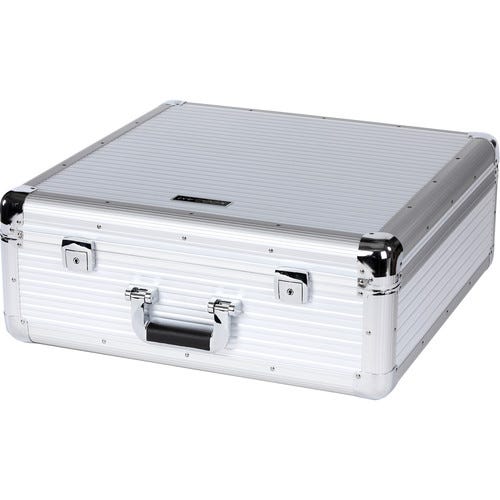
But what should I use? Then I remembered when I was in grad school, I worked on a film set, and I was impressed with the gaffers, who lugged around their grips (aluminum cases), and they looked so organized even though they seemed to be the least important people on set. It was from that memory I opted to start building my case with a proper Aluminum case, much like a gaffer — as an Innovation coach, I am only there as a backdrop to catalyze solutions. I am not the most important person in the room.
For the sessions I run, I have 2 cases — one for small groups and a much larger case for bigger groups up to 150 (of course many more coaches are needed to manage big groups).
Further, in recent years, my work has taken me on many trips, and it was inevitable that I would need to contain my work items professionally. So I invested in a hard, waterproof case to hold everything I needed for a professional. Waterproof so that my materials remain dry and orderly. Now let’s open my case and see what’s inside.
Sticky Notes
If you are reading this post, then there is a chance that you may be at a company with walls plastered with Sticky notes, but you may not know why
OR
you have attended an Innovation workshop, and along with your team created a wall filled with sticky notes of various colours as part of an ideation session.
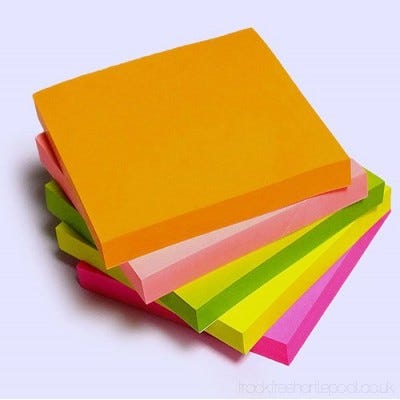
Sticky notes have become a staple in Innovation activities. Often referred to as Post-Its (the 3M brand), seems to be the sole thriving survivor of the paper era. Today, you cannot walk into any company and not see a sticky note covered wall. A big part of this pervasiveness of stickies comes from the rise of Agile, a project management approach utilized in software development.
Innovation as practice goes hand in hand with Agile.
Many companies team structures suggest a combination of both Agile and Innovation transformation coaches, working in tandem to support the Business units. So it is no surprise that both types of coaches use sticky notes, perhaps the Innovation coaches, at higher rates. Ideally, innovation sessions lead teams directly into their development sprints if designing software.
But how do we use them?
I use sticky notes as a shared taxonomy/language for teams to ideate. Foundational to innovation practice, are some essential methods that organizations go through to surface the value proposition of any solutions. Of note is an Experiential Journey map or simply Journey Map.
A Journey map is the steps customers go through when interacting with a company from simple things as calling customer support to use a product such as an app. Along this journey, a customer experiences both positive and negative experiences. Understanding this journey is central to optimizing solutions to create “gains” and value for a future state solution delivery.
To surface the value companies try to understand: the “Jobs to be done” by our customer; their associated pains, the Gain we can create and the blue sky ideas, to go above and beyond, to name a few.
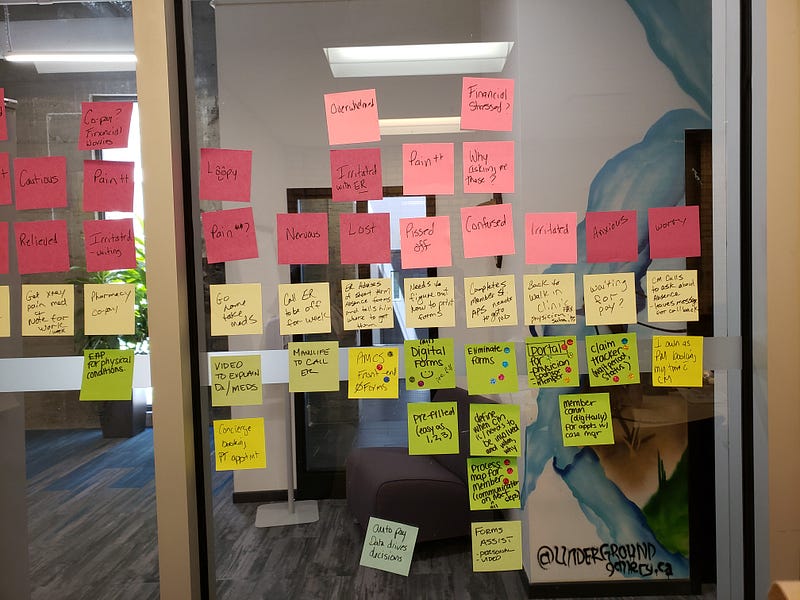
The Jobs to be done — simply, this is laying out the customers experience as a journey map to understand the customers existing pains. Teams document these jobs as steps in yellow sticky notes.
Secondly,
The Pains — For documenting the customer’s pain for each step, I use Pink. So above the yellow flow is a Pink flow of sticky notes. One pain per sticky so we can address them individually.
Third,
The Gains — Once we understand the customer’s Pain, the teams must ideate on how to mitigate those pains. Beneath the Yellow flow of sticky notes, the group uses the Green stickies to write down ideas of how they plan to address those pains. This step is an opportunity for the teams to post as many ideas as possible, which they will vote on later.
Lastly,
The Blue Sky ideas — Sometimes, when teams ideate, they can only think of solutions, which exist in their corporate ecosystem. However, when asked to think beyond that, they come up with new ideas. In my sessions, I may give them a random task as:
Imagine Amazon decided to enter our market space and was the intent of demolishing us, what would they do?
Many teams instantly go into competitive defence mode, and many more good ideas appear on the board. Blue sticky notes are used to represent this flow of ideas. Other coaches may use random colours, but I suggest sticking to a visual language that the teams can recall easily and repeat when they are back to their respective organization. The mnemonic aspect of a visual language allows teams to remember the session for later discussion outside the workshop.
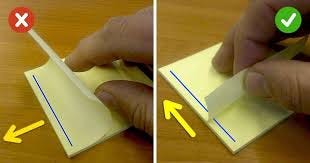
Did you know there is a right and wrong way to peel off a sticky note?
Beyond the above methodologies are countless others that require different colours of sticky notes. For example, I also use Orange or Purple (or a colour not used yet) as a round robin colour so teams can swap and add oversight for each other — see header image for reference.
Those little squares with the sticky strip on top are “surprisingly persuasive,” writes psychologist Kevin Hogan in Harvard Business Review.
Participants love the informality of sticky notes and the ability to throw away written ideas as needed to start again on a relatively small real estate. Sticky notes also allow for a flow of creativity without judgement.
Sticky notes are if not, the most critical element in my kit and not only do clients love them, but they also feel a high sense of playfulness while ideating on sometimes serious problems.
Stop Clock / Timer
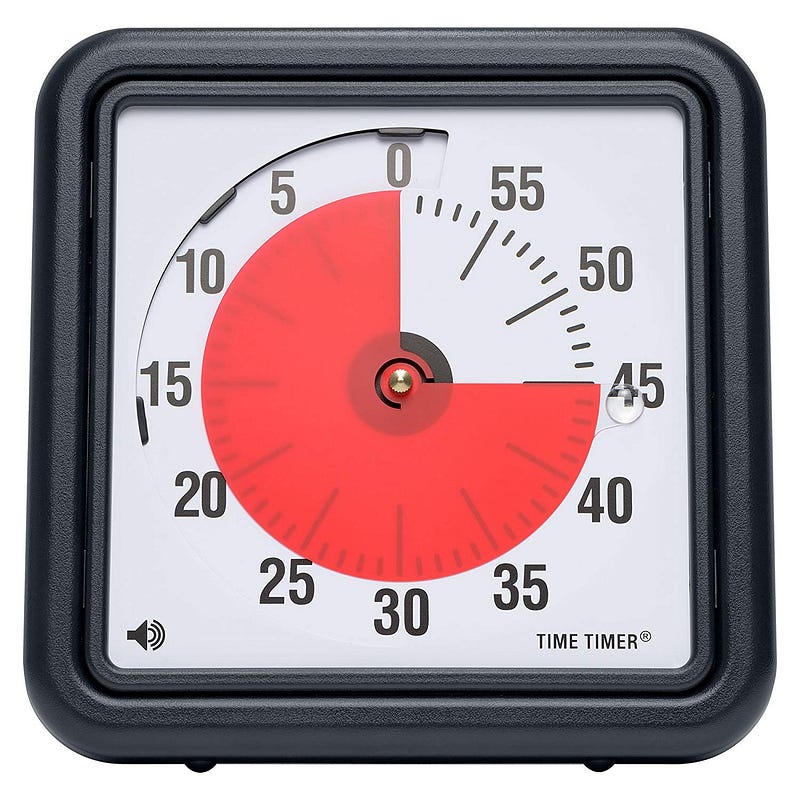
Time management is a vital part of running Innovation workshops. Traditionally teams meet to solve problems and spend a lot of time in fruitless, unstructured discussion about how to resolve. Left alone to ideate without a facilitator, many teams can spend hours together and go with nothing. A clock sets a bookend of when a task starts and when it ends. Teams are given the technique to solve a specific problem in a given time, and when the alarm goes, they must stop.
A clock adds a sense of focus and urgency for teams and is another critical tool in my box.
The timer shown is an 8inch; 60 Minute Visual Analog Timer with an Optional (On/Off) Alert. It has a silent operation mode (No Ticking). I also love the prominent red, indicating the remaining time, which can be spied across the room, especially team works spread across the room. And the volume is piercing enough to be heard by all in the room.
Star Stickers
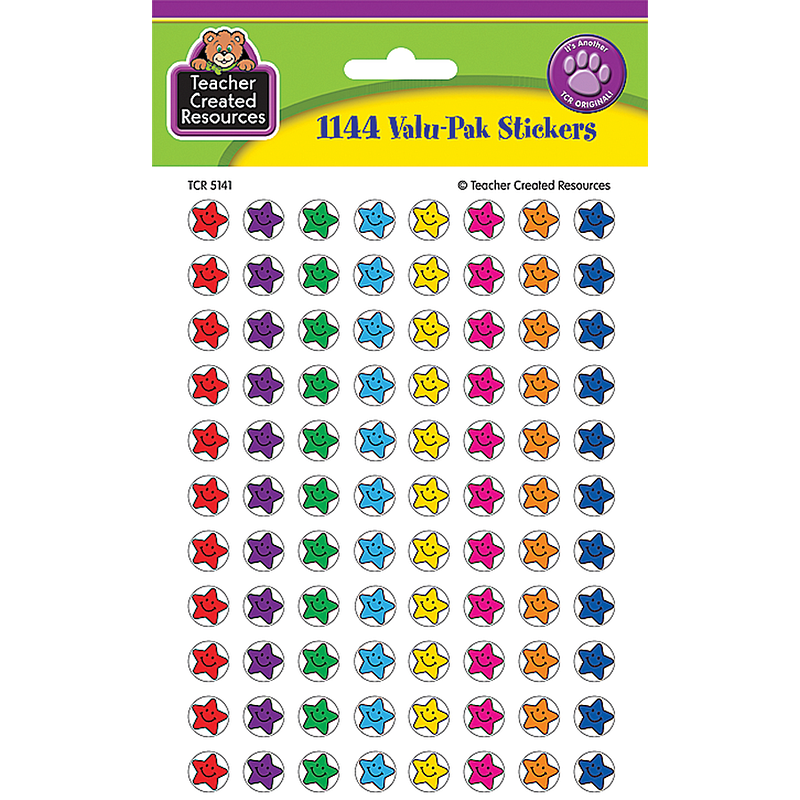
Perhaps the most beloved thing in my kit are these star stickers used for voting. Inevitably some attendees spend some of their times decorating their phones and notebooks with them, in between breaks or as an alternative to doodling, a welcomed activity to keep the hands active.
Though not the intent of these colourful stickies, I enjoy watching full-grown adults act like kids.
In sessions, as mentioned earlier, when teams come up with ideas, it needs to be voted on and prioritized. In Agile, it is critical that we do the most important things first. These voting stickers play a crucial role — limiting the louder voice and giving everyone equal status in solution. Each person is given the same number of voting stickers and asks to vote on the groups’ best ideas independently.
While I show star stickers here, sometimes they are simply circle or whatever is available at my local dollar store. I have recently also used dot voting (colourful sharpies). The main issues are that once someone has decided, it is hard to erase or remove the vote. And while the latter represents a more sustainable option, I love the star stickies as it is removable, if someone changes their mind.
Sharpies
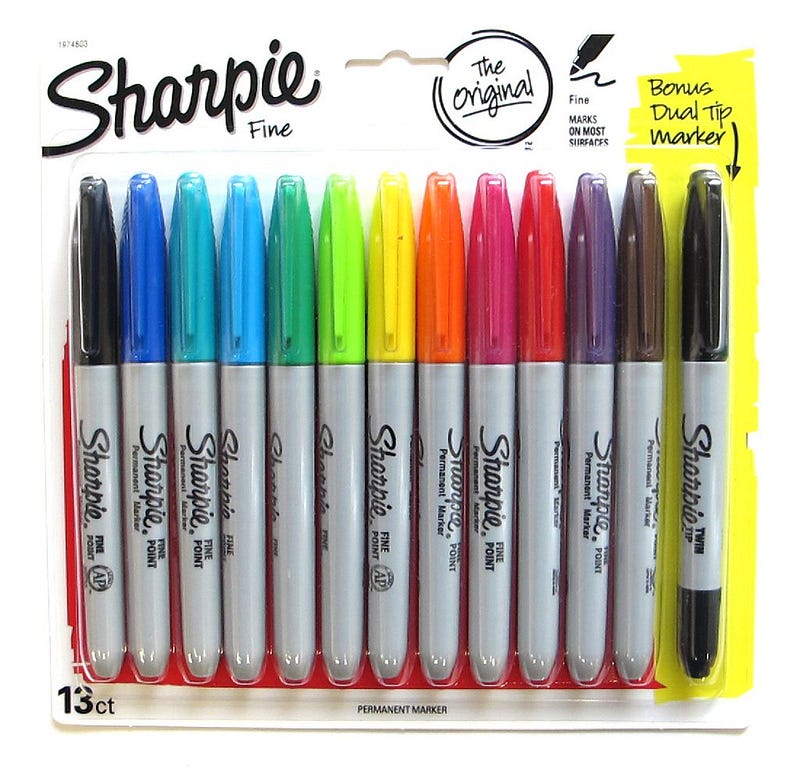
Sharpies are a staple in every innovation kit. Aside from the vibrant arrays of colours, they are used to write on sticky notes and other writing media during a workshop, such as flipcharts and simple printer paper. Sharpies are also used for a crucial aspect of ideation — drawing ideas.
Sharpie points are the perfect size to convey ideas in both textual and visual form and come in many colours to achieve very high fidelity of visuals, ranging from schematic diagrams, as well as storyboards that can be illustrative of a future state design idea of a product or a service.
Further, sharpies are perfect for Innovation coaches to read sticky notes, especially when transcribing for report purposes. A ballpoint pen or pen point is too small and often does not capture well on camera.
A little trick using Sharpies is one known to a few coaches — Murphy’s Law — A workshop attendee will accidentally use a Sharpie on a whiteboard. No need to panic!!! — write over sharpie on a dry erase board with a dry erase marker to remove any hint of a permanent marker.
Like magic!
And while I have a few other items in my kit such as paper (used to Crazy 8s, for example) and other colour stickies in various sizes used for others tasks, the above-numbered are the items are critical for all Innovation and Agile coaches.
Happy Coaching!
::::::::::::::::::::::::::::::::::::::::::::::::::::::::::::::::::::::::::::::::::::::::::::::::::
::: ABOUT ME :::
I am a deliberate Post — Corporate Innovation Coach and Strategist, working a variety of project types that challenge traditional Design Thinking and Strategy. I write on a wide variety of topics from Work Futures, Current topics as well as to Branding — essentially topics on the confluence of Society — Design & Technology.
I am also the author of the book User Experience in the Age of Sustainability and Muse in Chief at kemlaurin.com. you can also check me out on LinkedIn and Instagram. I love creating digital content and enabling small brands and start-ups. My mundane musing can be found on www.instagram.com/kemlaurin/
If you enjoy this blog, you know what to do. And please be kind to share.***