
LIFE LESSONS
What’s Important When in New York City
Finding the meaning of living
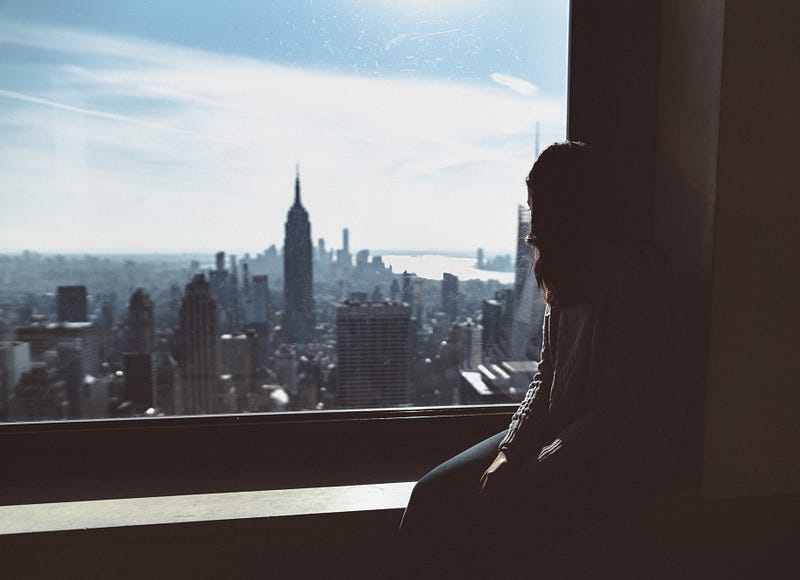
I remember sitting on the stiff leather couch in my boss’s office, unable to hold back the overwhelming exhaustion, and sobbing that I couldn’t do it anymore. For about six months, I’d worked every day from 8 AM until well past midnight, still fielding calls from the other side of the world as I took car service home from our SoHo offices to my apartment in the suburbs, the streets of Manhattan finally quiet in those slow hours. I’d get home to Milla, my dog, who’d been patiently waiting for me, tail wagging, a little whimper of longing escaping her as she’d rush to greet me. The calendar on the fridge had a little checkmark to let me know that the dog walker had been by some time in the afternoon.
I’d put the leash on Milla and we’d head out into the darkness for a walk. No matter how late it was or how tired I was, I knew it wasn’t fair that I’d kept her cooped up all day. Regardless of the hour, she was just happy to be with me, to see me, to walk beside me. Most nights, the stars would keep us company, peeking in and out from between the branches of our tree-lined neighborhood or there’d be a light sprinkling of rain and fog to obscure the sidewalk and cover us in gray. We’d listen to the rustling of leaves, the wind carrying the wetness of on-coming storms, and the changing of seasons. Afterward, we’d tumble into bed around 2 AM, only to wake 4 hours later to do it all again.
None of this was fair, and initially, I’d hoped that this assignment would only be a few weeks, but it’d been months with no end in sight. The long hours weren’t a complete stranger though. When working in advertising or technology, long hours came with the territory. Ten or twelve-hour days several times a week weren’t new. Working weekends and holidays to meet impossible deadlines weren’t new either, however, this was the first time where I pulled in sixty to seventy hours every week non-stop for months on end.
But then, my dad became ill. His kidneys were slowly failing. Time was quickly becoming less promised and more borrowed.
“What are you saying?” my boss asked me, leaning over her large cedar desk and clasping her slim, clean hands in front of her. She was a slender, blonde woman with her floral print shirt neatly tucked into her jeans, the epitome of corporate casual. “Is it the hours? Do you need a day off?”
A day off? I need more than a day off, I had thought. I was so exhausted, yet I found it hard to say yes, that the hours were crushing me, that the stress had become unbearable. I didn’t want her to think I was incapable, but there also wasn’t a strong enough concealer created that could erase the bags under my eyes. My hair had begun to shed in handfuls. Besides, a day off wouldn’t have solved anything, because, at the end of that 24 hour period, the mountain of work and the demands of difficult people would still be waiting for me. If anything, it would only be worse as the backlog would require even longer hours to catch back up.
On those long walks in the dark of night, I’d had a lot of time to think. With our shuffling feet kicking the fresh autumn leaves, Milla and I had walked in silence, the weight of time and the universal question of “What am I doing?” looming between us. The pale moon was often a beacon, floating in and out of sight as silver-lined midnight clouds drifted across its face. We’d walk towards it for as long as we could until it made its way west to chase the sun somewhere beyond the horizon.
What was I doing? I wasn’t sure anymore. I’d spent 20 years in New York City, working an average of fifty-five hours a week with an hour-long commute each way. I thought this was what I wanted when I was young and ambitious and naive. Six figures, nice apartment, high rise job in a fast-paced industry. Big job title. Designer clothes, fancy shoes. But my dad was dying and I’d hardly spent any time to stop and live.
It would be four years later that I would finally find myself standing in a cultivated field, the rows of eggplant seedlings waiting to be pushed into the dirt. My mother’s dry, cracked hands fold over my softer ones as she shows me how deep to dig the holes. She’s tiny and soft, except for her hands that couldn’t hide the years of hard work. Her wispy black hair peeks from beneath the brim of her straw hat as she leans in close to me, the faint scent of Tiger Balm and Herbal Essence floating around her. There’s an inch of wet mud soaking into my inadequate running shoes. At the end of the row is a child’s bright yellow snow sled filled with a liquid fertilizer that she uses to give the baby plants a boost before we settle them into the ground.
My back aches as I try again, swinging the hoe over my shoulder and into the Minnesota dirt, the air humid around us in the early spring morning. My dad is sitting in the white utility van that totes our equipment, refusing to stay home because he needed to be wherever my mother was. He’d shrunk, half the man he used to be when I was a child. His walk still had the crispness of a disciplined soldier, but now, he was much slower, much smaller. The illness had begun to show in the brownness of his skin, in the sunken depths of his cheeks, and in the infusion of grays in his once thick, black hair.
For as long as I could remember, my parents had always been farmers, carrying on with skills and techniques handed down from generation to generation, a love for the earth born from ancient ancestors. This connection to the land, the air, the sun had been diluted to my generation by the modern world, but I still felt its call in my veins.
The birds had awoken long before us, but the sun was just making its way above the line of trees, washing the humid morning in pale yellow light. My mother leaves my side to go check on my dad and to grab another handful of seedlings. The dirt on my hands had dried and had begun to flake, drifting off like ashes of a life left behind. I think back to other dawns, of a city skyline waking up to shades of pink and red against an indigo sky, the sounds of buses and trains, the scent of double espresso and fresh chocolate croissants. Six million people bustling awake. It all seemed so far away and alien. A lifetime ago. A different kind of work.
Someone calls my name, jerking me back. I’m surrounded by stillness, the only breath to hear are the whispers of my own and those of my parents. I turn towards my mother, watching as the sun bathes her golden in the soft morning light.


