
What’s Durian like and Can It Really Kill You?
The ‘King of Fruits’ is pungent, healthy, and possibly deadly.
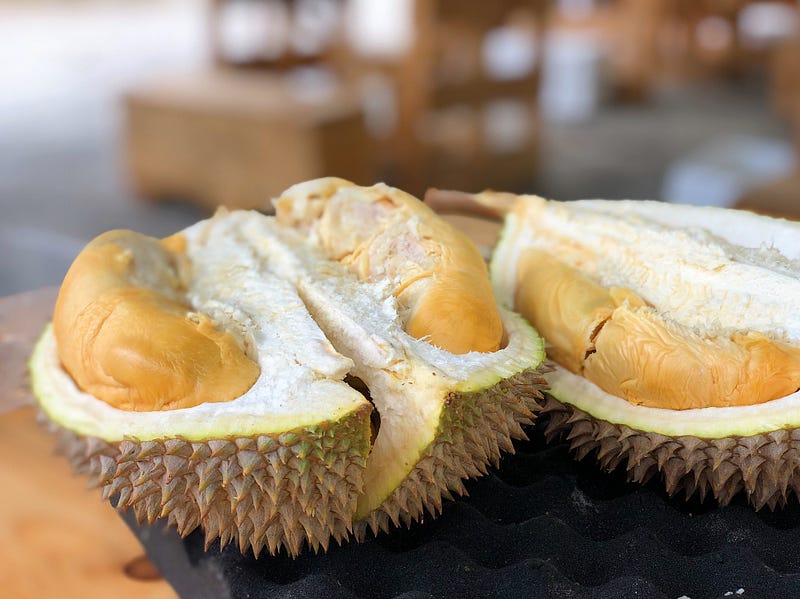
Durian is a legendary fruit that hails from Southeast Asia. It is famous for a couple of things but most notably the fact that it smells. Some think its aroma is wonderful, some think very much the opposite, but all sides agree that the odor is unique and incredibly strong. In Southeast Asia and the more popular export markets like China, the first reference or encounter many will have with the fruit will be public signs banning it.
Where does durian come from?
Known as ‘The King of Fruits’, durian is native to Borneo, Malaysia and Indonesia but is now farmed across Asia. It just needs somewhere that is consistently hot, as the fruit stops growing when the average temperature drops below 22 Celsius (72 Fahrenheit). It is currently farmed in Southern India, Sri Lanka, Cambodia, Hainan (Chinese island), and Thailand.
The top exporter of durian is Thailand by quite a wide margin. Even though the fruit is not native to the country it grows well there, producing around 700,000 tonnes every year, of which slightly over half goes to China. The Thai region of Chantaburi is responsible for about half of all durian production in the country and consequently is the location of the World Durian Festival every May — something to keep in mind if you hate the stuff.
Malaysia and Indonesia are the next biggest producers with around 265,000 tonnes each per annum.
What does it look like?
Durian comes in about 30 different varieties but they are generally pretty similar. The outer shell is green to brown and covered in spikes. They grow up to about a foot long (30 centimeters) and are around six inches in diameter (15 centimeters). The weight varies from two to seven pounds (one to three kilos), although they do occasionally get slightly bigger than that. The fruit is essentially hard, heavy, and covered in spikes and they grow on trees that can reach 150 feet tall (50 meters). So try not to walk under them.
Once you crack open the shell you’ll see the flesh of the fruit. It is usually light yellow in color but some varieties are more orange. The fruit lifts right out in a few chunks or pods, with the soft fibrous fleshy parts surrounding a hard brown seed.
Let’s talk about the smell
There is no denying the fact that durian has a powerful smell. I live in Thailand and as mentioned, it produces more durian than anywhere else. Yet there are still signs everywhere banning the fruit — public transport and hotels in particular. In my condo, durians can only be disposed of in the main rubbish area outside on the ground floor. Thai people might love durian but even they acknowledge that it reeks. It is banned on most public transport in Japan, Hong Kong and Singapore.
In Singapore, the durian is the national fruit with a building called The Esplanade in prominent Marina Bay was altered to look like a durian. Even so, carrying the fruit is banned on all transport, including taxis. The smell not only seeps out and fills an available space, but it also lingers like, well, like a bad smell.
Personal experience
I love durian and don’t mind the smell too much. That’s about the best I can say. It’s not nice but I am ok with it. When there is durian anywhere in my condo, its presence is smelled until it has gone (and hangs about for a bit). I think it smells a bit like over-ripe banana skins with a strong blend of unwashed feet. In Thailand, there are numerous durian festivals and even all you can eat buffet’s and although they are held outside, the range and intensity of the stink are impressive.
What others have said on the smell
Most people smelling durian for the first time are probably not going to like it. For example:
“Its odor is best described as pig-sh*t, turpentine and onions, garnished with a gym sock. It can be smelled from yards away.” Richard Sterling, food writer.
“Like eating raspberry blancmange in the lavatory.” — Anthony Burgess, Novelist
Like myself, a common opinion is to try and get over the smell in order to enjoy the fruit. The late and lamented Anthony Bourdain loved durian, yet admits:
“Like pungent, runny French cheese … Your breath will smell as if you’d been French-kissing your dead grandmother.” — Anthony Bourdain, Chef, writer and TV Host
So it smells. And I can personally attest that if having eaten some durian and you belch at any time for hours afterwards, that smell will return with a vengeance.
Does it taste nice?
This is surely the most important aspect. The durian’s intensity, flavor and smell all alter depending on the ripeness. Traditionally, you wait for the fruit to fall naturally. This is not possible with the way it is farmed these days, so ripeness needs checking. In Thailand, they tend to not let it get over-ripe. This has the added advantage that it doesn’t smell quite as much, although that is relative — it will still out smell all other fruit. As it is fresh, the experience is not quite as over-powering as when it has been exported and/or ripened further, so the flavor changes slightly.
I love durian but can only eat one or two chunks at a time before it starts to overwhelm. There is no other fruit even vaguely like it. On the surface, it tastes like a slightly fibrous custard. But an intense custard, if you can imagine such a thing. The texture softens and the sweetness grows the riper it becomes, so individual tastes vary. After the initial bite, a lot of other more subtle flavors start to emerge. Here are two attempts at describing it:
“Yes, I freely admit that when ripe it can smell like a dead animal. Yes, the fruit is difficult to handle, bearing likeness to a medieval weapon. But get down to the pale yellow, creamy flesh, and you’ll experience overtones of hazelnut, apricot, caramelized banana and egg custard. That’s my attempt at describing durian. But words fail; there is no other fruit like it.” — Thomas Fuller, New York Times Journalist
“A rich custard highly flavored with almonds gives the best general idea of it, but there are occasional wafts of flavor that call to mind cream-cheese, onion-sauce, sherry-wine, and other incongruous dishes.” — Alfred Russel Wallace, 19th-century British Naturalist.
So can durians kill you?
If you spend enough time in Asia you will be told not to drink alcohol with durian. Because you’ll die. It is a very common belief throughout Southeast Asia in particular and everyone will have a story proving it. From personal experience and that of friends of many nationalities, this is not true. If you have a few beers with durian, you’ll be fine. But only in moderation as there is some science behind the idea that overindulgence could be dangerous.
Durian and alcohol
Without getting too into the science of it all, a study by the University of Tsukuba found that the high sulphur content in durians inhibits enzymes that help to break down alcohol. However, there is no evidence shown that this has led directly to anyone dying. The most likely outcomes of too much booze and durian are nausea, vomiting, bloating, and maybe even heart palpitations. So while it is unlikely you will die, it is best to avoid mixing the two if possible.
Death by durian
People have been killed by durians. Possibly dozens a year as many would go unreported but it is not as sinister as it sounds. There are two ways it tends to kill.
Overindulgence while having a pre-existing condition — There have been a few cases where people with hypertension and diabetes have died after eating way too many durians. There was a case in Thailand about ten years ago where a man ate five entire durians on his own before dying of a heart attack. Another case in the Philippines occurred where a man with pre-existing conditions ate an entire basket of the fruit, washed down Coca-Cola and promptly had heart failure. These cases are rare and extreme.
Hit by a durian or the durian tree — This is the most common. Durians are hard, heavy and spiked. Attach a stick and it would make a good weapon. There have been numerous cases of deaths by unfortunate timing with the heavy fruit landing on someone’s head. Also, while the trees can occasionally reach heights of 170 feet, the roots are surprisingly shallow. Combine this with monsoons or typhoons (common where they are grown) and there have been a lot of houses crushed. Again, this is tragic but it is not frequent.
Conclusion
If you ever get a chance to eat durian, be open-minded and give it a chance. If you manage to make peace with the smell, you may find yourself with a new obsession. Or not. There is nothing like it and people seem to fall squarely on one side of the love/hate divide.
As to its safety… It’s inadvisable to get drunk, eat half a dozen entire fruits while sitting under a durian tree. Otherwise, it is pretty safe.


