
What’s Amsterdam Doing?
“The journey of 1,000 miles begins with a single step”
Amsterdam is the first city to adopt Doughnut Economics as its official policy. What the f*** does that mean?
What’s a Doughnut Economy? Essentially it’s a 21st-century economic model that replaces our insatiable appetite for GDP growth with a more sustainable balance that meets the needs of all people within the means of our planet.
“The Doughnut” is the sweet spot — the ideal range for humanity to thrive — between the ecological boundaries where we either overshoot Earth’s ability to sustain us, or we undershoot people’s basic human needs. The Doughnut monitors a number of key metrics that directly contribute to an uninhabitable planet. These categories are “derived from the social priorities set in the UN Sustainable Development Goals” to define a standard of living for which “every human being has a claim” and also from environmental scientists who work to protect “Earth’s critical life-supporting systems” (Kate Raworth).
The significant “Areas of Overshoot” are ocean acidification, chemical pollution, nitrogen & phosphorous loading, freshwater withdrawals, land conversion, biodiversity loss, air pollution, ozone layer depletion, plastic waste, electronic waste, and climate change [avg. global temperature change]. The “Areas of Undershoot” include housing, education, food & water, energy & utilities, income & work, health & happiness, peace & justice, political voice, social equity [class agnosticism], gender equality, and networks [social bonds].
That’s a lot to address.
Amsterdam, to kill multiple birds with one stone, is transitioning to a circular economy as the first step towards a Doughnut-based future.
How do “Circular Economies” help?
By transitioning to a circular economy, the City of Amsterdam is eliminating its dependence on raw materials. The environmental damage associated with extracting, processing, refining, storing, and transporting fresh materials is the majority of a new product’s carbon footprint. And the physical waste from throwing stuff away directly contributes to a number of ecological problems beyond the City’s borders.
This shift to circularity helps Amsterdam cut back on its contribution to ocean acidification, chemical pollution, freshwater withdrawals, air pollution, ozone layer depletion, plastic waste, electronic waste, and food waste… all at once.
The City of Amsterdam’s estimated CO2 emissions from raw-material consumption are 1,216 kt annually (1,216,000 metric tonnes per year). This comes from construction projects, local transportation, clothing, electronics, and food & organic waste. For reference, that amount of CO2 weighs as much as 8.5 “MSC Splendida” cruise ships:
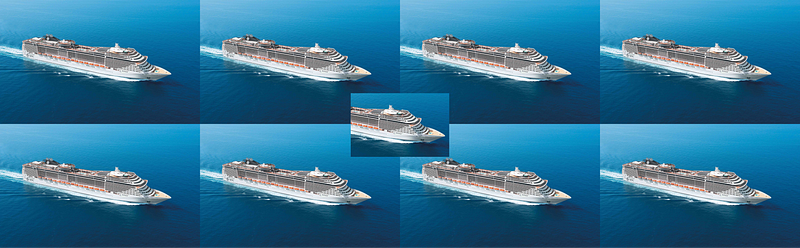
Eight-and-a-half cruise ships worth of CO2 emissions… every year. Just from consumption of new materials in Amsterdam. What’s more: this figure is likely an under-estimate, because their “Consumer Goods” segment only has data for the textile and electronics industries. Expanding this dataset to include household goods and pharmaceutical expenditures will help establish a more accurate representation of the City’s carbon footprint.
Perhaps the most significant impact of transitioning to a Doughnut-based circular economy is the fact it forces politicians and business executives to focus on meaningful metrics instead of seeing through the myopic lens of revenue growth.
Shifting to a perfectly circular economy would prevent the environmental damage associated with wasteful consumerism. In a sense, circular economies allow us to declare: “We have the ingredients for everything we need. We don’t need to churn, we need to consolidate.” Amsterdam city officials said it themselves:
“In a circular economy we reuse raw and other materials over and over again. That way we avoid waste and close the cycles. We learn to do more with less.
In a circular economy, the value of raw materials is retained as much as possible throughout a product’s lifecycle, from design to disposal.” — City of Amsterdam
Humans benefit, too, from sparing marine life a predominately plastic diet. Microplastics are so widespread in the water, we end up eating our own trash through inconspicuous, delicious fish dishes.
How can we reuse everything? As a part of this project, the Amsterdam team created a “ladder of circularity” to show “which processing options are preferable to others”:
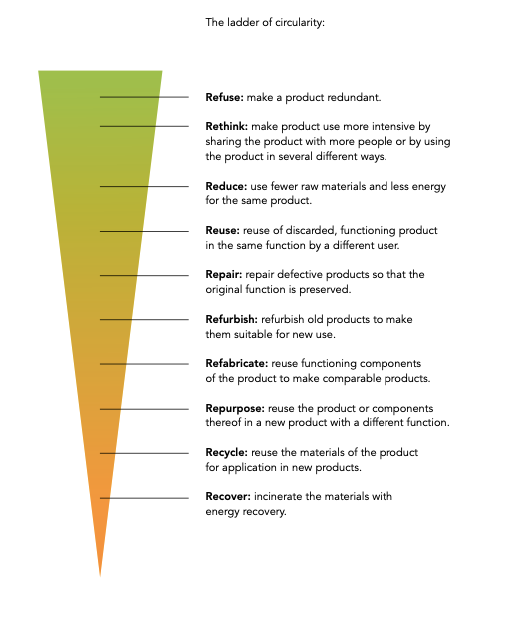
The ultimate goal is to eliminate the need for wasteful things entirely. The future of business is designing reusability directly into our products. Along the way, we’ll need to recover, recycle, repurpose, refabricate, refurbish, repair, and reuse everything that’s already been extracted from the planet and modified for human consumption. The sooner we can reduce demand for raw materials and rethink our product design, the better. And the sooner we can refuse disposable goods altogether, the best.
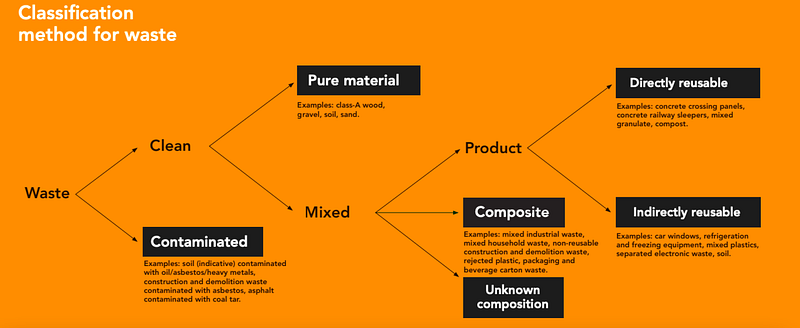
If you’re like me, it’s difficult to visualize everything that goes into the supply chain of society. Fortunately, the team also created a flowchart to classify the best method for reusing various types of waste:
At this point, it’s worth singing some praises for the key organizations involved in applying the abstract principles of Doughnut Economics to the real landscape of Amsterdam politics.
The Doughnut Economics Action Lab (DEAL) partnered with C40 and Circle Economy to create the The Thriving City Initiative (TCI), and the City of Amsterdam is proving their boldness by becoming the first city to formally adopt an Applied Doughnut as their modus operandi.
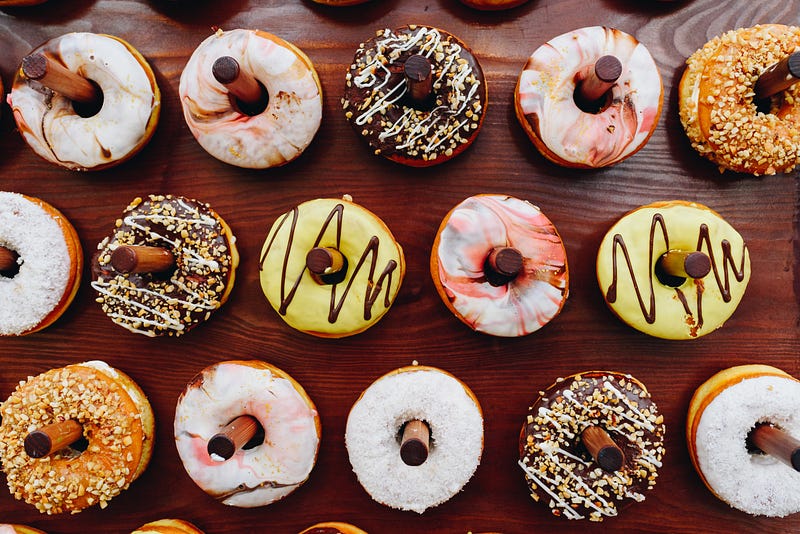
Thought Food
In the past, product design ended at the point of sale. Disposal was an externalized cost. Whether or not the the materials were biodegradable, recyclable, or directly reusable was of no concern to capitalist engineers in the era of plastics. Particularly in the period of neoliberal capitalism from 1980-now, profitability drove product design. Environmental damage was not even part of the conversation. Personal computers, for example, went through a number of massive innovations over the past thirty or forty years. They went from big desktop boxes to thin laptop notebooks. Every innovation in GPUs, CPUs, keyboards, trackpads, and touchscreens made the previous generations obsolete, so millions of computers were thrown away purely because a better thing came along. But every computer ever manufactured is still a trove of precious metals encased in plastic, simply sitting in a landfill and contributing to ocean acidification instead of to the next generation of technology.
Companies in the past didn’t have to concern themselves with the environmental impact of their actions; out of sight, out of mind.
Design in the future needs to consider the full life cycle of products, from assembly all the way through disposal and reuse.
The Amsterdam City Doughnut is a single step in the journey of 1,000 miles.
If you are thinking about joining Medium, please use my referral link here. It costs the same, and it will help support me as a Medium writer.
Subscribe for email notifications every time I post a new story!


