
Whatever Happened To Urge Overkill??
They had it all going for them!
Early days
Urge Overkill was formed in Chicago in the mid-1980s by Nash Kato (vocals/guitar) and Eddie “King” Roeser (vocals/guitar/bass guitar) after the pair met in college.
The band released the ‘Strange, I…’ EP in 1986, and the full-length album ‘Jesus Urge Superstar’ in 1989, both produced by Kato’s roommate, Steve Albini. Their mid-tempo noise-rock was considered typical of other bands on Touch & Go Records, and was lumped in with the pre-grunge bands of the day.
Next came the ‘Americruiser’ album in 1990, produced by Butch Vig. An improved sound drew better reviews. The mix of punk, power pop, and Stones-like swagger gained the attention of college and alternative radio. The band was moving on up.
Image
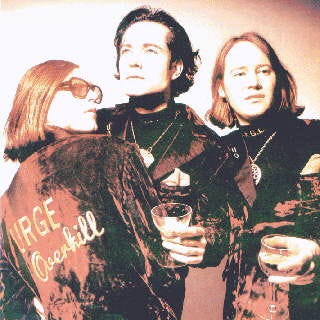
Significantly for the band, their image grew, developed, became a drawcard. A brief biography by Stephen Thomas Erlewine, published on Prince.org, discussed the band’s image:
Few bands ever lusted after rock stardom quite as blatantly as Chicago’s Urge Overkill. Although they draped their quest for stardom in a cloak of ironic detachment, it’s quite clear the trio expected that if they acted like stars, they would become stars. For a while, their stylish, retro-’70s outfits, matching medallions, and heavy Cheap Trick homages earned the group a popular following in alternative rock circles.
Onward and upward
The band went back to Albini as producer for the 1991 album ‘The Supersonic Storybook.’ Onto their fourth drummer (one could almost sense a ‘Spinal Tap’ situation developing …), Blackie Onassis joined the group, solidifying the band, sound, and image.
Significantly, the band scored the opening slot on the North American leg of Nirvana’s ‘Nevermind’ tour.
The band quickly recorded and released the ‘Stull’ EP in 1992, which pushed them a little further into the spotlight. The EP featured a cover of Neil Diamond’s ‘Girl, You’ll Be A Woman Soon. Once again, moving on up!
Breakthrough
Having gained significant popularity, the group leapt to a major label (creating a rift between them and Albini/Touch & Go) and set about recording ‘Saturation’ for Geffen Records. The album was produced by the Butcher Bros. and released in June 1993.
The record was somewhat unusual compared to previous releases with regard to lead vocals. On ‘Saturation,’ Nash Kato sings lead vocals on eight of the album’s 12 tracks, Eddie Roeser taking three tracks, Onassis with one, and Kato and Roeser sharing the lead on one song.
Compare that to previous output, where Roeser handles most vocals (six of nine songs on ‘The Supersonic Storybook’ and six of eight on ‘Americruiser’). Notably, Kato sang the lead on the three key singles that were released, ‘Sister Havana,’ ‘Positive Bleeding,’ and ‘Bottle Of Fur.’
‘Sister Havana’ became a significant hit, and the record received multiple favourable reviews. Some review snippets:
- Musician: “… an almost absurdly terrific, dross-free disc with toothsome, witty pop songcraft wedded to atom-smashing guitar work”.
- Rolling Stone: “… an invitation to another world, a world where melody and melodrama get their due”.
- Greg Kot: “In the past, style has set them apart. On Saturation, it’s the songs”.
- Mark Deming: “If they ever cut a whole album as good as side one of Saturation, they’ll rule the world.”
Live
Upon the release and success of ‘Saturation,’ the band made several appearances on high-profile TV shows, showcasing their excellent live sound. They ended the year with a series of support slots on Pearl Jam’s North American tour.
In January 1994, the group visited Australia, performing on the Big Day Out festival tour, appearing alongside Soundgarden, Ramones, Bjork, Smashing Pumpkins, Primus, The Breeders, and Teenage Fanclub. The band was considered one of the standouts of the festival by reviewers and punters alike.
They came on in the late afternoon at the Melbourne show, with the stage facing the setting sun. It was stinking hot. However, the band tore through their set brilliantly, with the guys dressed only in spandex pants.
Film
While contemplating making another record, their cover of Neil Diamond’s ‘Girl, You’ll Be A Woman Soon’ was featured in a scene in Quentin Tarantino’s ‘Pulp Fiction,’ released in cinemas in 1994. Their version, re-issued as a single, achieved moderate chart success around the world.
Zenith
At this point, Urge Overkill were top-flight stuff. They had the whole package:
- worldwide acclaim, on the back of a stunning record, mega tour slots, and a hit movie song;
- the cool image, with the matching outfits, the medallions, Kato’s coloured glasses;
- an incredible sound, with a guitar tone to kill for, superb drumming, and the compelling timbre of Kato’s voice; and
- brilliant songs that showed off their highly appealing blend of power pop and punk.
It seemed the band was set to ride the explosion of alternative rock to the top of the charts.
So what happened??
Exit The Dragon
The ‘Saturation’ album was a hard act to follow. The band released ‘Exit The Dragon’ in 1995, and it could not have had a more appropriate title. The dragon created over the previous few years lost the fire in its belly and exited, stage left.
The record was released later in the year than expected, perhaps missing the crest of the wave of attention. Mixed reviews did nothing to help.
In its own right, ‘Exit The Dragon’ is not a bad record. There are plenty of great songs. Unfortunately, it just wasn’t as outstanding, or better, than its predecessor. The band also did not have enough of a lengthy track record to get away with releasing a dud and have the fans move past it.
A significant point that may have affected the record’s success was Roeser’s return to lead vocals. He took the lead on six of the 14 tracks, Kato took five, and they shared two, with Onassis singing just the one.
The first single from the album, ‘The Break,’ was a tad uninspiring and featured the rough-voiced Roeser on lead vocals. Another song, ‘Somebody Else’s Body,’ sung by Kato, was a much better single release. Keep in mind that Kato sang the songs that brought the band fame.
I’ve sometimes thought that the fans wanted more of Kato and not so much of Roeser, which is not really what eventuated on ‘Exit The Dragon.’ Would an album with more Kato vocals have been more successful? Or was the lack of success simply just down to the somewhat darker, less inspiring songs?
Did the punters get fed up with the “too cool for school” image of the band? Were they destined to be just another pop-punk band that blew in, made a splash, and disappeared just as fast?
Nadir
Things went from bad to worse.
The group began a tour late in 1995 that quickly became a nightmare. Opening act Guided By Voices, known for shambolic, booze-fuelled yet high energy sets, were dumped from the tour after a few weeks, amidst claims of abuse and insults directed at the band, fans, sponsors, and the press. Soon after, the remaining shows were reportedly canceled by Geffen.
Blackie Onassis’ heroin habit was creating difficulties for the band. He was ultimately arrested for heroin possession. No charges were pressed. However, the incident fuelled plenty of speculation about the future of the band.
While reportedly attempting to get their act together on the quiet during 1996, tensions began to mount between Kato and Roeser, with Roeser ultimately leaving the group.
Kato and Onassis forged on, and in early 1997 left Geffen and signed with 550 Music. While preparing a new record, the label dumped the band. At that point, Urge Overkill called it a day.
A rather sad and disappointing ending to a band that potentially had the world at its feet.
Postscript
Kato and Roeser shelved their differences and reformed Urge Overkill (without Onassis) in 2004. They toured through Europe, North America, and Australia.
In May 2011, the band released ‘Rock & Roll Submarine, their first studio album in 16 years. One would have thought that any comeback album might be entitled ‘Phoenix rising’ or similar, rather than use the word submarine, which suggests hidden or out of view. Maybe the submarine was surfacing?! Perhaps ‘Re-enter The Dragon’ would have worked as a comeback title? Nope, I don’t think so …
Thanks for reading!
While you’re here, you might be interested in these pieces too: