
Whatever Happened to “The Singing Nun?”
I’ve seen her soul fly through the clouds

Suddenly, “Dominique” was everywhere. Most Americans had no idea what the 23-year-old “Singing Nun” was chirping about in her innocent, bird-like voice. Face it. We’re not polyglots. She sang in French.
The song landed at the right moment in history.
In November 1963, Lee Harvey Oswald assassinated JFK. Two days later, a nightclub owner killed Oswald on live TV. We were shell-shocked. People stumbled through their lives wondering what calamity would strike next.
A nuclear attack?
Riots? More assassinations?
It’s raining nuns!
Mass media to the rescue. They threw a nunfest. We’re overdue for another.
The mid-sixties produced “The Flying Nun,” a sitcom with Sally Fields as a nun who could fly when the wind hit her headgear. It was set in Puerto Rico but filmed in Burbank.
The era also gave us Julie Andrews as Maria von Trapp in the “Sound of Music.” Both blockbusters, in their ways.
Then, days after Jack Ruby plugged Oswald, we turned on our radios and heard “Dominique.” It got stuck in our heads where it still lives today, tucked between our hypothalami and pituitary glands. If you listen carefully, you’ll likely hear random Boomers whistling it in grocery stores across the USA. Around the world, even.
Songwriter Sister Luc Gabriel performed “Dominique” with a chorus of four nuns from her convent in Waterloo, Belgium. She accompanied herself on an acoustic guitar she named “Adelle.”
The ballad tells the story of Saint Dominic, the 13th-century founder of her religious order, the Dominicans. In the song, he wanders around, smiting enemies and preaching. It’s rosy, considering the Dominicans eventually started the Spanish Inquisition.
If you watched the second season of “American Horror Story (2012),” you heard Sister Jude play “Dominique” on a perpetual loop for the inmates of Briarcliff Manor.
Move over, Elvis. “The Singing Nun” goes viral
The nuns at my Catholic grade school brought the album to class and, like Sister Jude, played it every day. It changed our psyches in ways not yet completely understood.
Debbie Reynolds starred in the 1966 movie with Ricardo Montalban, Greer Garson, Katherine Ross and Chad Everett. Ed Sullivan had a cameo. The producers advertised it as a true story but fictionalized it to high Heaven.
I picture Sister Luc in a movie theater clutching her Rosary, mortified as Reynolds lusts over Everett on the big screen. When they got off their mopeds long enough, things got steamy in a G-rated way. I wonder what the sister would think of “The Horror Story.”
The “Singing Nun” soundtrack featured nine songs by Sister Luc, including “Dominique.” The score made the shortlist for an Academy Award but lost to “A Funny Thing Happened on the Way to the Forum.”
The single and album each sold over a million copies. “The Singing Nun,” also known as “Sister Sourire” (Sister Smile), appeared on the Sullivan Show just like Elvis and the Beatles. She won a Grammy.
The betrayal of “The Singing Nun”
Following her overnight success, Sister Luc returned to the convent. After the brief taste of freedom, she chafed under the restrictions. Jealous peers sharpened their claws.
In 1963, perhaps as penance, the Church ordered Sister Luc to take theology classes at the University of Louvain, Belgium’s largest French-speaking university. While there, she reconnected with a former student, Annie Pécher, now a physiotherapy student and nun.
They first met in 1959 when Sister Luc taught sculpture at scout camp. Pécher, 16, was one of the campers. She developed an unrequited crush on Sister Luc.
Four years later, Annie was 20. Her feelings hadn’t changed. It was more than a crush. However, Sister Luc, 31, saw Annie as a friend.
In 1966, Sister Luc left the convent before taking her final vows, blaming personality clashes with her superiors. Later, she said she was forced out. She disagreed with Catholic Church’s stance on social issues, including birth control. And she wasn’t silent about her beliefs. She’d found her voice.
The former nun resumed her birth name, Jeannine Deckers. She could no longer call herself the “Singing Nun” or “Sister Smile” but tried to relaunch her career as “Luc Dominique.”
She didn’t get a penny from the explosive success of “Dominique” since she’d taken a vow of poverty, chastity, and obedience. The album grossed over $100,000 in royalties, a fortune for Philips Records. Jeannine’s share went to her convent for their missionary work in the Congo.
Belgian tax collectors hunted her down and demanded payment. They handed her a huge tax bill on the royalties from her work. She could not produce receipts to show where the money went.
Taxes and legal fees brought the bill to $63,000. Neither the Church nor the record label offered financial or legal help. They said they no longer had any responsibility for Jeannine and no money to spare. She feared going to prison and became dependent on alcohol to numb the pain.
In 1967, Annie and Jeannine moved in together. Jeannine’s biographer says she fought her attraction to Annie for decades and bristled at the constant rumors. They built an altar in their flat and took Communion together.
However, Jeannine’s diaries suggest she and Annie fell in love and became sexual partners around 1980, 14 years after they started living together.
“The Singing Nun’s” career imploded. She angered the Church. Her 1967 album, “I Am Not a Star in Heaven,” contained the song, “La Pilule D’Or (Glory Be to God for the Golden Pill), in praise of birth control.
The Catholic Church excommunicated Jeannine and Annie partly due to rumors of a lesbian relationship. In Montreal, the hierarchy canceled one of her concerts. Her fan base defected. A Quebec audience walked out in mid-concert.
In 1983, Jeannine and Annie started a school for autistic children in the Belgian town of Wavre. They treated the children kindly and tried to build on their strengths. But donations dried up. There was no money.
Jeannine tried to save the school with one last-ditch musical effort. She picked up “Adelle” and wandered through a ruined abbey singing a disco version of “Dominique.” It flopped. History had moved on. Was it the last straw?
On March 29, 1985, Annie, 41, and Jeannine, 52, overdosed on alcohol and barbiturates. Annie left a note.
We go to eternity in peace…We have reached the end, spiritually and financially and now we go to God. We hope God will welcome us. He saw us suffer, so He should show us clemency. He alone can save us from this financial disaster.
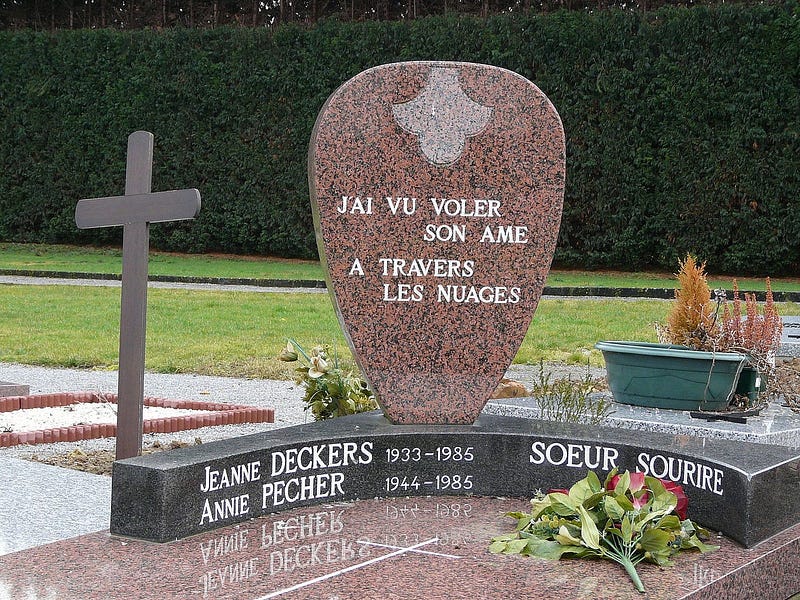
Jeannine and Annie are buried at Cheremont Cemetery in Wavre, Walloon Brabant. Although they died as suicides, the Catholic Church agreed to a church service and burial in consecrated ground.
Their inscription translates as “I saw her soul fly through the clouds,” a phrase from one of Jeannine’s songs. It also says, “Soeur Sourire,” Sister Smile.
Suicide is never the answer. The day after she and Annie died, Jeannine received a royalty check that would have paid the debt.
The more things change, the more they stay the same
Today we have a new “Singing Nun,” — Sister Cristina Scuccia. Her take on “Like a Virgin” went viral on YouTube.
I haven’t heard her sing, but Sister Cristina’s heart is in the right place. She founded a music academy in her home city of Palermo. It offers free music lessons to poor kids.
I hope she studies the lives of Jeannine Deckers and Annie Pécher and learns from their mistakes. Keep the receipts, Sister. Life can get real for a “Singing Nun.”
Sources:
Chadwick, D.A. (2010) The Singing Nun Story: The Life and Death of Soeur Sourire
New film tells tragic story of Belgium’s Singing Nun. The Guardian. April 28, 2009


.JPG)