
What Your Smart Scale Isn’t Telling You
The science behind knowing your body fat percentage

After conducting research in a body composition lab on high-end bio-impedance devices, I realized how household body fat percent scales can be misleading. These “smart scales” can be extremely useful for fitness tracking. However, it’s important to understand the different types of devices to find the one that will work the best for your body type, and also what throws them off so they don’t tell you the wrong fat percent.
Bear with me, as a bit of background information helps to explain this (if you’d rather skip the science, scroll down past the next photo). Most household body fat percent scales use the same technology: bioelectrical impedance, or bio-impedance for short. That technical term means they send a small electrical current through your body to estimate your amount of fat mass and fat-free mass. If your scale has metal contact points and tells you a fat percent–it’s using bio-impedance.
The electrical current in bio-impedance devices can only see this fat-free mass, and are effectively blind to fat mass (fat is an insulator, like rubber, and doesn’t conduct electricity). So how do they tell us our body fat percent if they can’t see it?
The answer is simply by subtraction. If these devices can estimate the amount of fat-free mass, and they know how much you weigh, they can subtract and reasonably guess how much fat is there.
This technology is comparable to reference methods and has low error in most people. However, in a recent study, Long et al. found that as body size increased in subjects, so did the differences in measurements between bio-impedance and the reference. Additionally, there are issues with different types of devices that are important for people relying on them to understand.

There are three main different types of household bio-impedance devices, handheld, step-on scale, and a combination of both. These all measure different parts of your body, so depending on your fitness goals, some of these may be more or less useful to you. We’ll take a look at specific differences between devices, so you can determine which would be best for your needs.
Let’s start with the step-on scale, such as this one. This type of scale reads your weight and body fat percent. This will look similar to a regular bathroom scale, but there will be metal contact points where you place your feet to conduct the electrical current.
The electrical current is like a river, in that it wants to take the shortest path between two points. The current travels from the scale, up one foot and leg, and instead of going up into the torso, it travels right back down the other leg to get back to the other contact point. So you can see, these step-on scales will only tell you the fat percent of your legs, and ignore your upper body. They take into account gender and may make some other adjustments to the reading, but all of these calculations will be hidden.
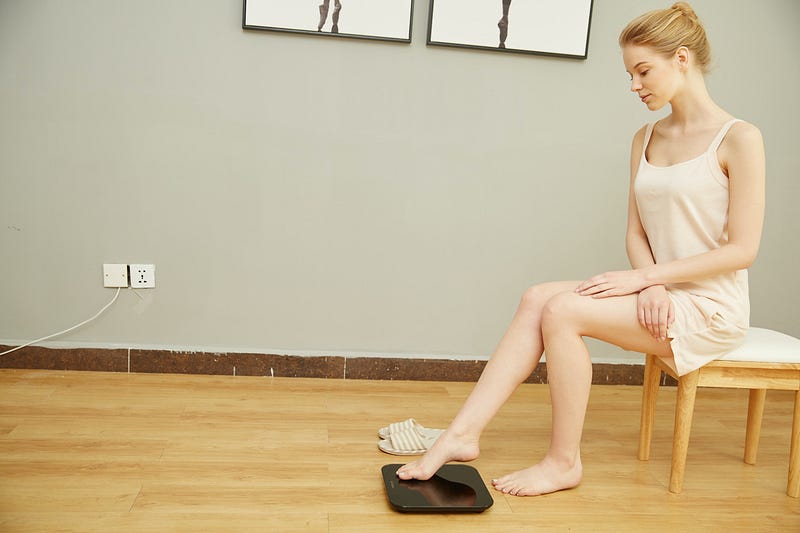
Perhaps if you care about just your lower body, this may be a way to track fitness goals, but keep in mind this isn’t the complete picture of your body fat percent. Conversely, if your body type has naturally low leg fat, tracking overall fitness progress with one of these scales will look more gradual than it actually is.
Let’s move on to the handheld bio-impedance devices, like this. These look like a steering wheel with two hand-holds. The electrical current travels between your hands and through your torso, so handheld body fat device only tells you the fat percent of your upper body, and completely ignores your legs. Additionally, these require that you manually enter your weight, so you’ll also need a regular scale to accompany these.
Similarly to the previous scale, if you only care about your upper body composition, this may be enough for you to track your fitness goals, but it’s not showing you a complete picture.
Finally, we have devices that have a step-on conductive surface in addition to a hand-held conductive surface. These bio-impedance devices with both will send a current through your entire body to give you a complete picture of your body fat percent, as well as giving you a current weight reading.
These scales will give you the best reading of your body fat percent and body weight. However, it’s important to remember that this is just an estimation, and still subject to error. I’ve compiled some tips below for reducing this error that I’ve picked up from doing research with bio-impedance devices. These try to control variables that will affect the scan to give you the best reading of your fat percent.
- Pick a consistent time of the day to take your reading and stick to it. This might be right when you wake up, right before bed, etc. Try to make this before a meal and not immediately after bathing. If you like to pair it with your workout, take the reading beforehand.
- Use the bathroom prior to taking a reading. Your bladder and stomach act like insulating balloons, so the current travels around them, and anything inside of them will be invisible to the current and counted as fat.
- Make sure your skin is clean and dry when taking a reading. When doing research, we use alcohol swabs and wait for the skin to completely dry. This is probably overkill for personal use, but it may help to wash your hands and/or feet and let them dry completely prior to measuring. Additionally, if your skin is waterlogged or sweaty such as after bathing or a workout, it will affect the conductivity and alter the reading.
- Separate all your limbs when measuring. In particular, be careful about the skin between your legs touching, and your arms being too close to your torso. The current can jump between bare skin if it’s touching and mess up the reading. A little trick: use a rolled-up towel in between skin that’s touching.
I hope this information helps you choose the best device for your fitness plan. You may see high-end versions of these scales at your gym, but these principles apply to all bio-impedance devices. Keep in mind: regardless of the bio-impedance device, it can only see what’s between the contact points.


