What You Should Know About Effective Leadership Behaviours
What your leadership behaviours say about you
Major research and theories have developed ways to identify and organise behaviours that are synonymous with effective leadership.
So what are they?
This article will discuss broad behavioural traits that an effective leader brings to the table to influence followers to induce organisational performance.
Ohio State Studies
The first major studies carried out by Ohio State University identified two broadly defined categories of leadership behaviour:
- Consideration and
- Initiating
1. Consideration
Consideration is defined as the concern for people and interpersonal relations.
2. Initiating
Initiating Structure shows concern for task accomplishment and defines the structure of a task.
Both types of behaviours were independent of each other in the study, and a leader’s use of one behaviour did not preclude his/her use of the other.
Effects on Performance
The relevance of the effects of the two behaviour categories on performance was best illustrated by Fleishmann and Harris (1962). This research noted that high consideration behaviour resulted in low turnover and fewer grievances amongst employees.
Yukl wrote that “strong and consistent findings was a positive relationship between consideration and sub-ordinate satisfaction” (Yukl, 2013).
Fleishmann and Harris’s findings also found that subordinates tend to be more satisfied with a leader who is at least moderately considerate.
Michigan State Studies
Theories were further expanded by Michigan State University studies. The focus of this research was to identify behaviours that effective managers displayed over ineffective managers when performance results were measured against group productivity rates.
This research formulated three types of effective leadership behaviours:
- Task-Oriented Behaviour
- Relations-Oriented Behaviour and
- Participative Leadership.
1. Task-Oriented behaviours
Task-Oriented Behaviour is described as an effective manager who does not do the same work as his/her subordinates, rather concentrates on planning, scheduling and coordination of their work.
A Task-Oriented leader guides subordinates by setting goals and performance targets. Similar to the Initiating Structure from Ohio State Studies.
2. Relations-Oriented behaviours
Relations-Oriented behaviours describe leaders who are friendly and considerate towards subordinates.
This type of manager is more helpful and supportive, demonstrated by keeping subordinates informed and being appreciative of their ideas and efforts. This also ties in with Ohio State’s Consideration category.
3. Participative leadership behaviours
Participative leadership behaviours expanded on previous studies. This leadership behaviour uses group supervision over individual “helicoptering” supervision, thereby engendering trust among subordinates.
Group meetings are a focus of this type of leadership where subordinates’ ideas and concerns are listened to and facilitated by the leader.
Peer Leadership
Bowers and Seashore (1966) refined the theory of leadership behaviours by proposing Peer Leadership.
They proposed that leadership functions can be carried out by someone besides a designated leader. Group effectiveness depends on the quality of leadership rather than those who perform the role.
Their conclusions emphasised the fact that a delegated leader, through delegation of the leadership function, can enhance group effectiveness.
“Both common sense and theoretical reasons for believing that a formally acknowledged leader through his supervisory leadership behaviour sets the pattern of the mutual leadership which sub-ordinates supply each other.” (Bowers and Seashore, 1966)
Blake and Mouton
In 1964, research on leadership behaviours evolved through Blake and Mouton’s model on the “managerial grid” whereby effective leaders possess high concerns for both people and production — the High-High Leader.
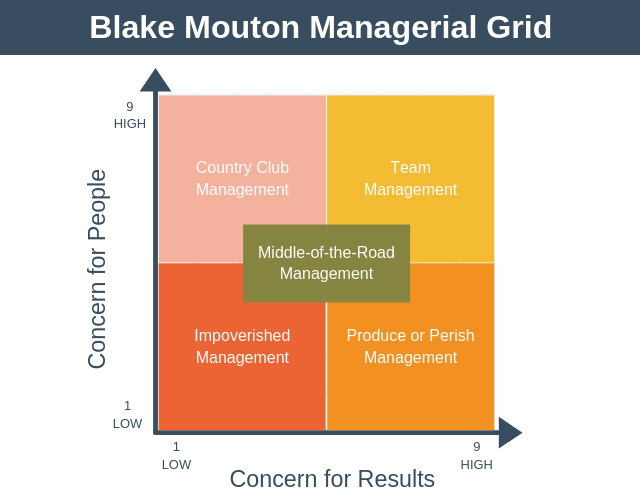
The need for effective leaders to adopt these behaviours has been agreed upon in most research but there is disagreement on how they both affect sub-ordinates.
An “Additive Model” suggests that a leader’s task-oriented and people-oriented behaviours exist independently of each other and that the leader must choose which approach to use in any given situation — one takes precedence over the other.
A competing model, the “Multiplicative”, states that the two behaviours interact and are mutually compounding in their effects on subordinates.
As noted by Fleishmann and Harris (1962), detailed instruction and frequent monitoring can be perceived as helpful behaviour by a leader who is supportive but punitive from one who is not.
Supportive behaviour affects a leader’s potential influence and can increase referent power (Yukl, 1981). Yukl’s evaluation of the High-High model states:
“An effective leader is not someone who merely uses a mix of task and relations behaviours but rather someone who selects specific forms of behaviour that both simultaneously reflect a concern for both people and task” (Yukl, 2013).
This points to the use of the meta-categories of Task-Oriented and Relations-Oriented leadership behavioural traits in defining and cataloguing behaviours that are relevant for influencing an individual or team.
Further research necessitated the inclusion of a third meta-category relating to change-orienting behaviour. This identified and grouped behaviours which help to influence the direction of an organisation.
Eskell and Arvonen
Eskell and Arvonen’s (1991) research identified three meta-categories of leadership behaviour:
- Task-Oriented Behaviours
- Relations Oriented Behaviours
- Change Oriented Behaviours
1. Task-Oriented behaviours
According to the research Task-Oriented behaviours are primarily concerned with accomplishing a task in an efficient and reliable way,
2. Relations-Oriented behaviours
Relations-Oriented behaviours are concerned with increasing mutual trust, co-operation, job satisfaction and identification with the organisation,
3. Change-Oriented behaviours
Change-Oriented behaviours are primarily concerned with understanding the environment, finding innovative ways to adapt to it and implementing major changes to strategies, products and processes.
This Three dimensional model of leadership behaviours refines the Initiating Structure from Ohio State and the Task-Oriented portion of Michigan State studies to reflect the strategic nature of a leader in helping his/her followers and his/her organisation to better adapt to facilitate change.
Relevant behaviours
Behaviours that are relevant for effective leadership with Task and Relations-Oriented approach include (Yukl, 2013):
- Short-term planning
- Clarifying roles and objectives
- Monitoring operations and performance
1. Short-term planning
This is the planning of work activities, deciding what to do, how to do it, who will do it and when it will be done; the day to day functions of operation.
The aim is to ensure efficient organisation of the business unit, coordination of activities and effective utilisation of resources.
The importance of planning was recognised in research by Carroll and Gallen (1987) and the evidence between planning and effective leadership was highlighted by Boyatzis (1987) and Kim and Yukl (1995)
2. Clearly defined roles and objectives
This behaviour relates to the clear expression and communication of what is expected from followers. It involves defining job responsibilities, assigning work and setting performance goals.
This behaviour helps to ensure that work efforts are aligned with strategy to optimise the progress of an organisation in the desired direction.
Research found a positive relationship between clarifying roles, objectives and effective leadership, by Alexander (1985) and Kim et al (1995). Also, the setting of specific and challenging goals has proved to “result in higher performance”, according to Locke and Latham (1990).
3. Monitoring Operations and performance
This involves the gathering of information about the operation of a manager’s unit including work progress, individual performance, output quality and the success of projects or programmes.
Monitoring provides much of the information needed for planning and problem solving which is why it is important for managerial effectiveness, as per Meredith and Mankel (1995).
Research has also shown evidence that appropriate monitoring impacts directly on performance.
Larson and Callahan (1990) found that task performance increases where subjects were monitored closely but decreased when they’re not.
Behaviours that are specific to Relations-Oriented leadership are:
- Supporting
- Developing
- Recognising
1. Supporting
These are behaviours that show consideration, acceptance and concern for the needs and feelings of other people.
Supporting behaviours solidify emotional ties between subordinates and leader, helping to foster a better work environment.
Research has indicated that higher levels of job satisfaction garnered through supportive leadership can result in (Brief et al, 1985):
- Reduced absenteeism and
- Fewer vacancies in an organisation
Also, research in this area of behaviour is strongly linked to the findings in the Consideration category derived from the Ohio State studies.
2. Developing
This includes managerial practices deployed to increase a person’s skills, facilitate job adjustment and career advancement. Behaviours include:
- Coaching
- Mentoring and
- Career counselling
Research in this area examines the correlation between developing behaviour and leadership effectiveness but the results “are not consistent” across samples (Javidson, 1995).
3. Recognising
This involves giving praise and showing appreciation to others, whether sub-ordinates or peers, for effective performance, achievement and contribution to the organisation.
The primary purpose, especially for subordinates, is to strengthen desirable behaviour and task commitment. Three types of recognition are:
- Praise
- Awards and
- Recognition ceremonies
Research shows that effective leaders provide extensive recognition to their sub-ordinates for their achievements and contributions (Kouzer et al, 1987).
A study by Wikoff (1983) found that praise by the superior improved subordinate performance.
Although empirical evidence suggests that results linking these behaviours is inconsistent, but does imply that recognition can be beneficial if used skillfully and under favourable conditions (Wikoff et al, 1983).
Final Thoughts
Much of effective leadership behaviour studies stemmed from Ohio State and Michigan State research.
So to recap, Ohio State identified two categories of leader behaviour:
- Consideration — Consideration is defined as the concern for people and interpersonal relations.
- Initiating — Initiating Structure shows concern for task accomplishment and defines the structure of a task.
Michigan State research focused on behaviours that effective managers displayed over ineffective managers, categorised into three types:
- Task-Oriented Behaviour — an effective manager who is concerned about planning, scheduling and coordination of their work efforts.
- Relations-Oriented Behaviour — leaders who are friendly and considerate towards subordinates. They are helpful and supportive, keeping subordinates informed and being appreciative of their ideas and efforts.
- Participative Leadership — This leader uses group supervision over individual “helicoptering” supervision, to gain trust among subordinates.
So let me ask you this— where do you fit within the leader-behaviour spectrum, and are you an effective leader?
References
- Alexander, L. (1985) Successfully implementing strategic decisions. Long-Range Planning, 18 (91–97).
- Blake, R. and Mouton, J. (1964) The Managerial Grid. Houston: Gulf Publishing.
- Bowers, D. and Seashore, S. (1966) Predicting organizational effectiveness with a four-factor theory of leadership. Administrative Science Quarterly, 11 p.238–263.
- Boyatzis, R. (1982). The competent manager: a model for effective performance. New York, Wiley.
- Brief, A. et al. (1981) Managing Job Stress. Boston: Little Brown.
- Carroll, S. and Gillen, D. (1987) Are the classical management function useful in describing managerial work?. Academy of Management Review, 12 p.38–51.
- Ekvall, G. and Arvonen, J. (1991) Change centred leadership: An extension of the two-dimensional model. Scandinavian Journal of Management, 7 p.17–26.
- Fleishman, E. and Harris, E. (1962) Patterns of leadership related to the employee grievances and turnover. Personnel Psychology, 15 p.43–56.
- Javidan, M. (1992) Managers as Leaders: developing a profile of effective leadership in top management. Impact of Leadership, 1 p.47–58.
- Kim, H. and Yukl, G. (1995) Relationships of self-reported and subordinate-reported leadership behaviours to managerial effectiveness and advancement. Leadership Quarterly, 6 p.361–377.
- Kouzes, J. and Posner, B. (1987) The Leadership Challenge: How to get extraordinary things done in an organization. San Francisco: Jossey-Bass.
- Larson, J. and Callahan, C. (1990) Performance monitoring: how it affects productivity. Journal of Applied Psychology, 75 p.530–538.
- Locke, E. & Latham, G. (1990). A theory of goal setting & task performance. Englewood Cliffs, N.J., Prentice Hall.
- Meredith, J. & Mantel, S. (1995). Project management: a managerial approach. New York, Wiley.
- Wikoff, M. et al. (1983) Behaviour management in a factory setting: increasing work efficiency. Journal of Organisational Behaviour Management, 4 p.97–128.
- Yukl, G. (2013) Leadership in Organizations. 7th ed. New Jersey: Pearson, p.103–131.
- Yukl, G. (1981) Leadership in Organizations. New Jersey: Prentice Hall.