What You Need to Know About Mars
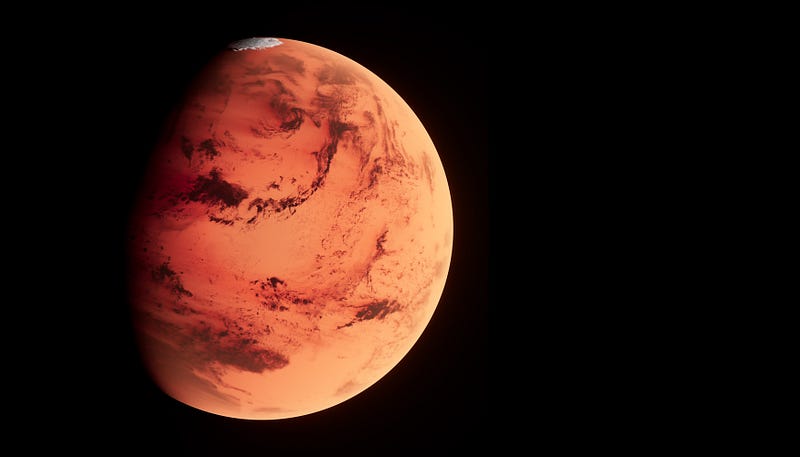
Nowadays, I am a little obsessed with Mars. I read and learn a lot about it. I have allocated time in my classes and taught about Mars.
Why on Earth did I allocate a session on Mars? I teach creativity and it turns out that curiosity is closely and intrinsically linked to creativity.
So, this is my masterclass on Mars. If you want to learn about Mars and learn about our collective future that extends to Mars, read on.
My Pedagogic Formula: Curiosity + Exploration + Wonder + Passion
I have recently made a commitment to myself that I would not teach anything to my students that does not excite me. I would only teach things that fascinate me.
Much of the higher education curriculum is based on tired formulas, memorization of theories and knowledge, pure academic literature, and textbook-style templates and frameworks. I am tired of it all.
If I am not inspired, how will I inspire my class? Change starts within you. So I decided to radically transform myself and my teaching approach.
I am offering two courses at Norwich Business School at the University of East Anglia. I offer an undergraduate module titled “Employability, Creativity, and Personal Development” and a masters module titled “Management Skills and Personal Development”. I wanted to innovate and re-create both of these modules using a new teaching approach.
I feel very lucky because I work at UEA. UEA is a fascinating place to teach because I feel a level of support that is unusual in the higher education sector. I can try out radical and exciting methods in my teaching here. My new teaching approach is based on 4 components:
- Being Curious and Asking Questions (Extreme Curiosity)
- Hunting for Originality and Inspiration Everywhere (Trans-disciplinary Exploration)
- Learning New Things that Amaze Me (Bewilderment and Wonder)
- Sharing my Enthusiasm with my Students (Passion)
According to this teaching approach, I would teach new things that I learned in the last 15 days before my lecture (I would not include anything that I learned before that date). This meant that I would spend a lot of extra time (min. 20–22 hours every week) to learn new things that astonish and amaze me.
It also meant that I threw the traditional curriculum out of the window. I got rid of all textbooks — I find regular textbooks inherently boring and out-of-date. I only shared fresh and exciting things that I learned recently. I allowed my feelings to guide me.
If I feel passionate and excited about a topic, then, I know that my students will also find that topic refreshing and original. Since I am sharing my own enthusiasm, my excitement when I am teaching these things is remarkable. This approach transformed and energized my teaching.
My Interest in Mars
So, how did I become so interested in Mars? When Elon Musk stated that he wanted to send one million people to Mars by 2050, I became intrigued about the red planet.
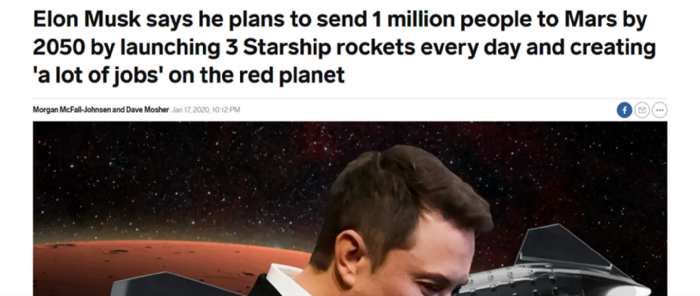
Imagining the possibility of human life on Mars is fascinating — it is one of the most ambitious dreams of humanity up till now.
Curiosity is the engine of all learning, growth, and development.
I will now ask you a series of quiz questions. Before you read the answer, please try to come up with your own guess. Then, it will be more fun to learn the correct answer and see if you have been on the right track.
Question 1: How long do you think it takes from the Earth to go to Mars?
Can you guess?
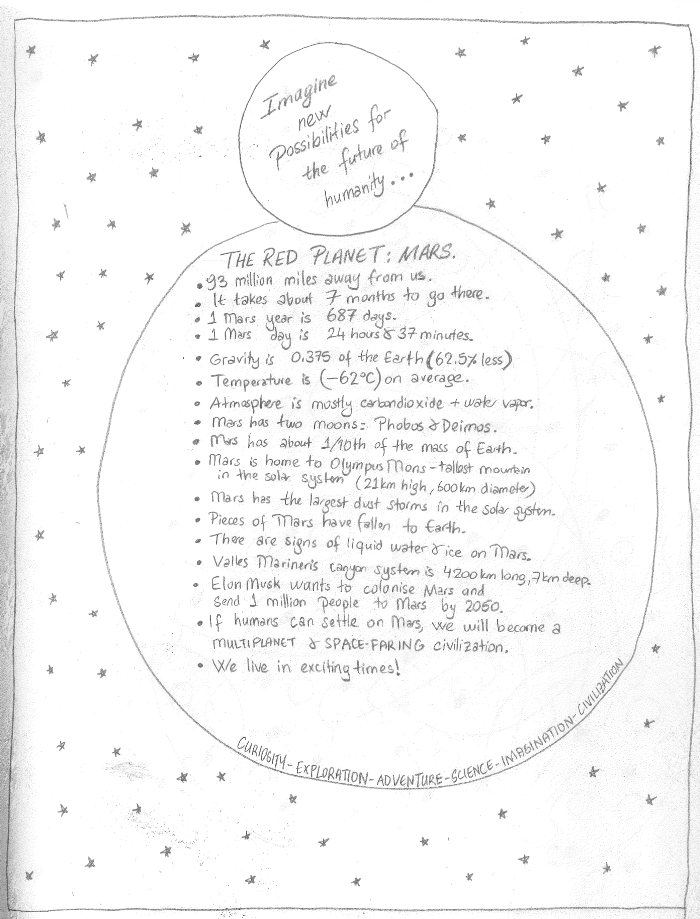
It takes about 7–8 months if everything goes right. The duration of each journey depends on when it is taken, of course. We would need to align the orbits of Earth and Mars. Every two years, Mars and Earth reach their closest point when Mars is as close as 55 million kilometers from Earth.
So, we can only go to Mars once every two years to take advantage of this orbital alignment. Still, the route is not straightforward — both planets are constantly moving around the sun. Thus, Mars is a moving target.
Question 2: How long do you think is one year on Mars?
What is your guess? Please write down your guess before reading the answer.
So, the correct answer is 687 days. The Martian year is almost double of the year on Earth! Of course, it makes sense, as the orbit of Mars is wider than that of Earth.
Question 3: There were 39 Mars missions to date. How many of them were successful?
The correct answer is 16. Mars missions began in 1960, but only 16 of 39 attempts were successful.
Why do we keep so hard to get to Mars?
- One reason is that we search for signs of water (ice) and microbial life on Mars.
- Another reason is to study the surface and terrain of the planet.
- Mars is an extremely rich destination for scientific discovery and exploration. Its formation and evolution are comparable to Earth.
- Mars had conditions suitable for life in the past.
- The landmass of Mars and Earth is very similar. Mars is a lot smaller than Earth, but its landmass is equivalent to that of the Earth since water covers 70% of Earth’s surface.
- So, learning more about Mars means learning more about our own planet’s history and future.
Question 4: Is gravity on Mars higher or lower than Earth? How does the surface gravity of Mars compare to Earth’s?
Please guess the answer before you read further.
The answer is that gravity on Mars is much lower than on Earth. The surface gravity of Mars is about 37% of the gravity found on Earth. This is about a third of Earth’s gravity.
Think about the implications of this mind-blowing fact. Let’s imagine. For example, if you jump on Mars, you could jump 3x higher than you could on Earth. If you threw a ball, it would go three times higher.
Let’s think about the implications of this for sports and games. Think of an imaginary Martian Olympics for a moment. People jumping 3 times higher and throwing balls 3 times farther. Think about how exciting it would be to watch these Olympics on Earth!
So, exploring Mars is all about curiosity, excitement, and imagination. I feel very excited thinking about this new planet and what possibilities it might hold for future human civilization. Of course, there are enormous hurdles we need to overcome to go to Mars and settle there.
Question 5: What is the temperature like on the surface of Mars?
Can you guess?
Of course, you have guessed that it will be colder, much colder than Earth (since it is further away from the Sun). The answer is about -60 degrees (on average).
Now, let us look at some interesting facts and figures about the red planet.
Question 6: By which year does SpaceX aim to send the first astronauts to Mars?
Any guesses?
The answer is 2024. Of course, we do not know if SpaceX will be able to accomplish this goal. However, we know that Elon Musk is ambitious, dedicated, and determined. He is probably the greatest inventor and entrepreneur of our times.
Question 7: Elon Musk and SpaceX have recently invented something revolutionary. Something that will change the history of space exploration forever. What is it?
Your guess?
The answer is…. Reusable rocket systems! Please watch the video below to witness this historical moment.
This is one of the greatest moments we have witnessed in recent times. Witnessing such moments gives me a lot of hope and courage about the future. It makes me believe in the future of our species.
Elon Musk is crazy, yes. He is a superhero. I think we should give him all the credit and trust he needs in order to advance towards his ambitious goals.
He already made a huge positive difference: He made landing on Mars a close and real possibility — not a vague aspiration.
Question 8: America’s 2020 budget included funding for a manned mission to Mars; which will bring back samples from the red planet. For which year is this plan?
Perhaps you guessed that NASA and the US government are also accelerating their Mars plans.
The answer is 2026. So things are going forward with enormous speed. Space is the new frontier ahead of us. Mars is the new frontier ahead of us.
I think we owe this momentum to Elon Musk. Elon Musk is a determined and persistent soul. He wants to go to Mars and form colonies there. And this will change everything if we can ever pull it off.
How will humans live on Mars?
We will form colonies on Mars. However, there are enormous challenges ahead of us:
- First, we will need oxygen (there is not enough oxygen on the surface of Mars, and Mars has a very thin atmosphere).
- Second, we will need water, as water is the basis of all life as we know it.
- Third, we need to consider food, shelter, and clothing challenges.
All of these challenges are huge challenges, but they are ultimately solvable problems. We will need to use cutting-edge science and engineering. Stephen Petranek is very optimistic about how we will address and solve these challenges.
One of the great things I have learned from this TED Talk was how MIT scientist Michael Hecht invented Moxie — a reverse fuel cell that sucks in the Martian atmosphere (which is 96% carbon dioxide) and brings out oxygen. Petranek says colonizing Mars will be the most disruptive event in our lifetimes, and also the most inspiring:
“It will make us a spacefaring species. And that means humans will survive no matter what happens on Earth. We will never be the last of our kind.”
Although Petranek is passionate and optimistic (like Elon Musk), we know that the hurdles of setting on Mars are enormous. Some of these challenges are explained in the video below:
Question 9: What could be some leisure and fun activities to be done on Mars? Any ideas? Use your imagination.
Imagine that TripAdvisor is asking your ideas: Top 3 things to try on Mars. What could be some sample ideas? Before you read on, imagine your own answers. Do your homework and some guesswork.
Based on our popular imagination and knowledge, here is my response to this question. The following are my TripAdvisor Top 3 things to do on Mars:
1. Exploring Valles Marineris canyon system which stretches 4000 km, 200 km wide, and has walls 2–5 km deep.
2. Exploring Olympus Mons — the largest volcano in the solar system (700 km across and 22 km high!)
3. Martian Olympics would be a feast! You can jump 3 times higher, and you can throw things 3 times further (due to 1/3 gravity!)
If you want to discover more, you can look at the top 10 places to visit in our solar system.
Elon Musk’s Most Ambitious Venture Ever: Colonising Mars
Let’s look at Elon Musk’s plans to colonize Mars now. Here is short summary of how Musk plans to send humans to Mars.
Elon Musk wants to build a metropolis on Mars starting in 2024. It is a long process and an ambitious project. SpaceX plans to send its first cargo mission to Mars in 2022, and a human mission will follow in 2024.
Elon Musk first explained his plans to the world during the stage of the 67th International Astronautical Congress in Guadalajara, Mexico on Sep. 27, 2016. You can witness this historical talk here. Elon Musk had shining eyes here — he was getting closer to realizing his childhood dream — going to Mars- every day. In a similar talk, Elon Musk discusses the long-term technical challenges that need to be solved to support the creation of a permanent, self-sustaining human presence on Mars.
As Elon Musk delves on possible potential architectures for sustaining humans on the Red Planet, it becomes clear that this is a transdisciplinary venture that requires the collaboration of the industry, the government, and the scientific community.
Realizing a Childhood Dream: Going to Mars
Elon Musk is a man who never gives up his dreams. His boyhood dream was to go to Mars.
He transformed the world’s commerce and payment systems through Paypal. He transformed energy systems through SolarCity. He transformed cars through Tesla. He is working to transform transportation systems through The Boring Company. All of these initiatives, however, are just vehicles for his most ambitious venture ever: Colonising Mars.
He established all these companies in order to be able to go to Mars one day. This is why Musk’s most ambitious and exciting work is taking place at SpaceX. SpaceX has already disrupted NASA and transformed space travel and rocket systems.
Elon Musk cares about whether the human species will continue. He gets emotional about the future of humanity. He sees the possibility of an alternate civilization on Mars as insurance against the existential risks and vulnerabilities of living on just one planet.
Elon Musk is the most revolutionary entrepreneur of our times. He failed thousands of times, but he never gave up. Like Edison, he is a magician. He pursues the impossible and sometimes even makes it happen.
The Mars Generation
“Ever since we first began exploring space, every generation has had a craft to transport their dreams into space. We have seen the Apollo Era, the Shuttle Era, and now we are ready to see the Orion Era. My generation, the Mars Generation, will make it happen. It’s our time, we are ready.” — Abigail Harrison
Elon Musk has inspired a whole new generation. Now, there are children and youth all across the world who want to go to Mars. One of them is Alyssa Carson. Alyssa spent her life training for the ultimate space odyssey. Even though there is no coming back from Mars, she wants to go there. She has been preparing for that moment all her life.
After the Apollo era and the Shuttle era, we have entered a new era of space — the Orion era. The space economy is the new gold rush. From asteroid mining to Mars colonization, from space travel to the search for life, space will be the most exciting sector in our lifetimes.
Space is where future riches are. The world’s most powerful billionaires (including Elon Musk, Jeff Bezos, and Richard Branson) all seek to dominate the commercial space industry.
In past decades, the space industry was an industry of governments. Now private companies are breaking through. Companies are already planning to mine asteroids, colonize Mars, and develop tools only to be used in space.
Astrophysicist Neil deGrasse Tyson says, “The first trillionaire there will ever be is the person who exploits the natural resources on asteroids. There’s this vast universe of limitless energy and limitless resources. I look at wars fought over access to resources. That could be a thing of the past, once space becomes our backyard.”
The Mars Generation is here
Mars is now in our collective consciousness and it is closer than ever. Today’s youth — Generation Z and the Alpha generation — are passionate about space exploration and the Mars mission. They are curious and enthusiastic about Mars. They can imagine themselves on a Mars mission and living on the red planet. Netflix has made a documentary about this generation, dubbed “The Mars Generation”.
If we are successful, members of this generation will be able to explore Mars — probably in our lifetime. This is the first time humanity will reach out so far into space and become a multi-planetary civilization. These are exciting times indeed.
If you would like to delve more into the topic of making Mars our new planet, “Mars: Making the New Earth is a great documentary from National Geographic. This documentary provides an in-depth visualization of what it would take to turn a cold and dead planet into a living world.
Finally; I will share with you a great series on the Mars mission. It is called “Mars” and it blends feature documentary with scripted drama that is set in the year 2032 and beyond. Mars is created by National Geographic and it narrates the thrilling quest of humanity to colonize Mars. Mars describes how humans settle on Mars, how the search for life continues, how scientific and commercial organizations work together or clash on the red planet, and what the far-reaching implications are. It is quite a masterpiece — I have binge-watched and finished two seasons in just two days. I strongly recommend it — you will learn a lot about our collective future.
Humans can indeed achieve fascinating things when they set their minds to it. Our best minds should not be wasted on how to make people click on ads. We need the smartest people to focus on grand challenges and wicked problems, such as climate emergency, poverty, and inequality.
We need more holistic and long-term entrepreneurs like Elon Musk who are focusing on the big picture:
“I would like to die thinking that humanity has a bright future. If we can solve sustainable energy and be well on our way to becoming a multi-planetary species with a self-sustaining civilization on another planet… I think that would be really good.” — Elon Musk
Elon Musk wants to retire and die on Mars. Making to Mars is his ultimate dream and I believe that Elon Musk and SpaceX will achieve this in our lifetime. I believe this will be the most exciting and adventurous event of our lifetime. This will start a totally new era of space travel and exploration.
Those who say it cannot be done should not interrupt those who are already doing it.
Of course, there will be enormous hardships and challenges. But, we humans are very creative and we can work heroically when it comes to difficult challenges.
Seeing Elon Musk creating such a system of interconnected companies that focus on complex challenges — from sustainable energy to colonizing Mars — is hugely inspiring.
In the words of Elon Musk: “When something is important enough, you do it. Even if the odds aren’t in your favor.”


