
What You Need To Know About Dialectical Theory
A Comparison of Hegel’s Idealism and Marx’s Historical Materialism.
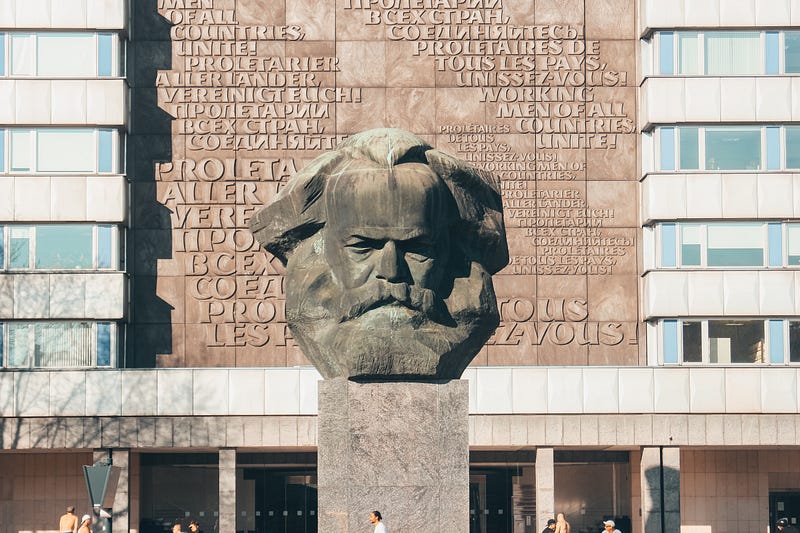
In The German Ideology, Marx and Engels criticize Hegelian idealism—an ideology where human ideas shape society—and instead advocate for historical materialism, in which economic structure defines societal institutions.
Their critique characterizes Hegel’s philosophy as unrealistic, specifically his concept of man’s relationship with geist. Supporting the materialist view, Marx focuses on the socioeconomic lives of “real, active men” and how their modes of production drive historical changes.
Overall, Marx distinguishes the two ideologies by their view on the dialectical process of history and the nature of the societies created.
Distinguishing idealism from materialism
According to Marx, idealists believe that ideas connect humans to their surroundings and define different historical eras. He uses the struggle of the Diadochi and the French Revolution to exemplify this constant cycle inherent to Hegel’s dialectic process.
Hegelians believe that a spiritual force of nature, geist or the “absolute spirit” according to Marx, drives this sequence of ideological destruction and renewal, or antithesis and synthesis, within society. The purpose of geist is to motivate the evolution of simple human consciousness to more complex “Hegelian categories of thought,” which involves the mind becoming self-aware.
This, for idealists, was the utopian, organic state that geist seeks to achieve after successive epochs are constructed, resolving some of the contradictions in previous ones.
Although Marx mentions the distinction between Young Hegelians, who believed a revolutionary change was necessary to overcome man’s divide between reason and desire, and Old Hegelians, who believed Prussia had already achieved utopian status and that change was not necessary, but generally criticizes both in a similar light.
Marx is largely untrusting of idealism because its theories of mind cannot be “verified in a purely empirical way” as they are “supposed to have taken place in the realm of pure thought.” For Marx, because Hegelianism makes claims about historical processes, it should have scientific evidence from history that supports it. Its clear lack of grounding in reality encouraged Marx to denounce idealism as “fantasy” and of “no value.”
In contrast, historical materialism could identify specific, factual moments in history where the economic structures within society changed. These transitions from “tribal ownership” to “ancient communal and State ownership” to “feudal or estate property” represent historical materialism’s factual basis. Marx prefers this to idealism, which cannot point to any eras that satisfy Hegel’s dialectical process, and can only presume a “nonsensical prehistory” that is fabricated by religion. The fact that German ideologists had begun widely adopted Hegel’s principles was, to Marx, a sign of decline in his country’s intellectual capital.
Delving into dialectics
Furthermore, historical materialism and idealism have separate perspectives on the nature of the dialectical process.
Generally, both ideologies view reality as a historical process that obeys the dialectical method. However, Hegelian idealism saw this process as a succession of ideas whereas historical materialism viewed it as a succession of “modes of production,” which refers to how a society organizes its economic production structurally. For Marx, “By producing their means of subsistence men are indirectly producing their actual material life.”
In other words, matter rather than geist drives the dialectical process because all of man’s mind and thought flow from the economic structure. Over time, productive forces become more and more efficient as technology evolves to satisfy human desires. This is a transformation of man’s “means of subsistence,” which defines what “they are” and consequently the nature of society.
As previously discussed, both historical materialism and idealism promote a dialectical process that aims to create a conflict-free society. The difference lies in what the ideologies prioritize as the “conflict”.
In Hegel’s form of idealism, geist seeks to overcome the divide between reason and desire within individuals. For Hegel, the schism between man’s Ego, subconscious needs and desires, and his consciousness barricades him from being fully aware of the mind. Geist controls man, but the dialectical process aims to reverse this.
Marx argues that this struggle, by which the mind is perpetually alienated, is just an “abstraction” because, like most of idealist ideology, it is not based on “real knowledge.” Rather, Marx proposes that a conflict-free society is one devoid of class struggle. According to him, as technologies evolve and become more efficient at resolving basic needs, “new needs” arise to challenge the mode of production. This infers that the means of production, which includes the labor force and machines, must be constantly innovating to reach society’s maximum productive capacity.
However, this evolution creates class struggles between class of individuals such as the owners of means of production and workers, or within social institutions such as the family. To support his argument that socioeconomic structures develop in this linear path, Marx illustrates three forms of ownership: the tribal ownership, the ancient communal and State ownership, and the feudal or estate ownership.
The forms of ownership
Tribal ownership is “the undeveloped stage of production, at which a people lives by hunting and fishing, by the rearing of beasts or, in the highest stage, agriculture.” At this stage, Marx saw a simple form of class struggle “confined to a further extension of the natural division of labor existing in the family.” Here, antagonism grew between patriarchal tribal members and their slaves, demonstrating the inherent conflict within social relations that led to the evolution of class struggle.
The second form of ownership, ancient communal and State ownership, exemplifies the complete development of “class relation” of production. At this stage, Marx expands the antagonism between owners and slaves to any social relation between an entity and its subordinates. Marx argues that communal private property, a form of economic structure, fully defines divisions of labor which leads to an asymmetric power dynamic between “town and country” or “industry and maritime commerce,” as examples. Marx then discusses feudal ownership, which mirrors the “hierarchical structure of landownership” presents in the tribal and ancient communal ownerships, but differs in its “different conditions of production.”
Describing these forms of ownership allow Marx to demonstrate that the development of societies is dictated by the economic structure and the class struggles associated with those modes of production.
In “Private Property and Communism”, Marx continues to apply materialism to the dialectical process by positing that the ideal goal is a state where man has complete control over his society’s economic structure, which laid the foundations for communism and the overthrow of capitalism. This is a drastically different ending to the dialectical process than in idealism, which seeks to achieve a more abstract utopia.
Furthermore, the three forms of ownership allow Marx to develop a linear depiction of history that is supported by facts and logic, as opposed to idealism, which does not contain tangible, historical evidence. For example, Marx is able to explain why ancient communal ownership moves from town to country in the Middle Ages: “This different starting-point was determined by the sparseness of the population at that time, which was scattered over a large area and which received no large increase from the conquerors.
In contrast to Greece and Rome, feudal development at the outset, therefore, extends over a much wider territory, prepared by the Roman conquests and the spread of agriculture at first associated with it.” Here, Marx can boast that historical materialism utilizes knowledge about real civilizations to bolster its form of the dialectical process.
In addition to the nature of states, Marx also distinguishes historical materialism and idealism on their views on religion. In idealism, all reality descends “from heaven to earth” meaning that the divine pervades reality and it is the mind and the ideas it produces that connects man to God. Marx reminds idealists that divinity is a “phantom of their brains” and scorns religion for allowing theological “dogmas” to control people’s lives, rather than men having power over their own ideas. He rejects the idea that a geist is creatively seeking higher levels of organization within society. Rather, Marx believes that increasingly organized and efficient states simply arise from natural selection, perpetuated by man’s endlessly developing needs.
Conclusion
Marx denies idealism its vision of geist and the divine guiding the dialectical process. Instead, he favors historical materialism, which utilizes empirical evidence and maintains a realistic view of the historical development of societies and religion. Here, the real, active man is the central actor whose productivity outweighs the passive, Hegelian man’s vague abstractions. For Marx, these differences completely separate these ideologies and foreshadow their drastically unique impacts on the evolution of future societies.


