
What You Must Know Before Investing in Hyped-Up Stocks
Looking at you, Tesla

The Wall Street Journal recently quoted data showing that Robinhood investors had ‘dramatically increased their holdings’ in ‘shares that have risen the most over the past three months’.
I’m worried — not about missing out on these ‘big winners’, but about getting scammed into giving away my money.
Buying whatever has been going up is not investing. It’s pure gambling.
About 9 months ago, I unloaded a good chunk of my savings into some mutual funds. I had a brilliant, cunning plan: choose the ones that have performed really well. Among others, I picked a REIT fund that paid a fat dividend and an Asian bond fund that hadn’t stopped going up for the last 3 years. Less risky assets, internationally diversified, and pays like stocks? Sign me up.
Fast forward 3 months — every stock market on earth was plummeting, the world was going up in flames, and I made a sweet pile of nothing at all. I lost 10% of my original capital.
I’m not predicting another pandemic. I’m just here to remind you of one of the most foundational yet forgotten lessons of investing, that is also in those disclaimers no one reads:
Past performance is not indicative of future results.
As of September 2020, the stock market has had a stellar run that no one thought was possible. I still remember every TV economist, every online pundit declaring an ‘L-shaped recovery’ and prophesying doom on the markets back in March.
But stocks came right back with a vengeance, and many of us missed the ride. I’ve felt the FOMO — I had dumped out most of my investments in the crash and sat on my hands as everything turned around.
It’s heartbreaking to look at a chart and think if only I had bought this.
It’s near impossible to watch a stock climb day after day, deaf to its naysayers, and yet still defy the urge to hop on the bandwagon.
But before you cave and lap up shares of Tesla or Netflix or even that high-flying ETF, you need to know it’s a bad call, especially if you’re a new investor. Your first investments shouldn’t be single-name stocks at all — more on that here.
Regardless of our skill level and involvement in investing, we all love the idea of making truckloads of money passively, and the fact that you’re reading this means that you’re serious about your finances. So don’t give it all away.
Why the hype will probably let you down
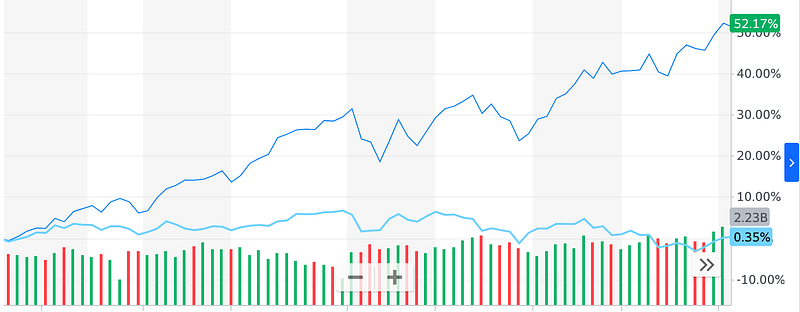
Here’s a really good-looking chart. It shows how a particular stock (dark blue) has performed compared to the S&P500 (light blue) over just 5 months. What if I also told you that this isn’t just some scammy penny stock, but a reputable stock with a mega-market cap?
If you see this chart and decide to hop on the hype train, what implicit assumptions are you making?
- There has to be a good reason this stock has continued to go up so much for so long. So, it should keep growing at this rate.
- It made this much money in just 5 months. So, I should be able to profit just as quickly.
- It’s a big stock, so what are the odds of a major crash? This is almost a sure thing.
The reason why you’ll likely be disappointed is that all of these assumptions are rookie investing mistakes.
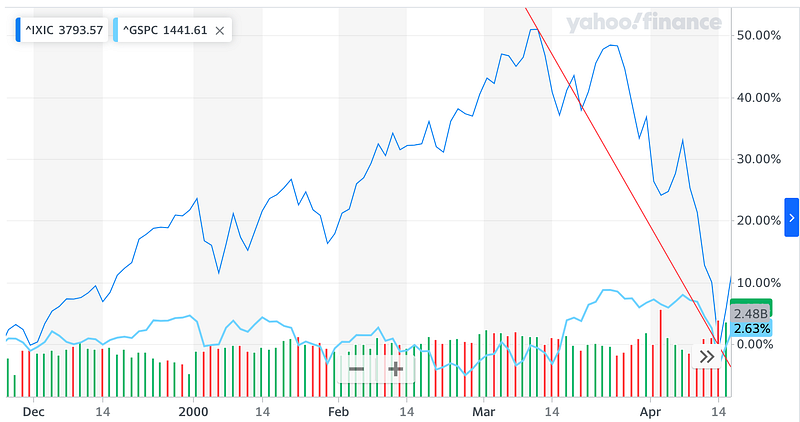
If you caved and bought — you’ve just flown headfirst into the dot-com crash of 2000 on the back of the Nasdaq index, and lost up to a third of your money.
Basic mistake 1: “It’ll keep going up”
I think we all know better than to make this assumption, but when the FOMO is strong enough, we are all susceptible.
This mistake caused every ‘bubble’ in history: the dot-com bubble in 2000, the housing bubble in 2008, the Dutch tulip bubble in the 1600s, etc.
Remember that any market is a culmination of demand and supply forces. A price is made when a balance is struck between those who have something and those who want something.
Prices rise when the demand for the good grows, or the supply drops. In the stock market, assuming stocks stay very liquid, demand is what mainly drives the price. When that demand rides on nothing but greed and FOMO, there will come the point where every Tom, Dick and Harry gets a stock, and the demand for it completely dries up. Then, pop.
Demand is never infinite. A healthy market is one where there’s a constant push-and-pull between sellers and buyers; it’s one of the only places on earth where being united makes everyone worse off.
You could go as far as to say that the longer a stock’s ‘unstoppable’ run, the more likely it’ll come crashing down — unless there are very valid reasons for it to keep going, like real earnings growth.
“It’s been going up” is not a valid reason.
From a different perspective, buying a stock just because it has gone up is like playing a slot machine because it just gave someone else a jackpot.
To make things worse, we suffer from the availability heuristic, in which we tend to rely too much on the most recent or most accessible information to make decisions. Recent profits make us more likely to believe in future profits.
You might’ve heard the saying that retail investors are always late to the party, so much so that retail hype on a stock may be used as a signal to sell. We’re the worst FOMO-ers and tend to buy in right at the top.
Instead of caving to the hype, ask yourself, is there a good reason to buy this? Do I genuinely believe that Tesla or Netflix or Kodak is worth more than this price because of its strengths as a business?
Basic mistake 2: “I’ll get in and out quickly”
When we hop onto hype trains, we don’t expect to stay on forever. We instinctively understand that they don’t last, but are convinced that we can make a quick buck and get off before the ride ends.
We forget that real investing is the exact opposite — a game of patience.
Real investing is predicated on an informed opinion that an asset is worth more than its current price. The investor then buys the asset and holds it until its price reaches fair value, or until something drastic forces the investor to rethink its value.
For the index investors who are less interested in stock picking, and prefer buying and holding a diversified portfolio, follow the old but gold adage: time in the market beats timing the market. No one can call the tops and bottoms of the market, and statistically speaking, the wisest approach is to remain invested for as long as possible. This ensures we capture every drop of profit and let compounding work in our favor.
Making investment decisions based on mere hype not only throws this all-important patience to the wind but also leads us into the delusion that we can magically predict when the big rally will end and cash our profits in time.
Of course, there’s a chance that the stock continues on its blistering run, or it might slow down a little, but not crash. After all, not everything’s a bubble.
If the stock keeps going, you’ve gotten lucky on the gamble. However, as our FOMO fades, greed rushes to take its place.
At the first sign of profit, most of us will get antsy — negativity bias makes us fear losing it, so we cash out. If it still keeps going up, we’ll get greedy, invest again, cash out again, and the cycle continues until one day everything comes crashing down. As for the risk-loving few who didn’t cash out, even another 30% won’t be enough for them, and they’ll hold on until the bubble pops. Greed reinforces our impatience, taking us further from smart investing and deeper into gambling.
If the stock slows down and consolidates instead of launching into a full-blown bubble, we’ll be disappointed because we were implicitly expecting the same fast and furious profits. We’ll get tired of waiting, cash out, and before we know it, the stock rallies without us again. Time in the market is the best approach, but few have the patience.
There are no winners in this hype game. If you can’t commit to it, don’t invest in it.
Basic mistake 3: “It’s a sure thing because it’s big”
This point probably requires little elaboration; you’ve seen my example of the Nasdaq bubble in 2000, and probably vividly recall the COVID crash.
Single-name stock hype trains are much more common, but big funds, ETFs, indices and entire markets are not immune to runaway speculation or ‘black swan’ (highly unlikely but very disastrous) events.
Every mega-cap stock provides a false sense of security because we succumb to herd mentality, i.e., making decisions based on others’ actions. “If so many people have bought this stock, it should be safe.” Ironically, the more people think this way, the more ‘unsafe’ the asset becomes because so much of its price gets influenced by emotional rather than rational investing.
This isn’t to say you should stay away from mega-caps. Quite the contrary, they enjoy lower volatility and better liquidity than smaller caps, both of which are beneficial to the long-term investor.
However, stay wary, especially the single-name stocks that attained massive market caps but don’t have the profits to show for it. Their prices are backed mainly by speculation, and thus prone to changing course without warning.
In the end, the same rule of thumb applies to mega-caps — if you don’t have a good reason to buy it, don’t.
When it might actually make sense to buy
It might make sense to go ahead and buy a hyped-up stock in one of two circumstances:
- You believe in a thesis AND are prepared for the long haul.
- You’re a trader, not an investor.
Like we’ve been tirelessly repeating, you need a real reason to invest in a stock. That reason could be so good that it’s worth sitting through the hype-train volatility, but be prepared to wait for your payoff.
For example, sensible arguments could be made about Tesla’s future profit potential, Nikola’s ability to take over the trucking industry, or even Aurora Cannabis’ viability as a business in a world where weed is legal.
If you truly believe in your investment thesis and are willing to wait years for it to come to fruition (i.e., not just buying for the hype), feel free. After all, Amazon investors in the early 2000s would’ve needed more than a stretch of the imagination… and 20 years.
Otherwise, if you’re a momentum or volatility trader looking to play these hyped stocks, the power to you. But if you’re reading this, then chances are that you intend to be a long-term investor. In that case, don’t trade; investing and trading are different skills, and mixing the two usually results in being bad at both.
If you’re not clear about investing vs. trading, you can read more in this guide I’ve written on the topic.
Hype is great when you’re on the right side of it, but if that’s all you’re relying on, you’re gambling. Be a smart, sustainable investor — don’t buy hype, buy value.
All information presented is for educational purposes only and not to be construed as legal, tax, investment or financial advice.
The Mini Post-Grad Survival Guide
A 5-day email course with tips on budgeting, investing, and productivity for 20-somethings. Sign up for free.