
The Significance of Serving Deep-Fried Tarantulas
The Explorers’ Club Annual Dinner Has Evolved to Reflect Global Concerns
A Tradition of Exotic Fare
In 1904, The Explorers’ Club was founded by Henry Collins Walsh to “unite explorers in the bonds of good fellowship and to promote the work of exploration by every means in its power.”
The club now boasts over 3500 members, and honorary members have included such prestigious individuals as Theodore Roosevelt, Prince Philip and Walter Cronkite.
The club headquarters is in New York City, and their annual dinner (referred to as ECAD) is a grand event, traditionally held at the Waldorf Astoria.
The ECAD is famous for featuring exotic menu items… which often seemed to have been chosen primarily for their shock value.
In 1951, club member Wendell Phillips Dodge organized the event and provided what he claimed to be frozen woolly mammoth meat to serve to his fellow adventurers, boasting that he’d brought the meat back from the Aleutian Islands.
The story became famous, and people began linking the tale to the tusk displayed at club headquarters.
“See that tusk? That was from the woolly mammoth served in 1951.”
Only in recent years was the story debunked by grad students from Yale University. Upon testing the fortuitously preserved bit of historic fare, they found the meat in question to be sea turtle. Turtle Soup was an item on the menu that night.
Oddly, the specimen was twice labeled incorrectly: a notation on the shelf indicating Explorers’ Club “woolly mammoth”, and the jar itself labeled “extinct giant sloth”. (Giant sloth was also rumored to have been served at the 1951 dinner).
Still, the tradition of serving the exotic, even sometimes bordering on the endangered, continued.
Served at ECAD Through the Years
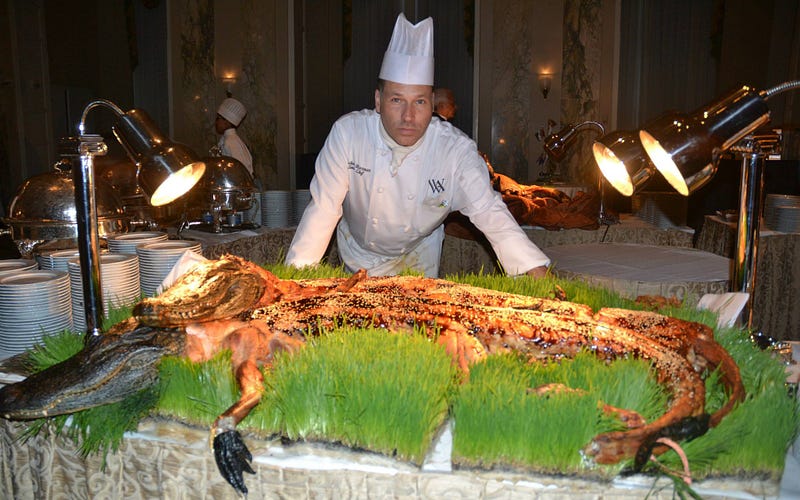
- 1966 — polar bear and baby seal
- 1977 — armadillo and opossum, goat testicles
- 2013 — Kangaroo, muskrat and beaver, unmentionable goat’s anatomy as drink garnishes
- 2014 — ostrich and alligator, olive-stuffed bovine eyeballs used as cocktail onions
A Long-Overdue Change
The tone changed in 2015 with the 111th annual dinner, held for the first time at the American Museum of Natural History in New York City. Although the menu items were still shocking, not for the faint of heart nor weak of stomach, there was a noticeable difference.
There were no mammals or birds being served. Instead, the focus was on insects.
Will Roseman, club president at the time, explained the shift.
“If we fully intend to feed the world as we go forward, we’re going to have to think of a better protein source. We all know bugs are high in protein, and we know they’re good for you, but what most people don’t know is how delicious they can be.” - Will Roseman, Explorers’ Club

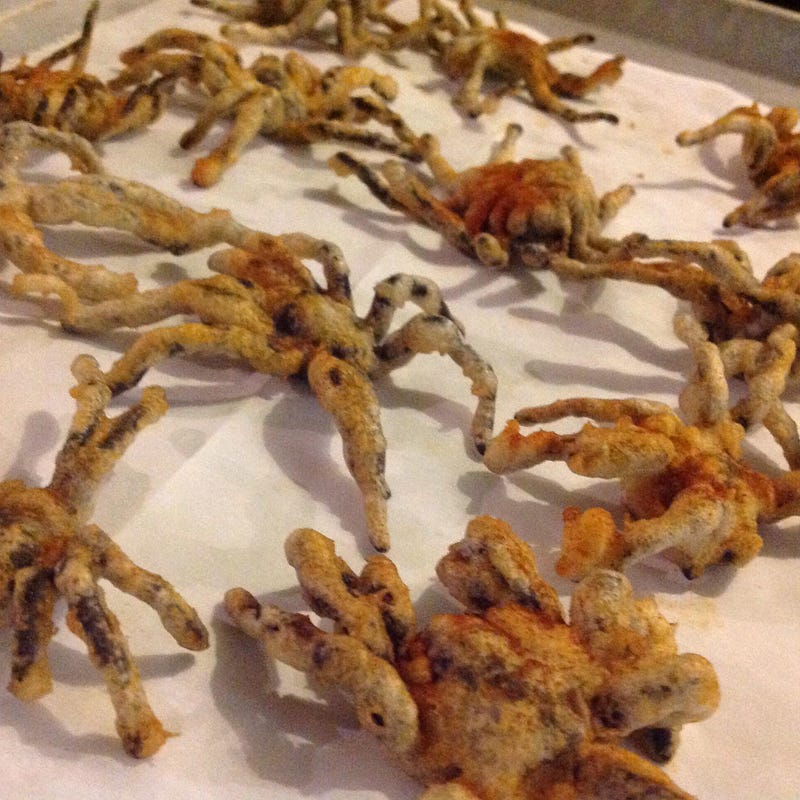
The menu for that auspicious occasion included deep-fried tarantulas, cricket nymph orzo, larvae-dipped chocolate strawberries and waxworm quesadillas.
David Gregory Gordon, author of Eat-a-Bug cookbook, was hired to do the cooking.
Upon mingling with the guests, Mr. Gordon said he noticed a divide between the generations of club members - which could account for, in part, the sudden leaning toward conservation in lieu of all-out shock value.
“From my own observation, there’s new blood and there’s old blood. As far as the old school, they’re the Kon-Tiki raft guys. They’re older, and they’re more conservative. The newer people want something that’s respectful of cultural diversity and sustainable. I think they were ready for a change.” - David Gregory Gordon, author Eat-a-Bug Cookbook
Explorers’ Club archivist, Lacey Flint, had her own opinion of the menu change, chalking it up to the new venue.
“Last year (at the Waldorf Astoria) there was an ostrich bar and an alligator raw bar. At the Museum of Natural History, they said, ‘We don’t want that kind of stuff here because we are conservation based.’” - Lacey Flint, Explorers’ Club archivist
Regardless of the reasons behind it, it would appear that a more earth-friendly, sustainable - though still shocking - menu is here to stay.
Prince Philip, well known for his lifelong conservation activism, would likely approve the direction his erstwhile club has taken… in theory, if not in practice!
Revenge Eating - Invasive Species
Besides bugs becoming the new trademark appetizer for the ECAD, invasive species have also moved to front and center.
In 2016, the dinner theme was “Oceans” in an effort to spread awareness of the danger to our seas from climate change and over-exploitation.
The menu focused on invasive species that have ravaged aquatic and coastal ecosystems throughout the United States.
Ted Janulis, club president that year, made this comment:
“We have this theme of exotics over the years, but it has really morphed into something special because now, we’re talking about invasive species; how you can consume invasive species as a way to stabilize and make the planet more sustainable.” — Ted Janulis, Explorers’ Club
Some appetizers of the 2016 dinner included:
Lionfish fillets — This iconic, striped, spiny fish has taken over the Eastern seaboard. Originally from the Indian and Pacific Oceans, these voracious predators consume huge amounts of fish and crustaceans each day, upending coastal ecosystems.
Asian Carp sashimi — The Asian Carp has inundated the Mississippi River and its tributaries. They eat up to 20 percent of their body weight a day in plankton, can reach 100 pounds in size, and are having a devastating effect on freshwater ecosystems in the Midwestern United States.
Iguana Meatballs — Green iguanas, native to Central and South America, are now considered to be an invasive species in Florida, Texas, Hawaii and Puerto Rico. They are wreaking havoc on local agriculture and are threatening the food supply of several endangered species.
Recent Years
In 2017 there was a return to eating some mammals, as the theme of “Cold Places” featured foods sourced from the Earth’s least hospitable locations.
Bug appetizers preceded arctic fare:
- yak meatballs
- pemmican
- arctic kelp
- caribou sausage
- freshwater fish
- hare confit.
(Baby seals and polar bears breathed a sigh of relief).
2018 and 2019 returned to an invasive species theme, with green iguana and lionfish returning, paired in 2019 with dishes made from invasive plant species.
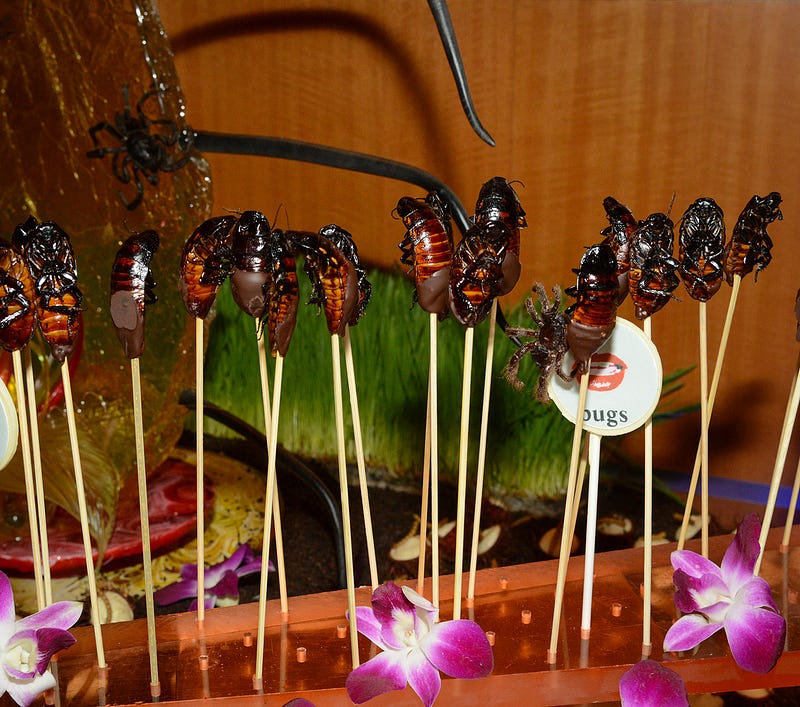
Both years saw a return of the ever-popular deep-fried tarantulas and hissing cockroaches on a stick.
The Explorers’ Club Annual Dinner for both 2020 and 2021 were canceled due to Covid-19, but a source on the dinner planning committee tells me the theme will likely stay with invasive plants and invasive aquatic species for the next dinner, with plenty of bug appetizers, of course!
References:
https://en.wikipedia.org/wiki/The_Explorers_Club https://www.explorers.org/