
What Went Wrong With LinkedIn AI Collaborative Articles
When AI goes wrong…

It sounded like a brilliant idea
Last month, I received my first invitation to contribute to a LinkedIn collaborative article.
I was over the moon: I was one of the “few selected experts,” and participation increased the chances of getting a coveted Top Voice Badge, an exclusive and recognized award dedicated to the top creators.
It sounded like a fantastic idea, right?
I dropped everything I was doing and started to add my input on a topic related to leadership and building effective teams. All hands on deck.
Expectations were high:
- Innovation: a smart and insightful article powered by AI.
- Exclusivity: only a few pre-selected creators are invited to contribute with their comments and perspectives.
- High quality: top talent married with utmost expertise.
- Results: a best-in-class synergy between human intelligence and artificial intelligence.
- Reward: an exclusive digital badge that strengthens authority and endorses expertise.
What could go wrong?
A lot of things…
Things got ugly…
After contributing to a few AI articles and observing the outcome, I saw a huge gap between expectations and reality.
What they are really like:
- Limited innovation: the AI-generated articles have no thought-provoking content. The topics are mainstream, and the substance is generic and superficial. The style is robotic and soulless. It’s like calling a bank.
- Lack of relevance: every creator gets weekly invites, often irrelevant to their field. In the space of 8 weeks, I have received 9 invites, and 50% had nothing to do with my expertise or interest.
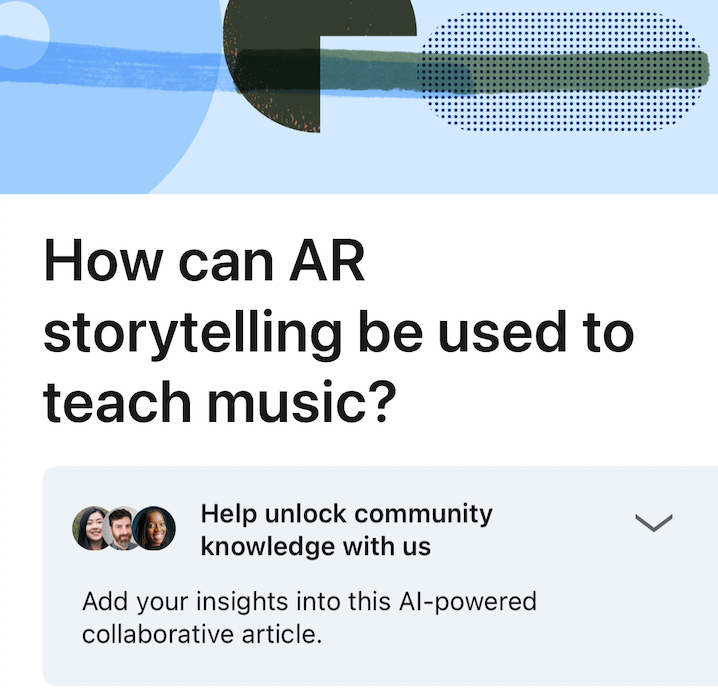
The most shocking one was an invitation to collaborate on an article related to AR and music. Fortunately for the readers, I declined it.
- Mixed quality: the expertise is inconsistent because the process has no filter. Dozens of creators jump at the opportunity to win a badge, and they are not always subject matter experts, but hey, everybody likes to play!
- Mediocre Results: it’s not a collaborative article. It’s a common knowledge piece written by AI with disparate comments from experts and non-experts whose primary motivation is… the Badge.
It’s still a great idea, but the execution is terrible.
LinkedIn profiles are now a sea of Top Voice Badges. One creator in particular proudly announced she earned 32 different badges. 32.
That’s that for the execution.
To be fair and inclusive, I wrote a post on LinkedIn asking the community. My article is a compliment compared to the general feedback, and some of the comments are gold:
The silver lining
If I ended my article here, it would be a negative piece bashing on a platform I love and adding little to the conversation. So, I won’t.
I thought about how LinkedIn could elevate this initiative and turn it into something meaningful that people actually want to read and use.
1. Sparkle a debate
Pick controversial topics that lead to a healthy and informed debate rather than telling us ‘the 5 pillars of leadership.’
Ask thought-provoking questions, and trigger a meaningful discussion where experts share different viewpoints rather than regurgitate their CVs in disguise.
2. Use AI to predict trends
Leverage the power of AI to predict the future rather than to paraphrase what we already know.
I would love to read about what the workplace will look like in 5 years or how solopreneurship is expected to grow 10X in the next decade.
Humans can tell us about the past. AI can tell us about the future.
3. Select *actual* top experts.
I’m not an expert in AR to teach music, but I have lived in 9 countries and speak 6 languages. Maybe AI can find the music expert somewhere and give me a topic related to cultural agility where I can chip in with something interesting to say.
It’s ironic that humans can’t use AI to put together a panel of human experts.
Make the process more exclusive and rigid to increase the quality. High-quality input leads to high-quality output.
4. Remove the Badge as the main incentive.
I confess I started collaborating on these articles for the wrong reasons: I wanted the badge. I have no issue admitting it, but most people do.
The result is that LinkedIn is turning into a treasure hunt where creators are running around like headless chickens to get 1 badge — or 32.
The irony
Who doesn’t love a bit of irony…
Half of the human contributions are generated by AI.


