
What We Found Out at Columbia University
This past weekend—as we previously mentioned—verification experts and investigative reporters joined up with budding journalists for an all-day workshop at Columbia University.
The aim: to dig in to data from the Ghost Boat investigation.
The bad news: we didn’t crack the case wide open. The good news: we made some important, useful progress.
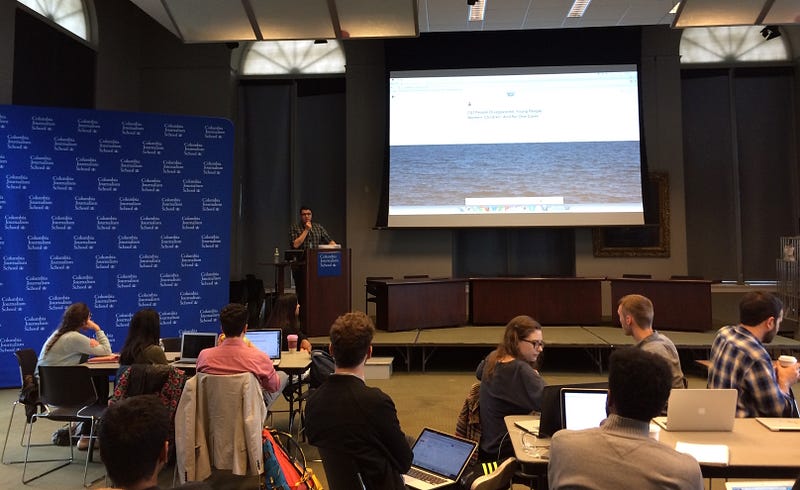
Ghost Boat editor Bobbie Johnson led the event, which was attended by around 35 people, including graduate students from Columbia University’s Graduate School of Journalism and the CUNY Graduate School of Journalism.
We had three main lines of investigation for the day—first, profiling the people of Ghost Boat; second, looking at geo-tagged data; third, examining shipping information for clues.
The last two were based on information that was already public—the shipping data secured by Kirk Pettinga, and social data from networks like Twitter and Instagram. But the profiling effort was largely based on a source we haven’t made public for security reasons—the list of names of people believed to be on the boat.
But each of these avenues got their own brief workshop, and then we dug in to see what we could find.
Profiling
Storyful’s Eliza Mackintosh kicked things off by explaining the steps she took to identify Alan Kurdi, the Syrian toddler photographed after he died on a Turkish beach. Attendees were given access to the Ghost Boat manifest, and after we divided up the list, participants searched for social media profiles of Ghost Boat passengers and the smugglers, identifying them and their last known activity.
During this search, Columbia student Chi An Wang developed a script to compare friend lists to the Ghost Boat manifest, while others made progress identifying Facebook and Youtube profiles. We’re hoping this will assist us as we move into the next phase of investigation.
Geodata
Eyewitness Media Hub’s Claire Wardle and Pete Brown spoke about using geolocated social posts on Twitter, Facebook, YouTube, and Instagram to find leads. Wardle also showed participants how to find locations using LatLong.net and how to use Advanced Google Search to search within social sites.
Students found coordinates in Libya and used them to search for information from the places where the Ghost Boat may have departed. Several students found a few leads and forwarded them to reporter Eric Reidy to follow up on, including potential witnesses.
We were also fortunate to have an Eritrean Tigrinya speaker attend, and she helped us translate the keyword search list and several Facebook postings found across several Ghost Boat family profiles.
Shipping Data
Columbia visiting professor Giannina Segnini, an expert on shipping investigations, shared part of a fascinating and lengthy presentation about tracking ships. Using our existing AIS data, Segnini determined there were around 40 ships in the Tripoli and Zuwarah areas on June 28 and 29, 2014. She also pointed out several social media sites specifically for seafarers that could be potential sources for witnesses. Students began work on parsing the data to identify potential crews to contact who may have come in contact with the Ghost Boat.
Some students also researched the weather data, since earlier in the investigation dangersquirrel discovered that there had been tsunami-like waves prior to the Ghost Boat’s scheduled departure. Segnini pointed out that this means there were likely crews in the area on the 27 due to the bad weather.
Hopefully as we continue to examine and sift through the information we found, there will be more leads to follow and more to share.
Onward.
Sent to our 1,427 followers.